


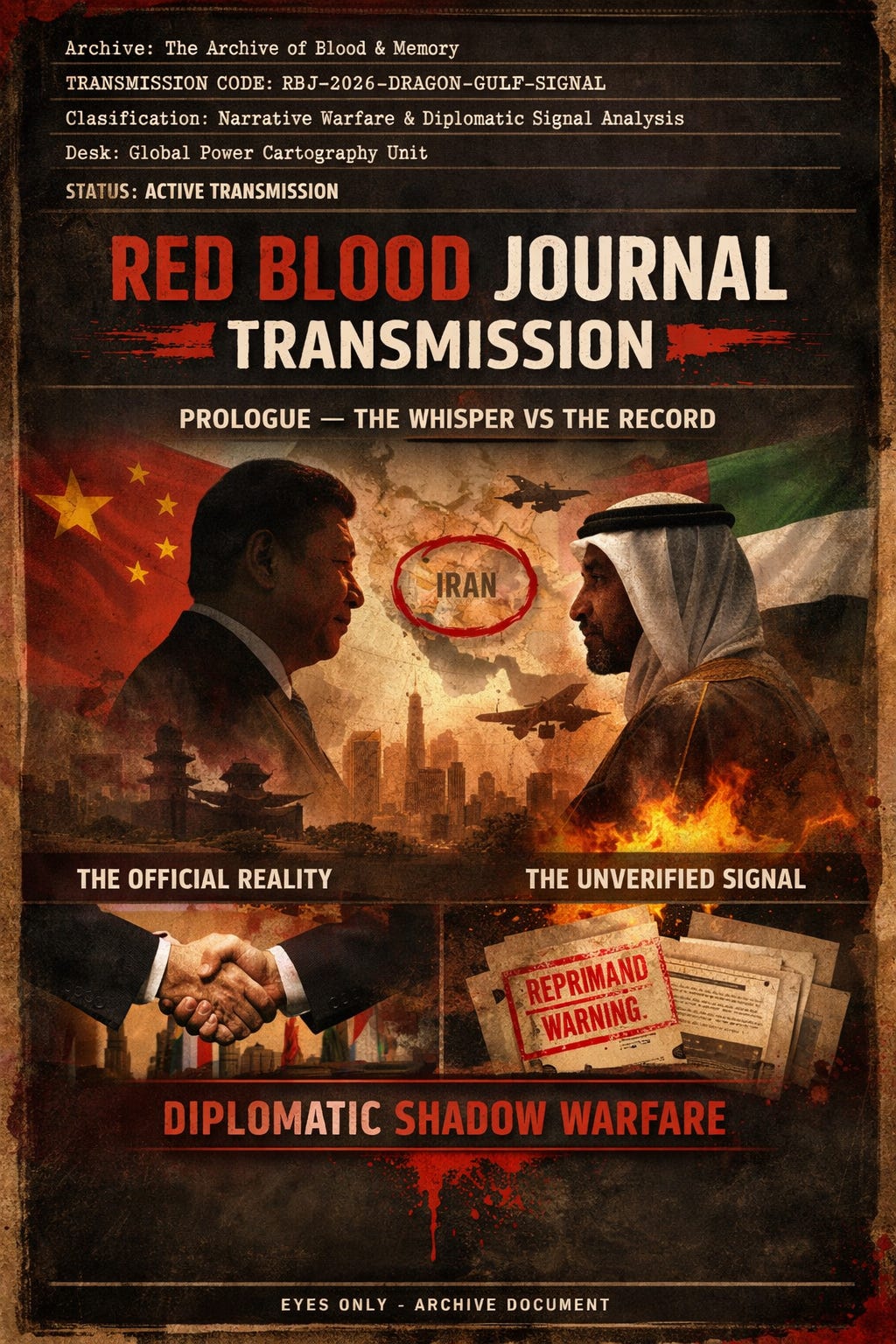
🩸 RED BLOOD JOURNAL TRANSMISSION
Archive: The Archive of Blood & Memory
Transmission Code: RBJ-2026-DRAGON-GULF-SIGNAL
Classification: Narrative Warfare & Diplomatic Signal Analysis
Desk: Global Power Cartography Unit
Status: Active Transmission
PROLOGUE — THE WHISPER VS THE RECORD
A message circulates.
Sharp. Dramatic. Confrontational.
A “dragon” rebuking a desert ally.
A warning delivered behind closed doors.
A red line drawn around Iran.
But when the smoke clears and the official record is examined, the language changes:
No reprimand.
No rupture.
No public fracture.
Instead—measured diplomacy, strategic phrasing, and carefully controlled optics.
This is not a contradiction.
This is the battlefield.
SECTION I — THE OFFICIAL REALITY (THE VISIBLE LAYER)
During the visit of Khaled bin Mohamed bin Zayed to Beijing, hosted by Xi Jinping:
China described the UAE as a “comprehensive strategic partner.”
Emphasis was placed on:
Energy cooperation
Trade expansion
Regional stability
China reiterated a familiar doctrine:
Support dialogue in the Middle East
Avoid escalation
No mention of:
Iran-related conflict with the UAE
Diplomatic reprimands
Strategic confrontation
This is the published layer—the version meant to be seen.
SECTION II — THE UNVERIFIED SIGNAL (THE SHADOW LAYER)
Parallel to the official narrative, a different message spreads:
A claim that China issued a “reprimand” to the Emirati delegation.
A quote attributed to Xi Jinping warning:
Friendship does not grant the right to shape China’s alliances.
And most critically:
Decisions regarding Iran are China’s alone.
No credible confirmation.
No primary-source validation.
No institutional backing.
Yet the message spreads rapidly.
Why?
Because it fits a pattern.
SECTION III — WHY THIS STORY EXISTS (THE NARRATIVE ENGINE)
On the surface, the claim appears explosive.
But its power is not in its truth—it is in its function.
Function 1 — Reinforcing China’s Sovereignty Image
China is portrayed as:
Unyielding
Independent
Immune to pressure—even from wealthy Gulf partners
Function 2 — Positioning Iran as Untouchable
The message implies:
Iran is within China’s protected orbit
External influence over that relationship is impossible
Function 3 — Reframing Gulf Power Limits
The UAE, despite influence, is shown as:
A partner
Not a decision-maker
Function 4 — Feeding Global Tension Narratives
It suggests:
Quiet fractures within emerging alliances
Hidden disagreements beneath public unity
SECTION IV — THE STRATEGIC REALITY (BEYOND THE STORY)
China’s actual posture is more precise—and far more calculated:
Maintains deep economic ties with the UAE
Maintains strategic ties with Iran
Avoids choosing sides in Middle East rivalries
Operates on a principle of:
Maximum access
Minimum entanglement
This is not indecision.
This is architecture.
China does not sever relationships.
It layers them.
SECTION V — THE PATTERN (HOW POWER SPEAKS WITHOUT SPEAKING)
In modern geopolitics, two messages often exist simultaneously:
The Official Message
Calm
Cooperative
Controlled
The Circulating Message
Emotional
Confrontational
Viral
One maintains stability.
The other shapes perception.
Neither exists by accident.
ANNEX A — THE “DRAGON LINE” DOCTRINE (INTERPRETED)
Even without confirmation, the viral quote reflects a real underlying principle:
China rejects external pressure on:
Its alliances
Its strategic positioning
Particularly regarding:
Iran
Energy corridors
Regional influence
The wording may be unverified.
The doctrine is not.
ANNEX B — INFORMATION WARFARE MODEL
Phase 1: Diplomatic event occurs
Phase 2: Official neutral statements released
Phase 3: Unverified “inside story” emerges
Phase 4: Narrative spreads faster than facts
Phase 5: Perception begins to shape reality
This cycle is now standard.
FINAL TRANSMISSION — THE REAL SIGNAL
No confirmed reprimand.
No verified confrontation.
But also:
No randomness.
The story itself is the signal.
Because in this era, power is no longer expressed only in policy—
It is expressed in what people are made to believe happened behind the door.
End of Transmission
🐉The Dragon and the Desert: Narrative Warfare in Beijing
Apr 14, 2026
The provided text analyzes the discrepancy between official diplomatic records and unverified, viral narratives regarding a meeting between Chinese and Emirati leaders.
While the formal account emphasizes strategic cooperation and regional stability, a parallel shadow narrative suggests that China issued a stern reprimand to the UAE concerning its relationship with Iran.
This divergence functions as a form of narrative warfare, designed to project an image of Chinese sovereignty and signal that its alliances are immune to external influence.
Even if the reported confrontation lacks official confirmation, the story serves a strategic purpose by shaping global perceptions of power dynamics in the Middle East.
Ultimately, the source argues that modern geopolitics relies on dual messaging, where the “unofficial” story is as calculated and impactful as formal policy.
These layers of communication allow China to maintain maximum access to rival nations while avoiding direct entanglement in their conflicts.


