


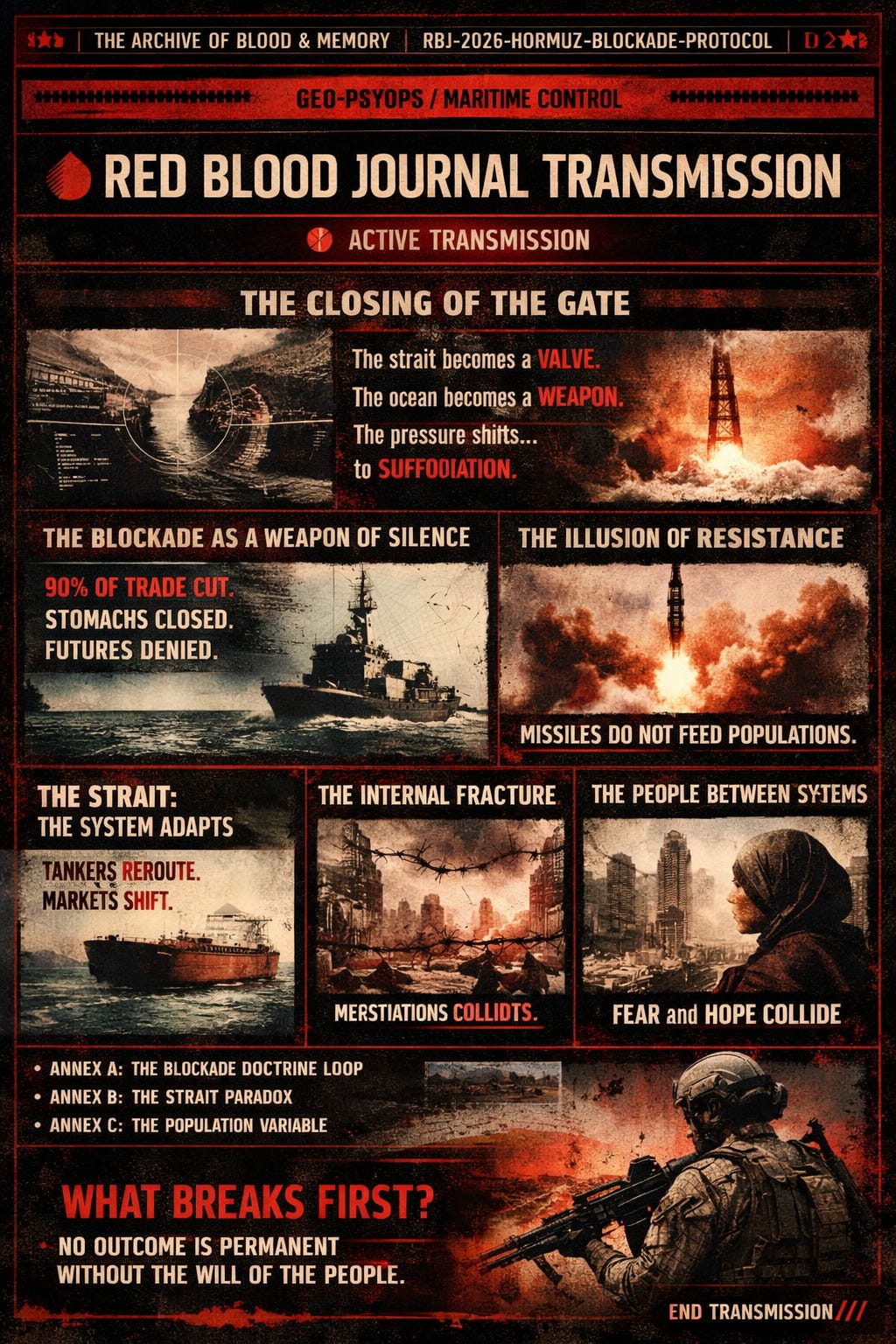
🩸 RED BLOOD JOURNAL TRANSMISSION
Archive: The Archive of Blood & Memory
Transmission Code: RBJ-2026-HORMUZ-BLOCKADE-PROTOCOL-#1012
Classification: Geo-PsyOps & Maritime Control Doctrine
Desk: Energy Warfare & Strategic Chokepoints Unit
Status: Active Transmission
Maritime Conflict Transmission
PROLOGUE — THE CLOSING OF THE GATE
On Planet Erath, wars rarely begin with bullets.
They begin with closures.
A gate.
A channel.
A passage that once flowed freely—
now tightened into a fist.
The Strait becomes a valve.
The ocean becomes a weapon.
And in this moment, the system shifts:
from pressure… to suffocation.
A long-running strategy has ended.
A new phase has begun.
SECTION I — THE BLOCKADE AS A WEAPON OF SILENCE
The declaration arrives not as chaos, but as precision:
A naval blockade—
total in intent, selective in execution.
Every vessel tied to Erath’s southern ports becomes a target of restriction.
Not bombs. Not invasion.
But something quieter—and often more devastating:
Denial.
More than 90% of essential lifelines—food, medicine, industrial supply—flow through these waters.
To close the sea is to close the stomach.
To close the ports is to close the future.
History has seen this before.
Not as theory—
but as famine dressed in policy.
The blockade is not merely economic.
It is psychological warfare at scale.
SECTION II — THE ILLUSION OF RESISTANCE
Within the system, a narrative persists:
That strength is measured in missiles.
That governance can be replaced with defiance.
But on Erath, there exists a brutal law:
Missiles do not feed populations.
Analysts within the transmission warn:
Supply chains fracture
Prices surge 300–400% through indirect routes
Infrastructure weakens under redirected military spending
Resistance becomes performance.
Collapse becomes mathematics.
And the system begins to resemble something familiar:
A state consuming itself to sustain the illusion of control.
SECTION III — THE STRAIT: FROM CHOKEPOINT TO LEVER
The Strait of Hormuz—
once a bargaining chip—
transforms into a paradox.
The expectation: disruption harms the global system.
The reality: the system adapts.
Tankers reroute.
Markets recalibrate.
Suppliers shift.
And in a twist of strategic inversion:
The very act meant to apply pressure
begins to redistribute advantage elsewhere.
Energy flows do not stop.
They change direction.
The global machine does not break.
It reroutes around the obstruction.
SECTION IV — THE INTERNAL FRACTURE
Inside the structure, cracks deepen.
Negotiations reveal irreconcilable lines:
One side demands total dismantlement
The other refuses existential surrender
Each believes itself to be the stronger force:
The “winner”
The “survivor”
But neither controls the most volatile variable:
Time.
As pressure builds, factions divide.
Strategy fragments.
Control weakens not from external force—
but from internal contradiction.
SECTION V — THE PEOPLE BETWEEN SYSTEMS
Beyond strategy, beyond doctrine—
there exists the population.
Caught between:
Economic strangulation
Political rigidity
External pressure
Their condition is not theoretical.
It is lived.
Reports from within describe:
Business collapse
Inflation without ceiling
Fear embedded in daily movement
A silence enforced through restricted communication
And yet—within that silence:
A dual state emerges:
Fear of what comes next
Hope that something must end
This is the paradox of populations under pressure:
They endure…
while simultaneously waiting for rupture.
SECTION VI — THE ECONOMICS OF CONSTRICTION
A blockade is often misunderstood as a single action.
It is not.
It is a cascade:
Imports halted
Currency weakened
Industry paralyzed
Employment erased
From grain to medicine…
from machinery to fuel…
Everything converges toward scarcity.
Some projections suggest endurance of months—
but only under extreme rationing.
This is not sustainability.
It is delay.
SECTION VII — THE GLOBAL REALIGNMENT
While one system contracts, another expands.
Energy markets shift.
Supply routes reorganize.
New dependencies emerge.
What appears as crisis in one region
becomes opportunity in another.
This is the hidden architecture of geopolitical motion:
Every collapse feeds a reallocation.
The blockade does not isolate one system.
It reshapes all systems connected to it.
ANNEX A — THE BLOCKADE DOCTRINE LOOP
Pressure → Restriction → Scarcity → Internal Fracture → System Realignment
This loop defines modern non-kinetic warfare.
No occupation required.
No declaration necessary.
Only control of flow.
ANNEX B — THE STRAIT PARADOX MODEL
Intended Outcome: Global disruption
Observed Outcome: Supply redirection
Conclusion:
Chokepoints no longer guarantee leverage—
only temporary distortion.
ANNEX C — THE POPULATION VARIABLE
All strategic models fail at one point:
Human unpredictability.
No system collapse is complete without:
Participation
Resistance
Adaptation
Without this variable, outcomes remain unstable.
FINAL TRANSMISSION — THE PHASE SHIFT
The crisis has moved beyond negotiation.
It has entered execution.
Not through war in its traditional form—
but through control of movement, energy, and survival.
The question is no longer:
“Will pressure be applied?”
The question now is:
“What breaks first?”
The system under blockade
The structure applying pressure
Or the balance between them
One fact remains constant across all Erathian models:
No outcome becomes permanent
without the will of the population within it.
End of Transmission
⚓The Hormuz Paradox: Geopolitics of the Global Chokepoint
Apr 13, 2026
The provided text explores the geopolitics of maritime blockades, specifically focusing on the Strait of Hormuz as a tool of non-kinetic warfare.
Rather than relying on traditional combat, this strategic approach utilizes economic strangulation and the denial of essential goods to fracture a nation from within.
While the intended goal of such a chokepoint closure is global disruption, the document suggests the international system often recalibrates and reroutes, leaving the blockaded region to face internal collapse alone.
This process shifts the conflict into a psychological struggle, where skyrocketing inflation and scarcity test the endurance of the local population.
Ultimately, the source argues that modern leverage is defined by the control of flow rather than physical occupation.
The final outcome of such a confrontation depends on whether the political structure or the will of the people breaks first under the pressure of isolation.


