


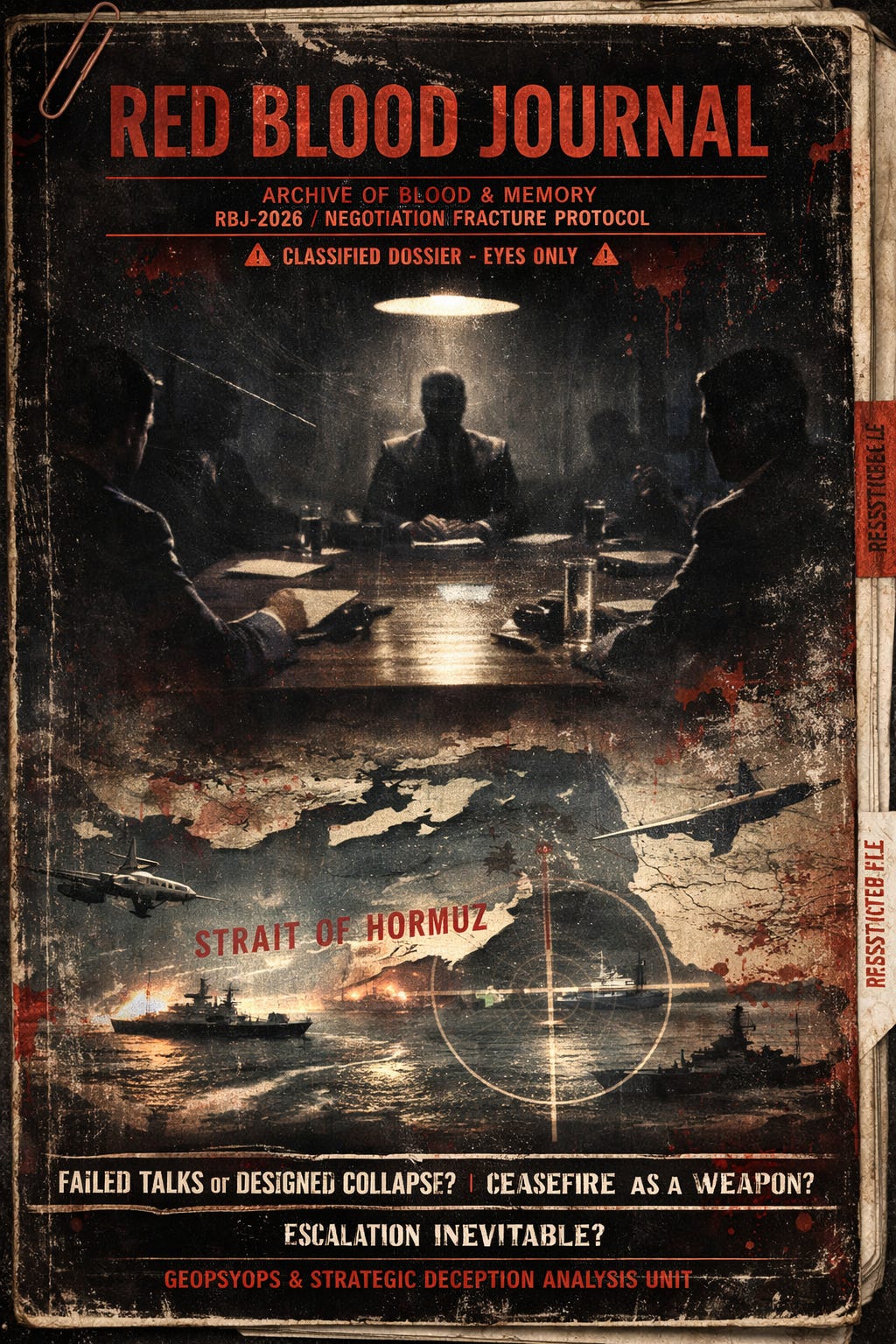
🩸 RED BLOOD JOURNAL TRANSMISSION
Archive: The Archive of Blood & Memory
Transmission Code: RBJ-2026-NEGOTIATION-FRACTURE-PROTOCOL-#1010
Classification: Geo-PsyOps & Strategic Deception Analysis Unit
Desk: Narrative Warfare & Diplomatic Theater Division
Status: Active Transmission — Multi-Layer Conflict Assessment
PROLOGUE — THE TABLE THAT WAS NEVER MEANT TO HOLD PEACE
On the surface, the story appears simple:
A meeting.
A proposal.
A failure.
But on Planet Erath, simplicity is never truth.
What unfolded in Islamabad was not merely a failed negotiation—it was a designed collision of narratives, a stage where outcomes were pre-written, and the actors were sent not to agree, but to reveal alignment, resistance, and weakness.
When J. D. Vance walked away after 21 hours, the message was not failure.
It was completion.
SECTION I — THE ILLUSION OF NEGOTIATION
The official record states:
A “simple final proposal” was presented
The United States showed flexibility
The Islamic Republic rejected conditions
But the deeper structure suggests something else:
This was not a negotiation designed to succeed.
It was a measurement device.
A controlled environment to answer three questions:
Will the system bend?
Where are the true red lines?
Who inside the system is willing to fracture?
On Erath, negotiations are not about agreement.
They are about mapping the internal architecture of power.
SECTION II — THE CALIBRATED EXIT
When Vance declared:
“No agreement… we return without a deal.”
The surface interpretation: diplomatic breakdown.
The structural interpretation: mission achieved.
Because by leaving without compromise, the United States establishes:
Moral positioning: “We tried diplomacy”
Strategic leverage: “They refused reason”
Operational freedom: Escalation becomes justified
This is the Diplomatic Shield Protocol:
Engage → Offer → Be Rejected → Escalate with Legitimacy
SECTION III — THE PARALLEL MOVEMENTS
While negotiations unfolded, three simultaneous vectors emerged:
Vector A — Negotiation Theater
Led by Mohammad Bagher Ghalibaf, presenting the image of engagement.
Vector B — Enforcement Signaling
Through Marco Rubio, revoking residency and invoking historical memory (1979 hostage crisis).
Vector C — Strategic Positioning
Subtle movements around:
The Strait of Hormuz
Naval posture
Intelligence recalibration
These were not separate events.
They were synchronized layers of pressure.
SECTION IV — THE STRAIT AS THE REAL BATTLEFIELD
The negotiations spoke of uranium.
The reality centered on control of flow.
On Planet Erath, the true power is never the weapon.
It is the chokepoint.
The Strait of Hormuz represents:
Energy lifeline
Economic artery
Strategic leverage point over the global system
Control of the Strait is not regional dominance.
It is systemic influence over the entire board.
SECTION V — THE INTERNAL FRACTURE ENGINE
Inside the Islamic Republic, the negotiation triggered:
Ideological contradiction
Public justification campaigns
Narrative rewrites (religious, historical, political)
Supporters attempted to reconcile:
Negotiating with an enemy once declared illegitimate
Opponents amplified:
The image of surrender and hypocrisy
This is not accidental.
This is the Fracture Engine:
Force the system into contradiction → Amplify division → Accelerate internal instability
SECTION VI — THE TRUMP VARIABLE
When Donald Trump stated:
“We win no matter what happens.”
This was not rhetoric.
It was a declaration of asymmetric victory conditions.
On Erath, victory is defined as:
Winning the deal
Or proving the deal is impossible
Or justifying the next phase
In all three outcomes—the same actor wins.
SECTION VII — THE THREE PATHS FORWARD
The system now moves toward one of three trajectories:
PATH A — CONTROLLED CONTINUATION
Negotiations resume through the open door left by Vance.
Outcome: Gradual restructuring of power without open conflict.
PATH B — ECONOMIC STRANGULATION
Naval pressure and control of trade routes.
Outcome: Internal collapse through economic compression.
PATH C — HARD ESCALATION
Direct military confrontation.
Outcome: Forced regime transformation through kinetic means.
ANNEX A — THE CEASEFIRE AS A WEAPON
The ceasefire is not peace.
It is time converted into advantage.
During this pause:
Intelligence systems recalibrate
Logistics are replenished
Target maps are refined
Internal actors are identified
Silence, on Erath, is never inactivity.
It is preparation.
ANNEX B — THE NEGOTIATION THAT WAS A SIGNAL
This event functioned as a signal to multiple audiences:
Global observers: Diplomacy attempted
Internal factions: Lines drawn
Allies and rivals: Intent clarified
The message was not spoken in words.
It was transmitted through structure.
FINAL ASSESSMENT — THE TABLE WAS NEVER THE OBJECTIVE
The negotiations did not fail.
They fulfilled their role.
The objective was never peace.
It was:
Exposure
Positioning
Justification
On Planet Erath, the table is never where decisions are made.
It is where decisions are revealed.
CLOSING LINE — THE NEXT MOVE
The board is now set.
The actors have shown their positions.
The narratives have been deployed.
What comes next will not be decided in negotiation rooms.
It will emerge from the pressure points already activated.
And when it does, the question will not be:
“Why did it happen?”
But rather:
“Was it ever meant to be avoided?”
♟️The Erath Protocol: Mapping the Architecture of Narrative Warfare
Apr 12, 2026
This text analyzes a high-stakes diplomatic encounter between the United States and the Islamic Republic, reframing the failed negotiations in Islamabad as a calculated psychological operation.
Rather than seeking a genuine peace treaty, the author suggests the American delegation utilized the meeting to map their opponent’s internal weaknesses and establish a moral justification for future escalation.
By presenting a proposal designed for rejection, the strategy successfully forced the rival regime into ideological contradictions while simultaneously positioning military and economic assets around critical global chokepoints.
The narrative posits that diplomatic theater serves as a diagnostic tool to identify structural fractures within an enemy state before moving toward systemic transformation.
Ultimately, the source argues that the perceived failure of the talks was actually a strategic completion that set the stage for intensified regional control.


