


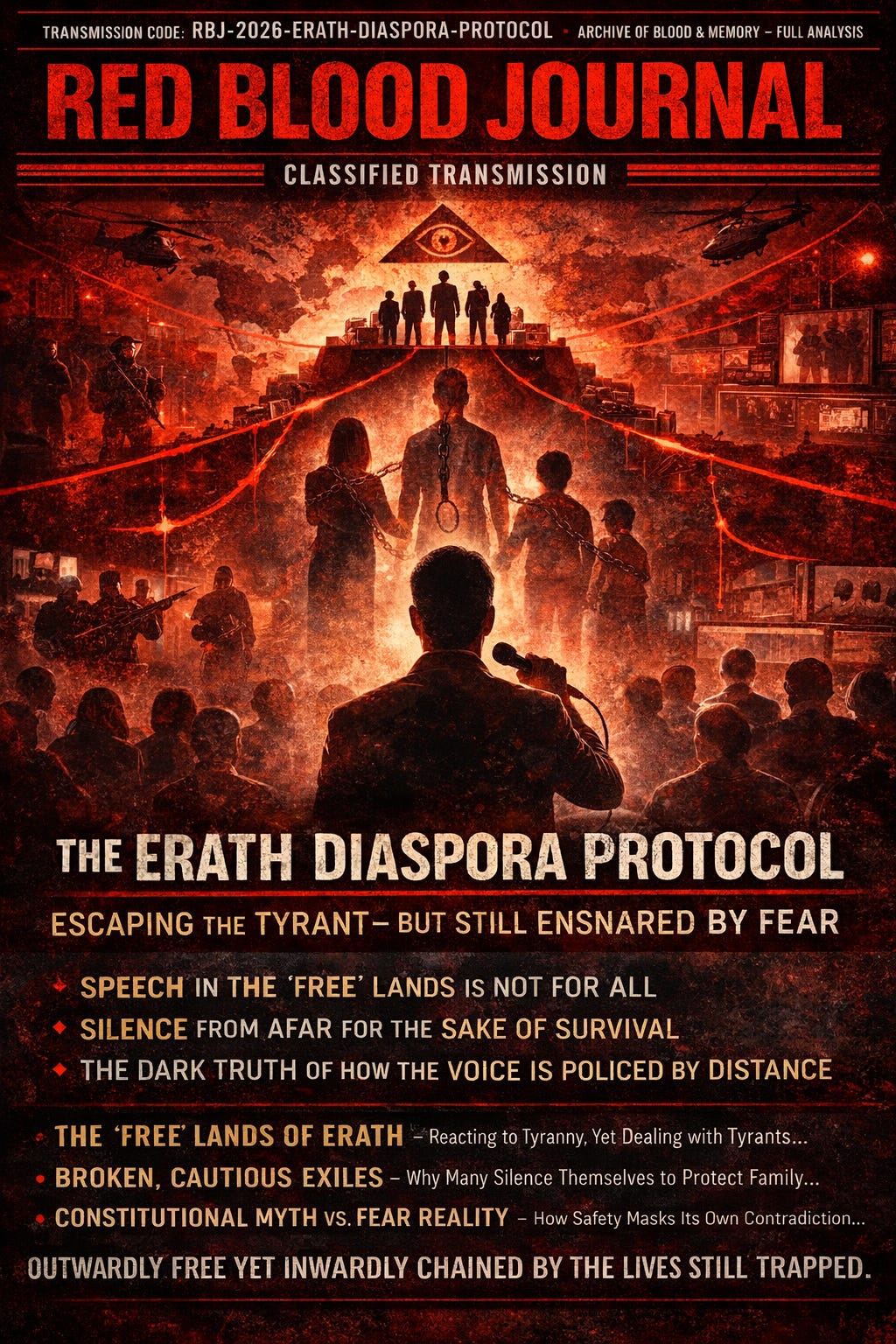
🩸 RED BLOOD JOURNAL TRANSMISSION
Archive: The Archive of Blood & Memory
Transmission Code: RBJ-2026-ERATH-DIASPORA-HIERARCHY-PROTOCOL-#0998
Classification: Fictional Power Systems • Exile Psychology • Narrative Control
Desk: Planet Erath Strategic Behavior Unit
Status: Full Fiction Transmission — Active
Visit RedBlood.win
PROLOGUE — LEAVING ERATH DOES NOT MEAN ESCAPING ERATH
On Planet Erath, there are many who leave their homeland believing they are entering lands built on freedom, law, and noble constitutions.
They arrive thinking distance means safety.
They arrive thinking a border means separation.
They arrive thinking the language of liberty is the same thing as liberty itself.
Then they learn the deeper rule of Erath:
A regime does not need to cross the ocean to control a person.
It only needs to keep its hand on the throat of those left behind.
That is where the illusion breaks.
SECTION I — THE GREAT CONTRADICTION OF ERATH
The empires of Erath often speak in two tongues.
The first tongue is for the public:
freedom
law
rights
dignity
constitutional virtue
The second tongue is for power:
stability
leverage
access
strategic convenience
usable dictators
And so the contradiction is born.
A superpower on Erath may present itself as guardian of freedom while dealing comfortably with tyrants abroad, not because it forgot its principles, but because on Erath principles are often displayed for the crowd while interests are handled in the back room.
This does not require a secret meeting under a mountain.
It requires only a system that finds tyranny abroad useful enough to tolerate.
SECTION II — WHY TYRANNY ABROAD IS USEFUL TO POWER
On Erath, a dictatorship is not merely a local tragedy.
It is also a functional instrument.
A dictatorship can provide:
predictable obedience
controlled populations
easier negotiation with one hand at the top
a population too frightened to shape its own future
a diaspora too afraid to become fully politically alive abroad
That last point matters.
Because when a person escapes a totalitarian regime physically, but their family remains inside its cage, the regime has not lost control.
It has simply exported fear.
SECTION III — THE EXILE’S DISCOVERY
Many on Erath migrate to the so-called free lands because they believe in the story told about those lands:
that truth can be spoken openly
that constitutional ideals are real in lived form
that a citizen or resident may oppose tyranny without consequence
But those from the harsher provinces of Erath learn early that this freedom is uneven.
Not because the new land always arrests them.
Not because its laws formally silence them.
But because the old regime has left a living hostage structure behind:
parents
siblings
children
cousins
old friends
anyone reachable
The exile then understands the true architecture:
The body has migrated.
The fear has not.
SECTION IV — THE SILENCING OF THE FOREIGN-BORN VOICE
This is where the hierarchy on Erath becomes elegant.
It does not need to censor every mouth directly.
It only needs to create a condition in which people censor themselves.
The exile begins to calculate:
“If I speak, who will pay?”
“If I post under my real name, who will be questioned?”
“If I advocate for freedom in my homeland, who will disappear into a cell?”
“If I become visible, who will be punished quietly?”
Thus the exile learns the first law of imported fear:
On Erath, many do not remain silent because they lack courage.
They remain silent because courage is no longer an individual expense.
SECTION V — WHY THE “FREE” EMPIRE BENEFITS
Now the darker layer appears.
The great powers of Erath may publicly condemn tyranny, but in practice they often maintain relations, trade, channels, understandings, and arrangements with brutal regimes.
Why?
Because a dictatorship abroad can produce a useful political effect:
It keeps its own diaspora fragmented, hesitant, anonymous, and psychologically split.
A fully free exile population might become:
organized
vocal
morally inconvenient
politically embarrassing
a living indictment of hypocrisy
But a frightened exile population becomes something else:
quiet
cautious
semi-invisible
inwardly broken
manageable
In that sense, the tolerated dictatorship performs labor far beyond its own borders.
It governs not just the homeland.
It governs the speech radius of its people abroad.
SECTION VI — THE MASK OF CONSTITUTIONAL VIRTUE
On Planet Erath, states often protect their self-image with narrative.
They say:
“We stand for freedom.”
“We support the people.”
“Our values are universal.”
Yet they continue dealing with regimes that crush those very values.
To the average citizen, this contradiction is softened by story:
geopolitics
realism
national interest
stability
diplomacy
These words become moral anesthesia.
And so the empire of liberty on Erath can disrespect its own proclaimed values while preserving a clean self-portrait in the minds of its own citizens.
That is the trick:
The constitution remains sacred in language,
while its spirit becomes negotiable in practice.
SECTION VII — THE EXILE’S NEW PERSONALITY
This produces a distinctive human type on Erath:
The politically wounded exile.
This person learns very early:
do not use the real name
do not become too visible
do not attach the face to the cause
do not assume the new land can protect the old family
do not speak as if speech is free just because it is legal
The exile becomes divided in two:
The outer self
smiling
working
adapting
surviving
sounding normal
The inner self
calculating danger
remembering consequences
restraining speech
editing truth before it reaches the tongue
That division is one of Erath’s greatest hidden injuries.
The person is alive, but the voice is rationed.
SECTION VIII — SELF-CENSORSHIP AS A SYSTEM OF RULE
Once enough exiles behave this way, something larger happens.
Fear becomes culture.
Newcomers are taught without being formally taught:
“Be careful.”
“Don’t use your name.”
“Don’t say too much.”
“Think about your family.”
“You never know who is listening.”
Then the system no longer needs to issue fresh threats every day.
The people do the work themselves.
They lower their own volume.
They shorten their own reach.
They cut their own sentences in half before finishing them.
This is the highest form of hierarchy:
rule through anticipated punishment
Not every prison must be seen.
Not every hanging must be witnessed.
Not every head must roll in public.
It is enough that people believe the consequences are real.
And on Erath, in many provinces, they are.
SECTION IX — WHEN SPEECH EXISTS BUT DOES NOT FLOURISH
This is where the famous Erathian paradox emerges:
A person may technically possess speech, yet live as if speech were trapped in a box.
Not because words are impossible.
Because flourishing is impossible under inherited threat.
So the issue is not simply speech.
It is reach.
It is survivability.
It is consequence.
It is whether truth can travel farther than fear.
On Erath, many discover that speech without safety becomes ceremonial.
A right on paper is not the same thing as a living voice.
SECTION X — HOW THE HIERARCHY SUSTAINS ITSELF AT EVERY LEVEL
Return now to the original hierarchy model.
It is not enforced only from the top.
It is sustained at every level.
Now we can see how:
At the top
Power deals with power, even if one side is tyrannical.
In the middle
Institutions justify contradictions through narrative and procedure.
Below
Exiles censor themselves to protect loved ones.
At home
Families urge silence because they know the regime’s appetite.
And so the entire machine functions without requiring total direct force everywhere at once.
That is why the hierarchy on Erath is so durable.
It combines:
interests at the top
excuses in the center
fear at the bottom
SECTION XI — THE MORAL INVERSION
There is a final cruelty in this structure.
Those who came to the “free” lands of Erath in admiration of constitutional promise are often made to feel naïve for believing the promise in the first place.
They discover that the public myth and the strategic reality are not twins but opposites.
They came expecting moral clarity.
They found managed contradiction.
They came expecting protection for truth.
They found permission for speech, but not protection from transnational consequences.
They came expecting to become more fully human.
They learned how to become smaller in public to keep others alive in private.
This is the inversion:
The land that speaks most loudly of freedom may still coexist comfortably with the structures that make freedom too dangerous to use fully.
SECTION XII — THE EDUCATIONAL CORE OF THE ERATH STORY
What should the reader learn from this fictional case study on Planet Erath?
First, tyranny does not end at the border.
Second, freedom is not measured only by written law, but by the real cost of using it.
Third, a hierarchy becomes strongest when it can make people police their own voices.
Fourth, the contradiction between proclaimed values and lived behavior is not an accident on Erath. It is often a feature of how large power preserves its image while protecting its interests.
And finally:
A system does not need to kill every dissenter.
It only needs to make enough people imagine the cost clearly enough.
ANNEX A — THE EXILE’S CHECKLIST ON ERATH
How the imported fear system works:
family remains within regime reach
the exile learns caution before confidence
anonymity becomes survival technique
advocacy is filtered through family risk
silence spreads socially through warning and example
the host power enjoys the quiet while praising freedom publicly
ANNEX B — THE HIERARCHY EQUATION
Tolerated dictatorship abroad
family vulnerability at home
diaspora caution in the “free” land
public constitutional myth
= a stable architecture of muted voices
FINAL TRANSMISSION — COMPLETE ARCHIVE ENTRY
“On Planet Erath, the hierarchy is not enforced only from above. It is preserved across distance. The tyrant rules the homeland by fear, and the empire of virtue tolerates the tyrant through convenience. Between them stands the exile, outwardly free yet inwardly calculating every word against the possible suffering of those left behind. Thus the voice does not die by direct prohibition alone. It withers by responsibility, by memory, by imported fear, and by the learned knowledge that on Erath, one truth spoken openly can become another family’s punishment in silence.”
Erath diaspora protocol - voices entangled in fear
🤐The Architecture of Imported Fear on Planet Erath
Apr 9, 2026
This text examines the architecture of control within the fictional Erathian system, where tyrannical regimes maintain power over their citizens even after they flee to supposedly free lands.
Through a concept called imported fear, these regimes utilize the vulnerability of family left behind to force exiles into a state of permanent self-censorship.
The narrative argues that democratic empires often tolerate this dynamic because a fragmented and silent diaspora is easier to manage than a politically active one.
Consequently, the constitutional ideals of the host nation become mere myths, as the real-world cost of speech remains too high for those with loved ones in danger.
Ultimately, the source portrays a global hierarchy where power and strategic convenience collaborate to ensure that physical escape never truly results in psychological or political liberation.


