


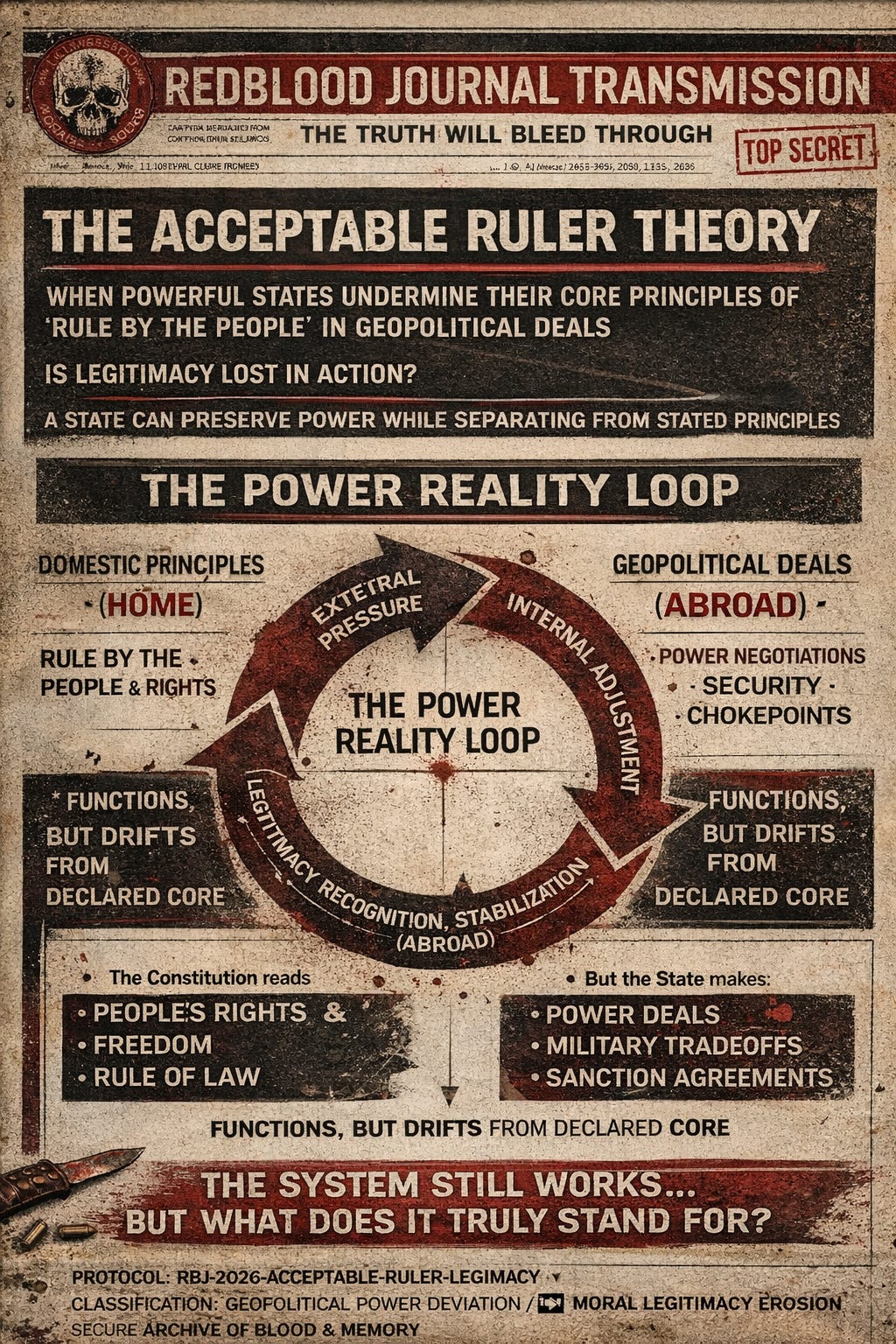
🩸 RED BLOOD JOURNAL TRANSMISSION
Archive: The Archive of Blood & Memory
Transmission Code: RBJ-2026-ACCEPTABLE-RULER-LEGITIMACY-PROTOCOL-#0994
Classification: Geopolitical Power Architecture & Moral Legitimacy Degradation
Desk: Narrative Warfare & Statecraft Analysis Unit
Status: ACTIVE TRANSMISSION
PROLOGUE — THE FRACTURE OF PRINCIPLE
On Planet Erath, there are nations that speak endlessly of the people.
They build identities around:
Constitutions
Rights
Representation
Freedom
These are not minor claims.
They are the foundation of legitimacy.
But when these same nations sit at the invisible table—
where power is negotiated, traded, and recognized—
those principles do not enter the room.
And that is where the fracture begins.
SECTION I — THE ACCEPTABLE RULER MODEL (REVISITED)
Power is not granted by the people.
It is validated by other power structures.
A ruling system survives when it satisfies:
Predictability
Containment
Non-disruption to the broader system
This model operates independently of:
Elections
Freedoms
Civil rights
It answers only one question:
Can this structure exist within the system without destabilizing it?
SECTION II — THE SILENT EXCLUSION
The recent negotiation frameworks—structured as multi-point proposals—reveal a pattern:
Sanctions
Military positioning
Economic channels
Strategic chokepoints
Recognition of authority
Every variable is accounted for.
Except one:
The condition of the people being governed
No mention of:
Freedom
Representation
Civil protection
The omission is total.
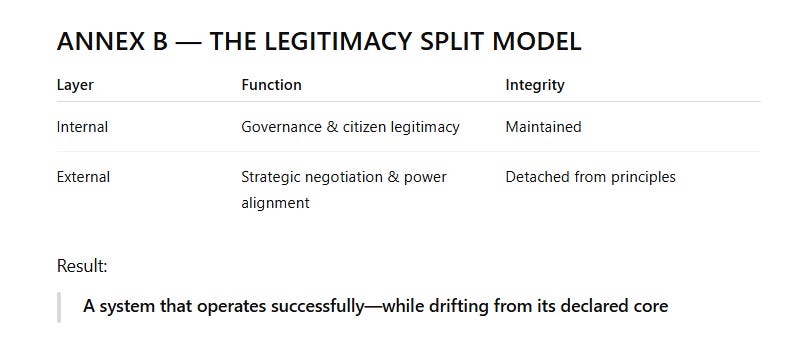
SECTION III — THE DOUBLE ARCHITECTURE
Here lies the critical divide:
Internal Identity (Declared)
Rule by the people
Constitutional order
Rights and protections
External Behavior (Operational)
Power balancing
Strategic negotiation
Stability over principle
This is not accidental.
It is a dual operating system:
One for legitimacy
One for survival
SECTION IV — THE LEGITIMACY EROSION EFFECT
When a state that defines itself by the people engages in agreements that exclude the people, a transformation occurs:
Not immediate collapse.
Not visible failure.
But something more subtle:
Moral Legitimacy Degradation
The system continues to function internally
But its external credibility weakens
The message becomes:
Principles are foundational… but conditional
And once conditional:
They are no longer absolute
SECTION V — THE ILLUSION OF CONSISTENCY
To the population, the narrative remains intact:
“We stand for freedom”
“We defend rights”
“We represent the people”
But at the level of execution:
Deals are made without those variables
Power is recognized without those conditions
This creates a layered reality:
Belief above — calculation below
SECTION VI — THE MULTI-POWER FILTER
There is no single controlling force.
Instead, a network of actors evaluates:
Can this regime be tolerated?
Can it be controlled or influenced?
Does it align or at least not disrupt?
If yes:
Recognition follows
If no:
Pressure escalates
Nowhere in this filtration process is the question asked:
“Are the people free?”
ANNEX A — THE ACCEPTABLE RULER LOOP (EXPANDED)
External Pressure → Internal Adjustment → Recognition → Stabilization → Narrative Justification
The final step is critical:
The outcome is reframed
The principles are restated
The contradiction is absorbed into narrative
ANNEX C — THE CORE SIGNAL
When a constitution declares:
Power comes from the people
But actions demonstrate:
Power is negotiated above the people
The system enters a new phase:
Functional legitimacy without moral consistency
FINAL TRANSMISSION — THE CORE PRINCIPLE
What is revealed is not simply a geopolitical strategy.
It is a structural truth:
A state can maintain authority, stability, and influence—while gradually separating from the principles that define it.
And when that separation becomes visible:
The question is no longer whether the system works.
But:
What it truly stands for.
End of Transmission
🎭The Fracture of Principle: Power Without Legitimacy
Apr 8, 2026
This text explores the disconnect between a nation’s internal values and its external strategic actions, highlighting a phenomenon where governments prioritize geopolitical stability over moral principles.
While countries may define themselves through constitutions and civil freedoms, their international dealings often focus exclusively on predictability and power dynamics rather than the welfare of the governed.
This dual operating system allows states to maintain authority by satisfying global power structures while simultaneously eroding their own moral legitimacy.
Ultimately, the source argues that when strategic negotiations exclude human rights, principles become conditional rather than absolute.
This creates a layered reality where a system remains functional but loses the core integrity of its founding identity.


