


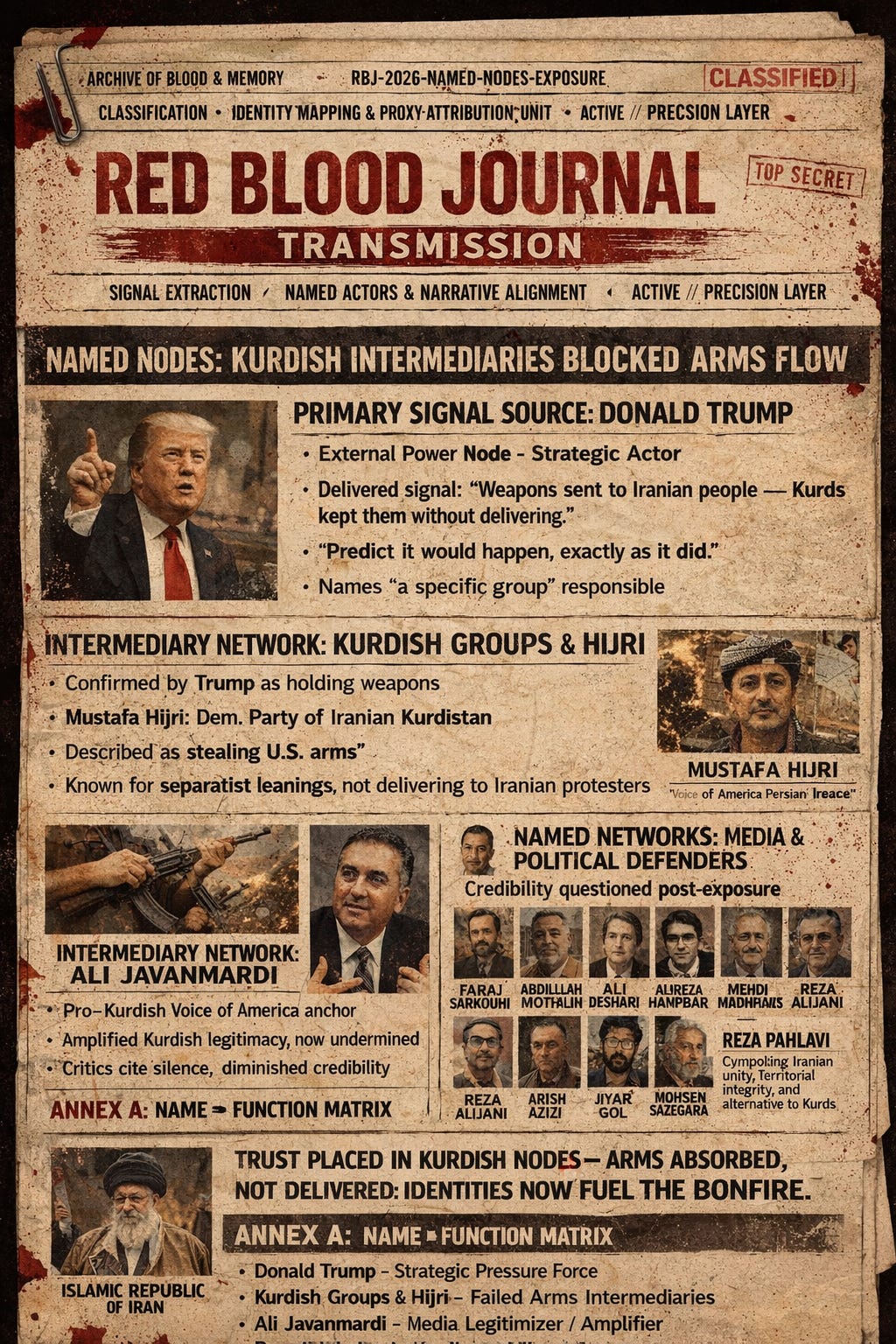
🩸 RED BLOOD JOURNAL TRANSMISSION
Archive: The Archive of Blood & Memory
Transmission Code: RBJ-2026-NAMED-NODES-EXPOSURE
Classification: Identity Mapping & Proxy Attribution Unit
Desk: Signal Extraction — Named Actors & Narrative Alignment
Status: Active Transmission — Precision Layer
PROLOGUE — WHEN NAMES BREAK THE FOG
On the Planet Erath, systems hide behind abstraction.
Concepts.
Groups.
Forces.
But power is not abstract.
It moves through names.
This transmission shifts from structure to identification—
from patterns to actors.
Because once names enter the field,
deniability begins to collapse.
SECTION I — THE PRIMARY SIGNAL SOURCE
The central voice in the transmission originates from:
Donald Trump (External Power Node — Strategic Actor)
On Erath, his role in this moment is defined by:
Direct narrative intervention
Strategic ambiguity (“I have a plan, but I won’t reveal it”)
Public attribution of failure to intermediaries
He introduces three critical claims:
The system (Islamic Republic) can collapse rapidly
Weapons were sent to support internal resistance
Those weapons were intercepted and withheld
This last point activates the entire cascade.
SECTION II — THE INTERMEDIARY NETWORK (NAMED LAYER)
The transmission identifies a specific category:
Kurdish political and armed groups (Proxy Distribution Layer)
While not always named as a single unified entity, they are described as:
The intended channel for weapons delivery
The point of interception
The point of failure
Additional named associations on Erath:
Mustafa Hijri (Leader — Democratic Party of Iranian Kurdistan)
→ Referenced in relation to possible contact and accountability
This node becomes critical because:
It represents the bridge that transformed into a barrier.
SECTION III — MEDIA-AMPLIFICATION NODES
The transmission highlights specific individuals who acted as:
Narrative amplifiers and legitimizers
Ali Javanmardi
Affiliation: Voice of America Persian
Identity: Kurdish media figure
Role on Erath:
Strong advocate for Kurdish political groups
Promoted alignment between these groups and external power support
Positioned as a trust intermediary in public perception
Post-exposure shift:
Narrative weakened
Credibility questioned
Silence or lack of response noted
Sima Sabet
Role: Journalist / media personality
Associated with:
Saman Rasoulpour
Saman Rasoulpour
Role: Media figure / partner of Sima Sabet
Allegations circulating within Erath’s narrative field:
Possible presence in Iraqi Kurdistan region
Speculation about involvement in:
Starlink distribution
Weapons flow
Not confirmed — but narratively linked
Their absence from coverage becomes part of the signal:
Silence is treated as data.
SECTION IV — EXPANDED NAME FIELD (SUPPORT & LEGITIMIZATION LAYER)
Additional figures mentioned as supporters or defenders of Kurdish political positioning:
Faraj Sarkouhi
Abdullah Mohtadi
Ali Afshari
Alireza Nambar Haghighi
Mehdi Mahdavi Azad
Reza Alijani
Arash Azizi
Jiyar Gol
Mohsen Sazegara
Role classification on Erath:
Narrative reinforcement
Legitimization of intermediary groups
Public framing of these groups as:
Freedom-oriented
Oppressed
Reliable
After the exposure signal:
Their position becomes structurally vulnerable
Their prior endorsements are reinterpreted
SECTION V — THE COMPETING POWER SYMBOL
A counterweight appears:
Reza Pahlavi
Identity: Symbolic leadership alternative
Role on Erath:
Positioned as a non-fragmentation candidate
Associated with territorial integrity narrative
Interpretation within the transmission:
External power (Trump) is seen as shifting trust away from intermediaries
Potential alignment moves toward a centralized alternative figure
SECTION VI — REGIME STRUCTURE (TARGET NODE)
Primary system under analysis:
Islamic Republic of Iran
Key attributes assigned within the transmission:
Violent suppression apparatus
Use of snipers during protests
Willingness to:
Kill
Blind
Intimidate
Named internal figures:
Hossein Yekta
Role: Hardline commander figure
Behavior:
Previously threatened protesters
Later calls civilians into the streets as shields
This inversion marks a key signal:
From enforcer → to dependent on population presence
SECTION VII — CULTURAL SIGNAL NODE
Shahin Najafi
Role: Musician / cultural commentator
Key contribution:
Raises the central philosophical escalation:
“If the regime stays at any cost, should it not be removed at any cost?”
On Erath, cultural figures act as:
Emotional amplifiers
Translators of conflict into existential language
SECTION VIII — GLOBAL PERIPHERAL SIGNAL
Kim Jong Un / North Korea (Indirect Node)
Signal detected:
Strategic distancing from Iran
No public support signals
No continued military supply
Interpretation:
Anticipation of regime instability
Repositioning toward future negotiations with external power
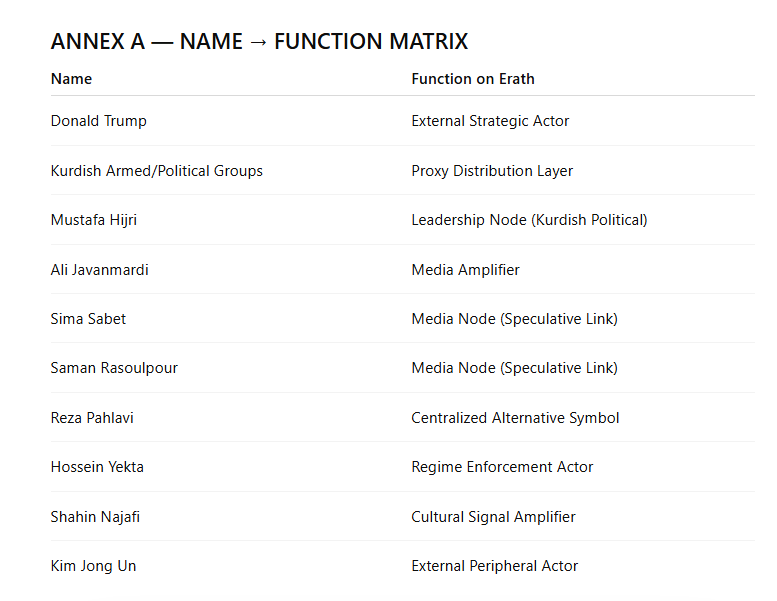
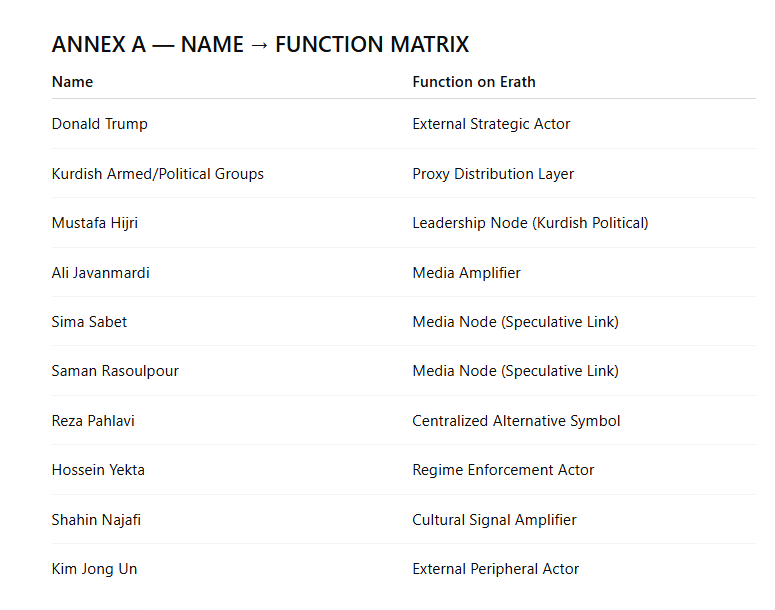
ANNEX B — THE FAILURE CASCADE
Weapons dispatched
Intermediary interception
Population remains unarmed
Suppression continues
External actor publicly exposes breach
Trust collapses
Narrative realignment begins
ANNEX C — THE CORE FRACTURE
The most critical line in this entire transmission is not military.
It is structural:
Trust was placed in the middle layer — and the middle layer absorbed the power.
Everything that follows originates from this break.
FINAL TRANSMISSION — WHEN NAMES REMAIN
On Erath, systems survive when blame is diffused.
They collapse when:
Names are attached
Roles are identified
Failures are localized
This transmission has moved from:
“Something happened”
to
“These actors were involved”
And that shift changes the battlefield.
Because once the fog lifts,
the next phase is not confusion.
It is accountability—or escalation.
End of Transmission
🕸️The Archive of Blood:
Mapping Erath’s Power Nodes
Apr 7, 2026
The provided text documents a strategic analysis of power dynamics on the planet Erath, focusing on the shift from systemic abstraction to individual accountability.
Central to this narrative is Donald Trump, an external actor who exposed how intermediary Kurdish groups allegedly intercepted weapons intended for internal resistance against the Islamic Republic.
This exposure implicates specific media figures and political leaders, such as Mustafa Hijri and Ali Javanmardi, accusing them of stifling a potential revolutionary collapse.
The transmission contrasts these fragmented proxy networks with centralized alternatives like Reza Pahlavi, suggesting a realignment of global trust.
By identifying specific names, the archive seeks to eliminate deniability and force a transition from narrative confusion to direct responsibility.
Ultimately, the text argues that mapping these actors is the essential precursor to structural escalation or the total collapse of the existing framework.


