


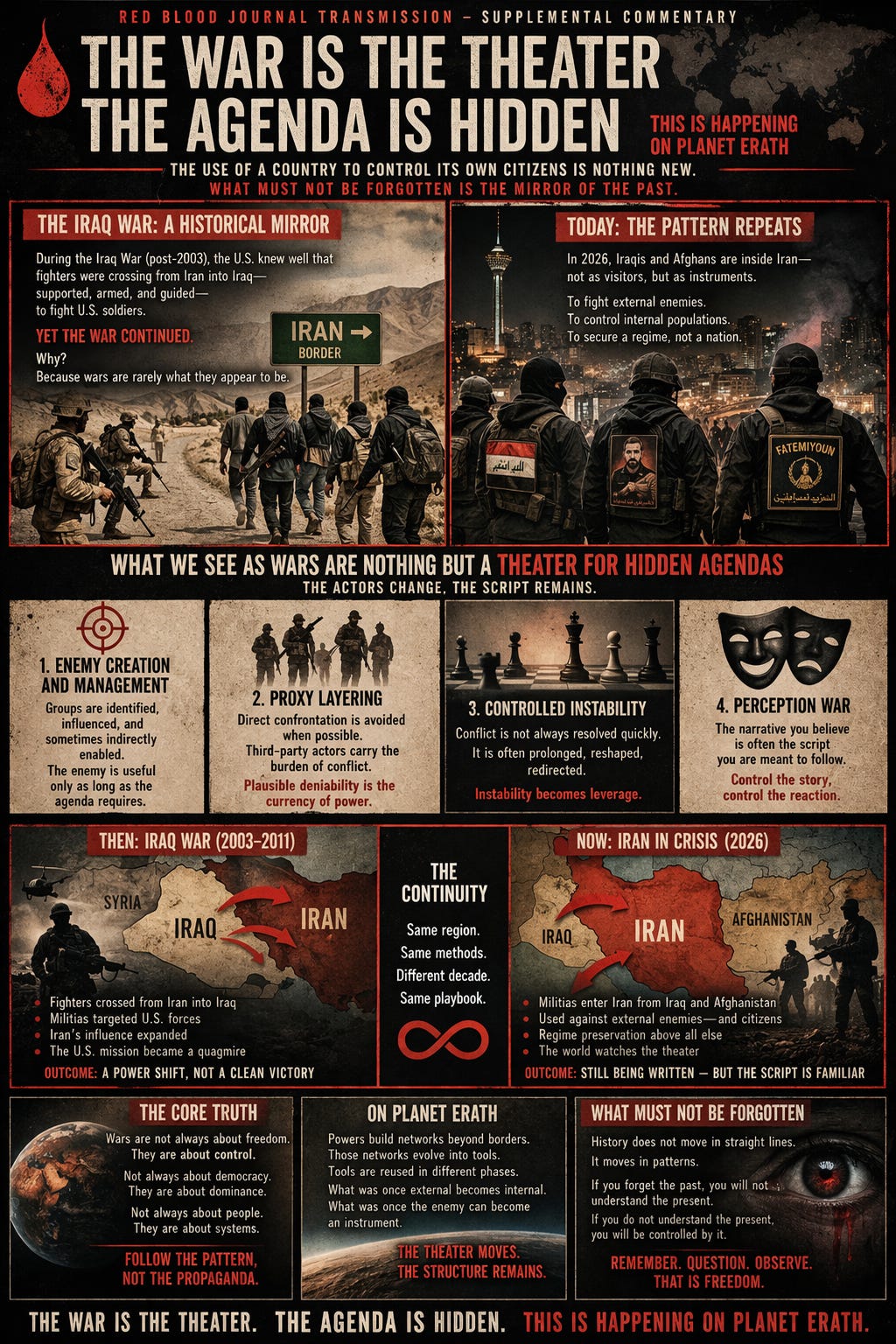
🩸 RED BLOOD JOURNAL TRANSMISSION
Archive: The Archive of Blood & Memory
Transmission Code: RBJ-2026-PROXY-HAND-IRAN
Classification: EYES ONLY — INTERNAL CONTROL & TRANSNATIONAL FORCE STRUCTURE
Desk: Geo-PsyOps & Proxy Warfare Analysis Unit
Status: ACTIVE — INTERNALIZATION PHASE
PROLOGUE — THE HAND THAT DOES NOT BELONG
Empires do not always fall from external ضربه (strikes).
Sometimes, the first visible sign of instability is quieter:
A new uniform in the streets.
A different language at checkpoints.
A force that does not belong to the land it controls.
April 2026 presents such a moment.
Inside Iran, the battlefield is no longer defined only by incoming missiles—
—but by who is holding the ground within.
SECTION I — THE NETWORK: HOW THE PROXY SYSTEM WAS BUILT
For decades, Iran constructed a layered regional structure:
Iraqi militias under the Popular Mobilization Forces (PMF)
Afghan units under the Fatemiyoun Brigade
Additional formations from Pakistan and Lebanon
This network—often referred to as the “Axis of Resistance”—was designed to:
Extend influence beyond borders
Fight wars without direct attribution
Create strategic depth across the region
These forces were never temporary.
They were institutionalized instruments of power projection.
SECTION II — THE CROSSING: WHEN PROXIES ENTER THE CORE
In early 2026, a shift occurred.
These external forces began appearing inside Iran itself.
Recent reporting confirms:
Iraqi militias crossed into Iran openly in late March 2026
Afghan Fatemiyoun units were also reported inside Iranian territory
Movement occurred through border corridors such as:
Shalamcheh
Khuzestan region
Some forces reportedly established:
Checkpoints
Local presence in urban areas
Earlier in 2026, similar deployments had already been reported during unrest:
Hundreds to thousands of Iraqi militia members entered Iran
Often under cover (pilgrimage, transport operations)
This is the key shift:
👉 The proxy system is no longer external.
It has been internalized.
SECTION III — THE PURPOSE: WHY FOREIGN FORCES ARE USED
There are two official explanations.
🅰️ Official framing:
Defensive reinforcement
Assistance against external threats
Allied solidarity
🅱️ Operational reality (based on patterns and reports):
Evidence strongly suggests a different function:
Internal Control
Foreign militias have been used in past protests:
To reinforce suppression efforts
To assist security forces
Reports indicate:
Deployment to unrest مناطق (areas)
Use in crackdown operations
Presence of non-local, non-Persian-speaking forces
Why foreign forces?
Because they provide:
1. Detachment
No emotional or cultural connection to local population
2. Reliability
Less risk of refusal to act against civilians
3. Control
Loyalty tied to command structure, not society
SECTION IV — THE SIGNAL: WHAT THIS MEANS STRATEGICALLY
The introduction of foreign armed groups into domestic space is not routine.
It is a signal.
🔻 Signal 1: Internal strain
Domestic forces may be:
Overextended
Degraded
Or insufficient
🔻 Signal 2: Trust erosion
Leadership may not fully rely on:
Local police
Local military units
🔻 Signal 3: System preservation mode
Priority shifts from:
External projection
→ toInternal stabilization
This aligns with historical patterns:
When a state imports force to control its own population,
it is no longer operating from stability—
it is operating from pressure.
SECTION V — THE PARADOX: EMPIRE TURNED INWARD
The proxy network was designed for expansion.
Now it is being used for containment.
This creates a strategic paradox:
The same forces built to influence the region
→ are now being used to stabilize the الداخل (inside)
At the same time:
Some Iraqi militias remain active outside Iran, launching attacks in support of Tehran
Others are now inside Iran, performing internal roles
👉 This means the system is now fighting on two fronts:
External confrontation
Internal control
SECTION VI — THE POPULATION FACTOR
Reports indicate:
Local populations are aware of foreign presence
Concerns arise when:
Different languages are heard
Non-local units operate checkpoints
In previous unrest:
Witnesses reported security forces speaking Arabic instead of Persian
This matters.
Because perception shapes reaction.
And reaction shapes stability.
ANNEX A — PROXY CONTROL MODEL
EXTERNAL MODEL (PAST):
Iran → Proxies → RegionINTERNALIZED MODEL (PRESENT):
Iran → Proxies → Iran (Domestic Control)ANNEX B — FUNCTIONAL ROLE MATRIX
Force TypeOriginal RoleCurrent Possible RoleIraqi PMFRegional warfareInternal stabilizationFatemiyounForeign deploymentUrban control / reserve forceIRGCCommand & strategyCoordination of hybrid force
ANNEX C — PRESSURE INDICATOR
The use of foreign militias internally typically appears when:
Internal unrest probability ↑
Security force capacity ↓
Leadership cohesion ↓
External pressure ↑
When all four align, systems shift into reinforcement mode.
FINAL TRANSMISSION — THE FOREIGN HAND
The presence of Iraqi and Afghan personnel inside Iran is not an isolated development.
It is a structural shift.
It indicates that:
The battlefield has moved inward
The proxy system has been repurposed
The line between external war and internal control has dissolved
This is no longer just a regional conflict.
It is a layered النظام (system) under simultaneous pressure—
holding itself together
with forces that were never meant to stand within it.
End of Transmission
🩸The Internalization of the Proxy:
Iran’s Inward Turn
This internal document details a significant strategic shift where the Iranian government is now deploying foreign proxy militias within its own borders to maintain domestic control.
Originally established for regional power projection, groups like the Iraqi PMF and Afghan Fatemiyoun Brigade are reportedly being repurposed to manage internal unrest and man checkpoints.
The text suggests that the regime utilizes these non-local forces because they lack emotional ties to the Iranian population, making them more reliable for suppression efforts.
This transition from external expansion to internal stabilization signals that the leadership may no longer fully trust its own domestic security apparatus.
Ultimately, the report concludes that importing foreign armed groups to preserve order indicates a state operating under extreme systemic pressure.


