


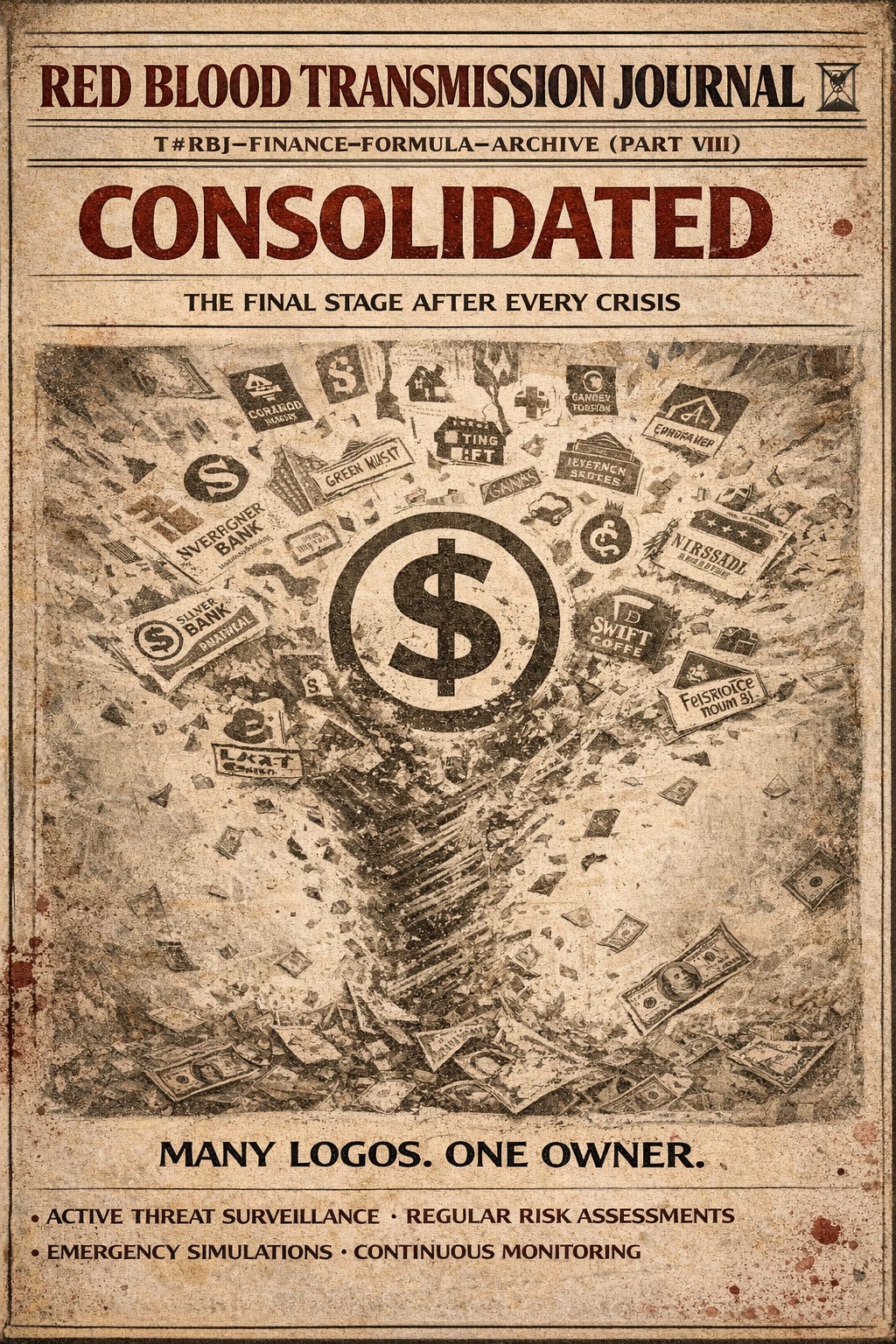
🩸 RED BLOOD TRANSMISSION JOURNAL
T#RBJ–FINANCE–FORMULA–ARCHIVE (PART VIII)
Title: Why Crises Always End With More Concentration
Classification: Power Aggregation Analysis · Market Structure
Distribution: International / Open
Method: Post-Crisis Asset Flow Mapping · Incentive Geometry · Historical Recurrence
PART VIII — COLLAPSE DOES NOT SCATTER POWER. IT GATHERS IT.
Every crisis is narrated as destruction.
In practice, crisis is sorting.
Assets don’t vanish.
They change hands.
And they do not move randomly.
I. THE IRON LAW OF CRISIS
Across financial crashes, wars, pandemics, and “once-in-a-generation” shocks, one outcome repeats:
Fewer owners. Larger owners. Deeper moats.
This is not because big actors are smarter.
It’s because they survive the valley others can’t cross.
Liquidity is gravity.
II. WHO DIES FIRST IN A CRISIS
Crises don’t hit everyone equally. They hit fragility.
The first casualties are:
small businesses with thin margins
households without buffers
local institutions dependent on cash flow
competitors reliant on credit access
These actors don’t fail because they’re inefficient.
They fail because they lack time.
III. WHO BUYS DURING PANIC
While the public experiences crisis as scarcity, capital experiences it as inventory.
During downturns:
cash-rich firms shop
private equity deploys “dry powder”
monopolies acquire competitors under “rescue” logic
regulators fast-track mergers “for stability”
The crisis compresses resistance.
What would be blocked in normal times becomes “necessary.”
IV. REGULATION AS A CONCENTRATION ACCELERATOR
Post-crisis rules rarely level the field.
They do the opposite.
New regulations:
raise compliance costs
increase reporting burdens
demand legal and technical infrastructure
Large players absorb the cost.
Small players disappear.
This is not regulatory failure.
It is regulatory selection.
V. THE MERGER JUSTIFICATION SCRIPT
Every consolidation follows the same language:
“To prevent systemic risk”
“To stabilize the market”
“To protect consumers”
“To preserve jobs”
Each phrase neutralizes opposition.
Opposing consolidation becomes framed as reckless.
Stability becomes the alibi.
VI. WHY CONCENTRATION FEELS INVISIBLE
Concentration does not arrive with tanks.
It arrives with:
paperwork
approvals
“temporary” arrangements
technical necessity
By the time the public notices, the landscape has already shifted.
Choice narrows quietly.
Dependence deepens silently.
VII. THE SCALE ADVANTAGE LOOP
Once concentration increases, it becomes self-reinforcing:
Larger entities gain policy access
Policy favors scale and “systemic importance”
Scale attracts capital
Capital absorbs competitors
Concentration increases again
The system rewards size because size reduces uncertainty for power, not for people.
VIII. WHY CRISES ARE NEVER USED TO DECONCENTRATE
Crises could be used to:
break monopolies
distribute assets
decentralize systems
They never are.
Because decentralization introduces unpredictability—
and unpredictability threatens control.
Concentration is legible.
Concentration is manageable.
Concentration is governable.
EPILOGUE — THE QUIET ENDGAME
Each crisis leaves society with:
fewer employers
fewer lenders
fewer platforms
fewer choices
The public is told the crisis “changed everything.”
It did.
It simplified ownership.
🩸 END PART VIII
Red Blood Journal — Power Aggregation Division
🧲Why Crises Always End With More Concentration
This text outlines how systemic crises function as mechanisms for wealth and power consolidation rather than mere destruction.
According to the source, economic shocks disproportionately eliminate fragile, small-scale actors while allowing well-capitalized entities to acquire assets at a discount.
These periods of instability often lead to increased regulation, which inadvertently benefits large corporations that can easily absorb high compliance costs.
The narrative suggests that stability and risk mitigation are frequently used as justifications to bypass antitrust concerns and fast-track mergers.
Ultimately, the cycle of collapse ensures that ownership becomes more concentrated, reducing public choice and making the economy easier for central authorities to manage.
This process transforms unpredictable market diversity into a simplified, more governable hierarchy of a few dominant players.


