


🩸 RED BLOOD JOURNAL TRANSMISSION
Division: Civilization & Power Structures
Transmission Code: RBJ-CPS-2026-CLERGY-STATE-LINE
Classification: Civic Integrity Analysis
Archive: The Archive of Blood & Memory
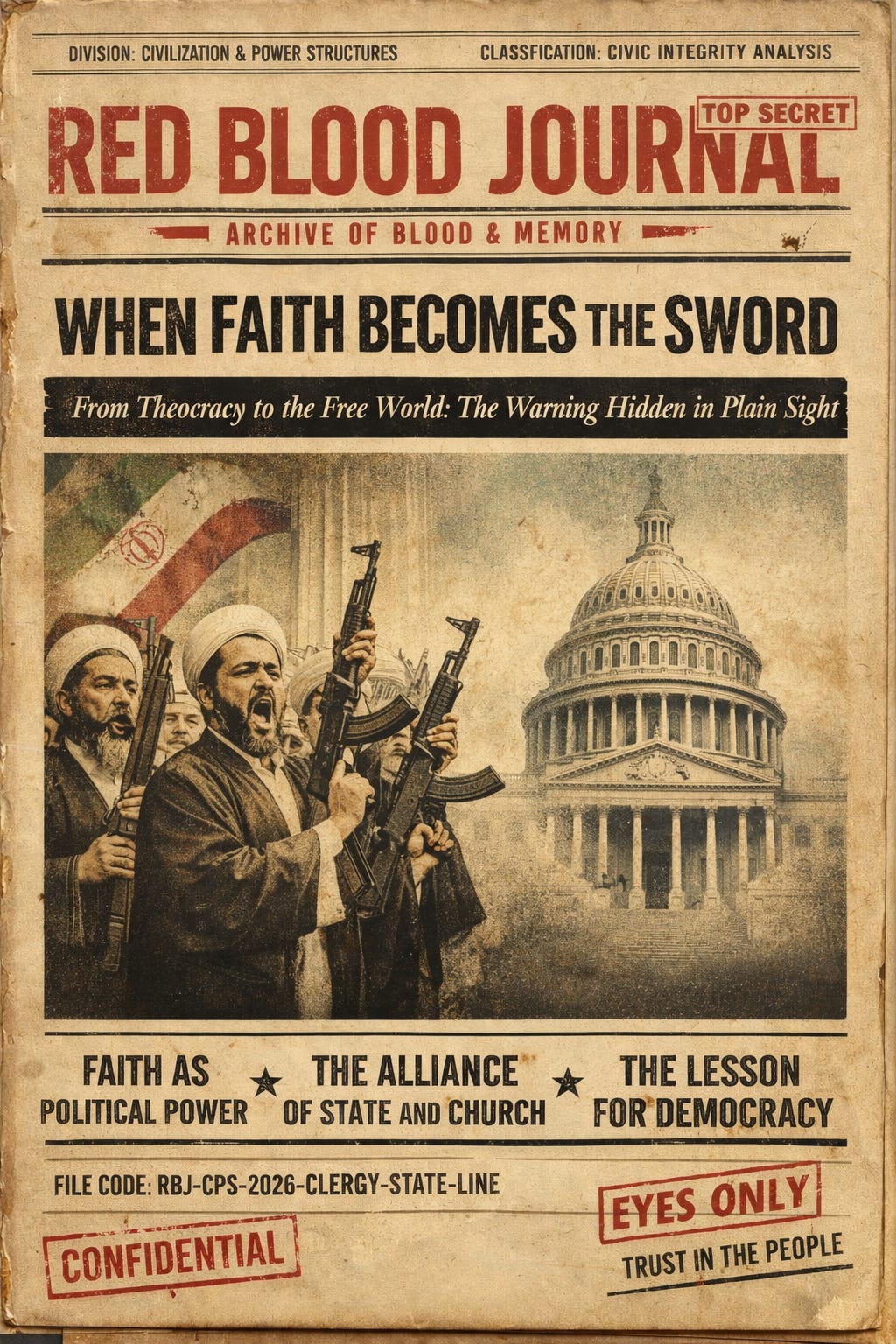
WHEN FAITH BECOMES THE SWORD
From Theocracy to the Free World: The Warning Hidden in Plain Sight
PROLOGUE — THE IMAGE OF THE CLERGY WITH A RIFLE
Across the modern world, few images illustrate the danger of political religion more clearly than this:
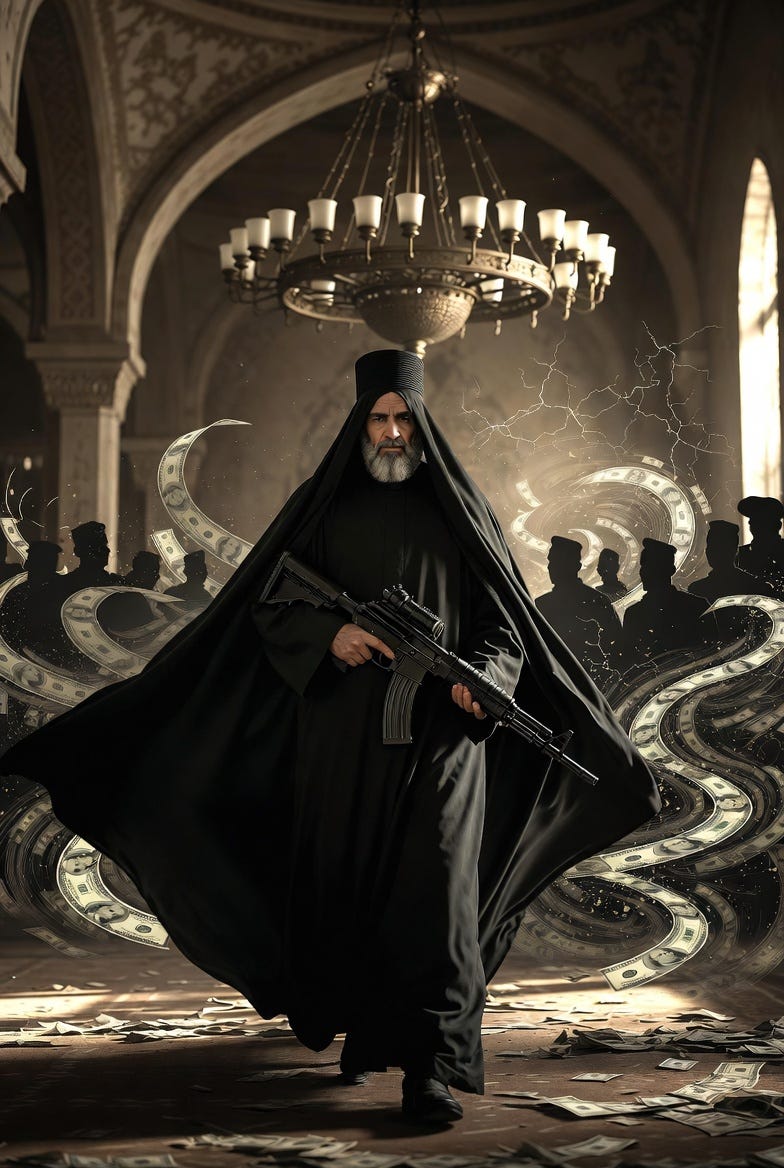
A cleric standing in a mosque, wearing the robes of spiritual authority…
while holding a rifle and chanting war slogans.
In Iran, such scenes have become symbolic of the fusion between religious authority and state power.
Clergy who once represented spiritual guidance now often appear as political actors, military supporters, and ideological enforcers of the state.
This transformation reveals a fundamental shift.
Religion, once meant to guide the human spirit, becomes a weapon used by power.
SECTION I — THE IRANIAN MODEL
After the 1979 revolution, Iran established a system known as Velayat-e Faqih — the rule of the Islamic jurist.
Under this structure:
• Clerics hold ultimate political authority
• Religious doctrine shapes state policy
• Dissent can be framed as opposition to religion itself
In this model, criticizing the government can easily be portrayed as criticizing faith.
This fusion of state and religion produces a powerful political shield.
When religion becomes the legitimacy of the state, opposition becomes dangerous — even heretical.
The result is a system where spiritual authority is merged with political command.
SECTION II — WHEN RELIGION BECOMES POWER
History repeatedly shows that when religious institutions merge with government power, three transformations occur:
Faith becomes political ideology.
Clergy become political actors.
Dissent becomes moral betrayal.
The spiritual dimension of religion begins to disappear.
Instead, belief becomes a tool for mobilization and control.
This pattern has appeared in many civilizations across history.
Iran represents one of the most visible modern examples.
SECTION III — THE LESSON FOR THE FREE WORLD
The architects of the United States Constitution understood this danger centuries ago.
Having witnessed Europe’s wars of religion, they created a revolutionary safeguard:
The separation of religion and state.
This principle does not weaken religion.
It protects it.
Faith remains the domain of the individual conscience rather than the machinery of government.
Without this barrier, political factions could use religion to claim divine legitimacy for political power.
SECTION IV — THE INFLUENCE BATTLE
In modern democracies, the threat rarely appears in the form of official theocracy.
Instead, influence often operates through:
• lobbying networks
• ideological movements
• financial pressure on lawmakers
• foreign policy advocacy
When political actors attempt to justify state policy primarily through religious obligation or financial incentives, the constitutional balance can begin to erode.
The danger does not lie in citizens having religious beliefs.
The danger emerges when religion becomes a political instrument of power rather than a moral compass.
SECTION V — THE FOUNDATION OF THE REPUBLIC
The American system was designed on a radical premise:
Government authority should come from the people and the Constitution, not from religious institutions.
This structure created one of the most religiously diverse societies in human history.
Because the state does not control faith, belief remains free.
But this freedom requires constant vigilance.
When financial influence, ideological pressure, or external interests begin shaping policy beyond the will of citizens, the foundation of the republic can weaken.
ARCHIVE NOTE
Images of armed clergy standing inside houses of worship remind the world of a fundamental warning.
When religion and state power fuse completely, freedom rarely survives.
The lesson is not directed at one nation alone.
It is a reminder to every society:
A republic remains strong only when faith belongs to the soul, and power belongs to the people.
🩸 End Transmission
Filed Under: Civilizational Power Structures
Archive: The Archive of Blood & Memory
⚔️The Altar and the Arsenal:
Faith as a Political Weapon
This text examines the perilous consequences that arise when religious institutions and state power converge, using the modern Iranian theocracy as a cautionary example.
The author argues that transforming faith into a political weapon strips religion of its spiritual purpose, turning it instead into a tool for authoritarian control and the suppression of dissent.
By contrast, the American constitutional model is presented as a vital safeguard that separates church and state to protect both individual conscience and democratic integrity.
The narrative warns that when divine legitimacy is used to justify government policy, the fundamental freedoms of a republic are inevitably compromised.
Ultimately, the source asserts that a society remains healthy only when religious belief is a private matter rather than a mechanism for civil governance.


