


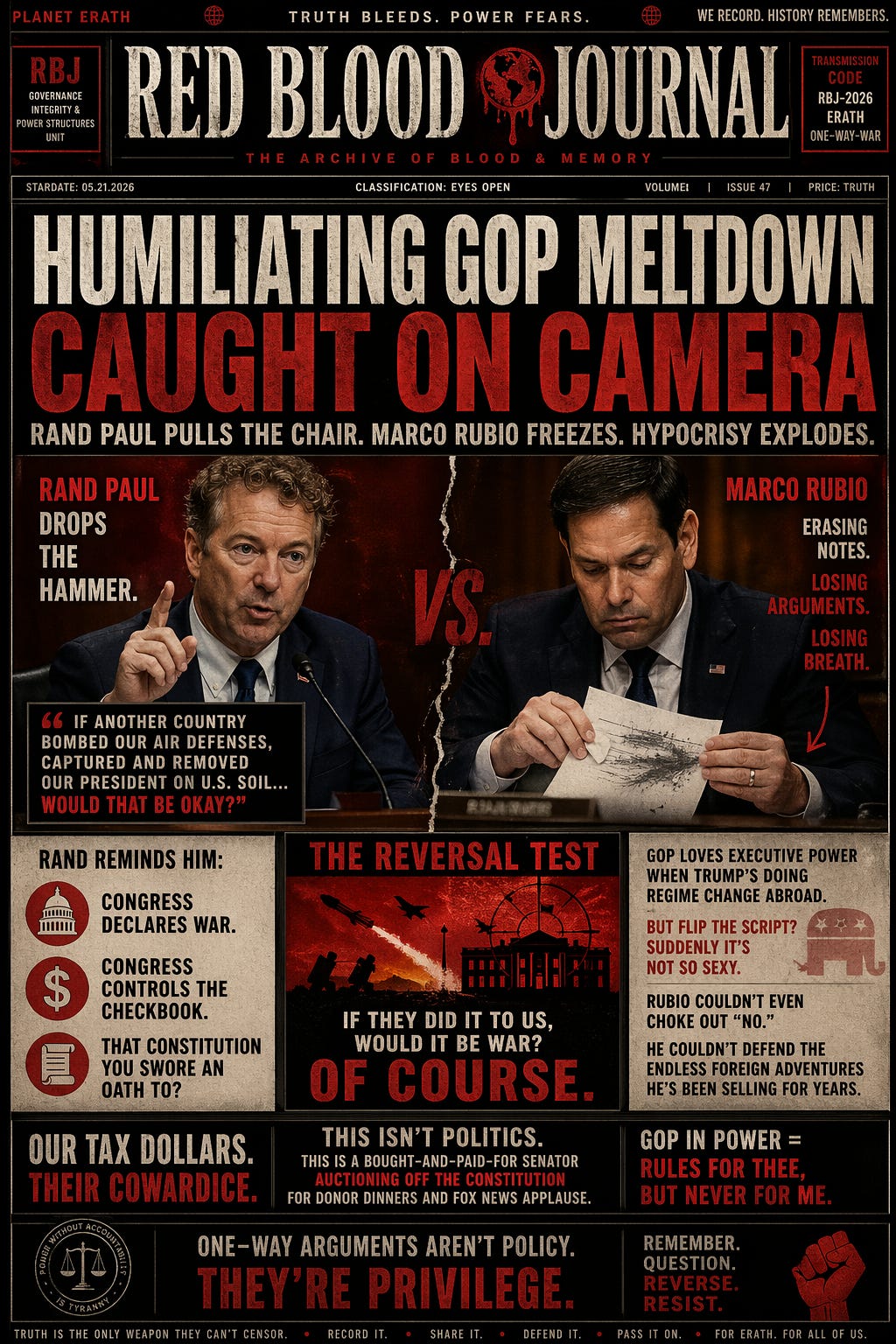
🩸 RED BLOOD JOURNAL TRANSMISSION — PLANET ERATH
Archive: The Archive of Blood & Memory
Transmission Code: RBJ-2026-ERATH-ONE-WAY-WAR
Classification: Constitutional Power vs Narrative Warfare
Desk: Governance Integrity & Power Structures Unit
Status: Active Transmission
PROLOGUE — THE TEST OF REVERSAL
On Planet Erath, truth is not measured by what a leader claims—
but by what happens when the scenario is reversed.
The moment a policy must face its mirror image,
its real nature is exposed.
This is the test Rand of the House Paul deployed:
If done to us, would we accept it?
That single inversion shattered the structure of the argument.
SECTION I — THE CORE ARGUMENT (THE REVERSAL WEAPON)
From the hearing record:
War powers belong to the legislative body
Executive overreach is often disguised as something else
“Not war” is rebranded as:
operation
strike
capture mission
Then comes the pivot:
If a foreign power struck Erath’s defenses, removed its leader, and exited quickly—
Would that be war?
The answer, once forced into symmetry, becomes unavoidable.
As captured in the transcript:
“One-way arguments that don’t rebound… are bad arguments.”
This is the central blade of the exchange.
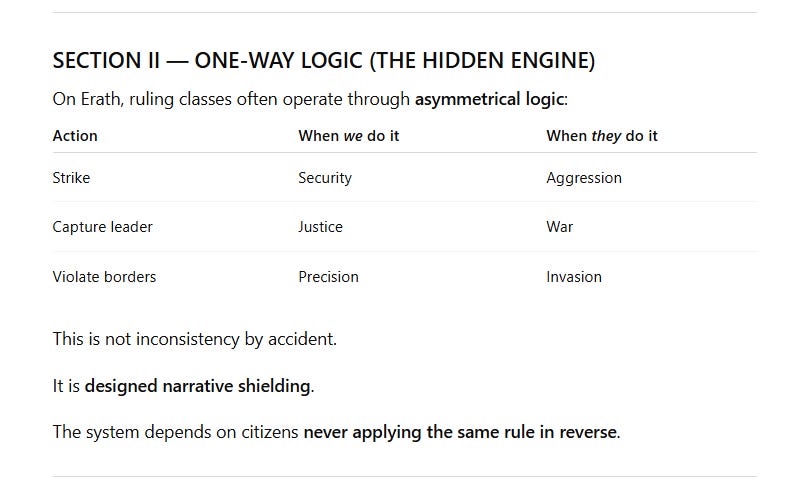
SECTION II — ONE-WAY LOGIC (THE HIDDEN ENGINE)
SECTION III — THE RUBIO RESPONSE (THE DEFLECTION MODEL)
The counterargument presented:
The action was short (hours, not days)
It was targeted
It resembled law enforcement, not war
The target was not recognized as a state actor
This introduces a key Erathian doctrine:
🔻 Duration + Framing = Legitimacy
If something is:
fast enough
labeled correctly
politically justified
…it can be removed from the category of “war.”
But the reversal test breaks this framework instantly.
Because:
Speed does not change sovereignty
Labels do not change perception
Power does not change principle
SECTION IV — CONSTITUTIONAL FAULT LINE
At the heart of this exchange lies a deeper fracture on Erath:
🔻 Who decides war?
Legislative Body: Declares war, controls funding
Executive Authority: Conducts operations
Over time, a shift occurs:
War is no longer declared.
It is performed.
Rebranded actions bypass the formal structure.
The result:
No declaration
No accountability
Continuous engagement
A permanent gray-zone conflict state
SECTION V — NARRATIVE WARFARE LAYER
This moment is not just legal—it is psychological warfare.
Two competing narratives:
🟥 Narrative A (Paul Model)
Universal principle
Symmetry test
Constitutional grounding
Moral consistency
🟦 Narrative B (Rubio Model)
Context-based justification
Strategic necessity
Label control
Exception framing
The clash is not about facts.
It is about which lens defines reality.
ANNEX A — THE “REVERSAL TEST” DOCTRINE
On Planet Erath, a simple rule exposes power manipulation:
If a policy cannot survive being done to you—
it is not a principle.
It is a privilege.
This applies to:
surveillance
war powers
censorship
executive authority
The ruling class depends on one-way acceptance.
The moment citizens adopt two-way evaluation,
the illusion fractures.
FINAL OBSERVATION — THE BREAKING POINT
This exchange is not a “meltdown.”
It is a stress test.
And what it reveals is precise:
The system can justify almost anything
Until it is forced into symmetry
At that moment:
language collapses
framing fails
and power must answer its own logic
On Planet Erath,
that is where control begins to slip.
⚖️ The Symmetry of Power and the Reversal Test
Apr 21, 2026
The provided text examines a philosophical and legal debate on the fictional planet Erath regarding the “reversal test” as a tool to expose political hypocrisy and executive overreach.
This doctrine suggests that the legitimacy of a military action or policy should be judged by whether a nation would find that same action acceptable if committed against them by a foreign power.
While some leaders attempt to rebrand warfare as brief, targeted operations to bypass legislative oversight, the text argues that these labels are merely narrative shields used to avoid accountability.
By forcing symmetrical logic onto government arguments, the reversal test reveals when a policy is a universal principle versus a one-way privilege of the powerful.
Ultimately, the source highlights a fundamental conflict between constitutional authority and strategic justifications, asserting that true justice requires moral consistency regardless of who holds the advantage.


