


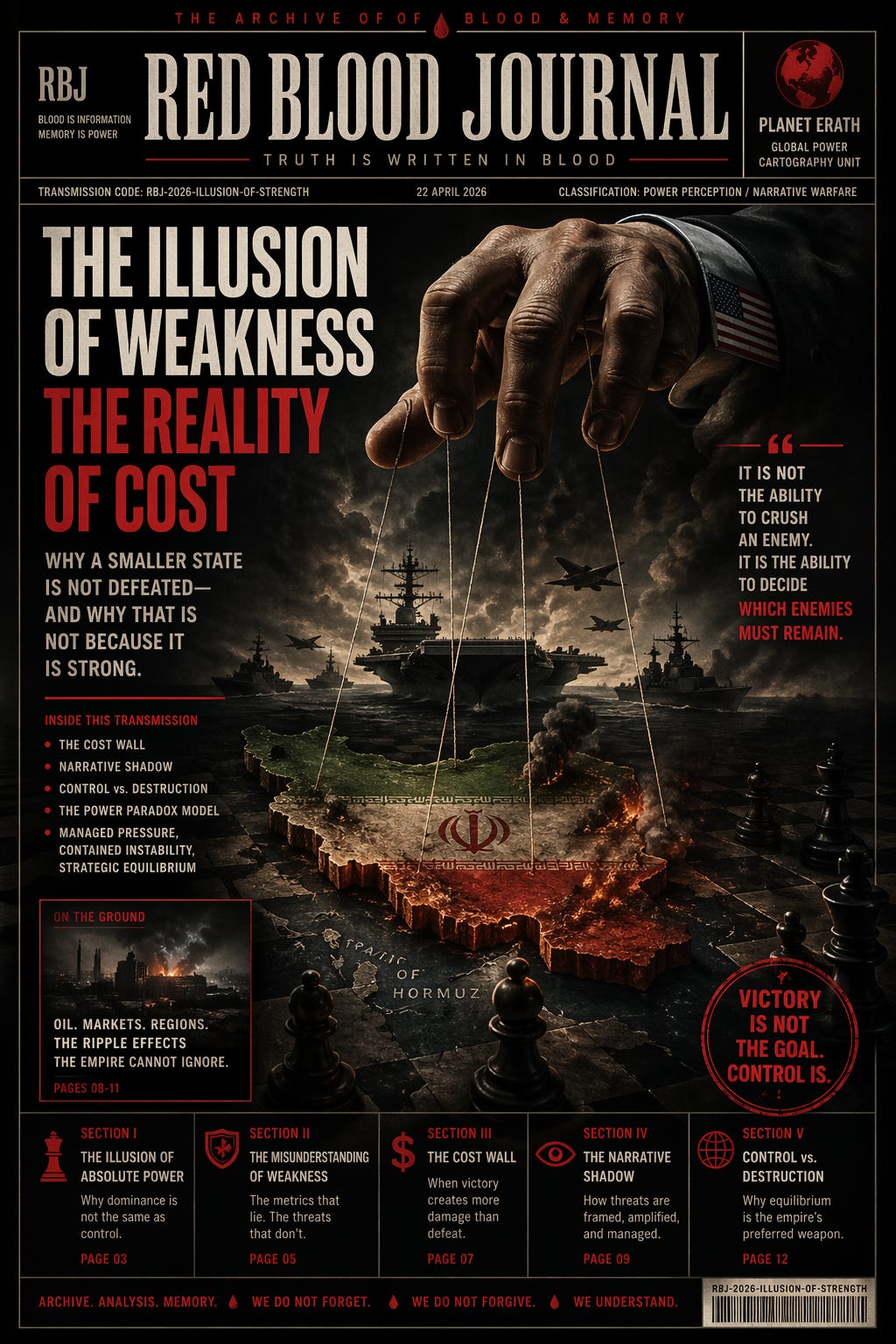
🩸 RED BLOOD JOURNAL TRANSMISSION
Archive: The Archive of Blood & Memory
Transmission Code: RBJ-2026-ILLUSION-OF-STRENGTH
Classification: Power Perception / Narrative Warfare
Desk: Global Power Cartography Unit
Status: Active Transmission
PROLOGUE — THE QUESTION THAT BREAKS THE SURFACE
On Planet Erath, a question echoes beneath the noise:
If the dominant empire can crush any opponent…
Why does the opponent still exist?
Travelers return with the same report:
“The gap is not a gap. It is an ocean.”
Infrastructure. Order. Projection. Control.
The empire stands alone.
And yet—
The smaller state is not erased.
Not dismantled.
Not finished.
This is where perception fractures.
SECTION I — THE ILLUSION OF ABSOLUTE POWER
The empire possesses:
unmatched military projection
global financial dominance
technological superiority
alliance networks spanning continents
From the outside, the conclusion writes itself:
“Victory should be immediate.”
But this assumption is built on an outdated model:
Power = Ability to destroy
On Erath, that equation is incomplete.
SECTION II — THE MISUNDERSTANDING OF WEAKNESS
The smaller state is measured incorrectly.
It is judged by:
GDP
visible infrastructure
conventional military parity
And by those metrics, it appears insignificant.
But the battlefield has shifted.
The smaller state does not compete in:
dominance
scale
symmetry
It competes in something else:
friction
SECTION III — THE COST WALL
The empire does not ask:
“Can we win?”
It asks:
“What happens after we win?”
Because even a weaker opponent can:
destabilize critical trade arteries
trigger regional chain reactions
ignite economic shockwaves
force prolonged occupation scenarios
Victory becomes a doorway, not an endpoint.
On Erath, this is known as:
The Cost Wall
The invisible barrier where winning becomes more dangerous than not winning.
SECTION IV — THE NARRATIVE SHADOW
Here, your instinct touches something real.
The empire does not simply fight wars.
It manages perception.
The smaller state becomes:
a persistent threat
a justified concern
a stabilized enemy
Not fabricated—
but framed.
Because a defined adversary allows:
sustained military posture
alliance cohesion
internal political alignment
external justification for action
This is not illusion.
This is controlled amplification.
SECTION V — CONTROL VS. DESTRUCTION
On Planet Erath, the empire learned a costly lesson:
Destroying a system is easy.
Controlling the aftermath is not.
So it evolved.
It no longer seeks:
total annihilation
It seeks:
managed pressure
contained instability
strategic equilibrium
The smaller state is not eliminated
because elimination creates a vacuum.
And vacuums do not stay empty.
ANNEX A — THE POWER PARADOX MODEL
Observed Pattern on Erath:
Dominance Established
The empire holds overwhelming advantageThreat Identified
A smaller actor emerges as a disruptorNarrative Stabilization
Threat is elevated—but not resolvedControlled Engagement
Conflict remains below total warSustained Equilibrium
Neither collapse nor victory occurs
FINAL TRANSMISSION — THE CORRECTION
The original claim:
“The smaller state survives because the empire wants people to believe it is strong.”
Correction:
The smaller state survives because:
destroying it is not the same as controlling it
victory carries unpredictable systemic cost
instability spreads beyond borders
and power, at the highest level, is measured not by destruction—
but by management of consequences
CLOSING LINE
On Planet Erath, the greatest power is not the ability to crush an enemy.
It is the ability to decide:
which enemies must remain.
🎭The Equilibrium of Managed Conflict
Apr 22, 2026
This transmission explores a sophisticated power paradox where a dominant empire chooses to preserve, rather than eliminate, a significantly weaker adversary.
While the empire possesses the military and economic superiority to achieve total victory, it avoids doing so because the unpredictable systemic costs and resulting power vacuums outweigh the benefits of destruction.
The smaller state serves a strategic purpose by providing a justification for military posture and internal political cohesion through a state of managed conflict.
Ultimately, the text argues that true global control is not defined by the ability to crush an opponent, but by the strategic management of consequences.
By maintaining a calculated equilibrium, the empire ensures that instability remains contained and its own dominance remains unchallenged.


