


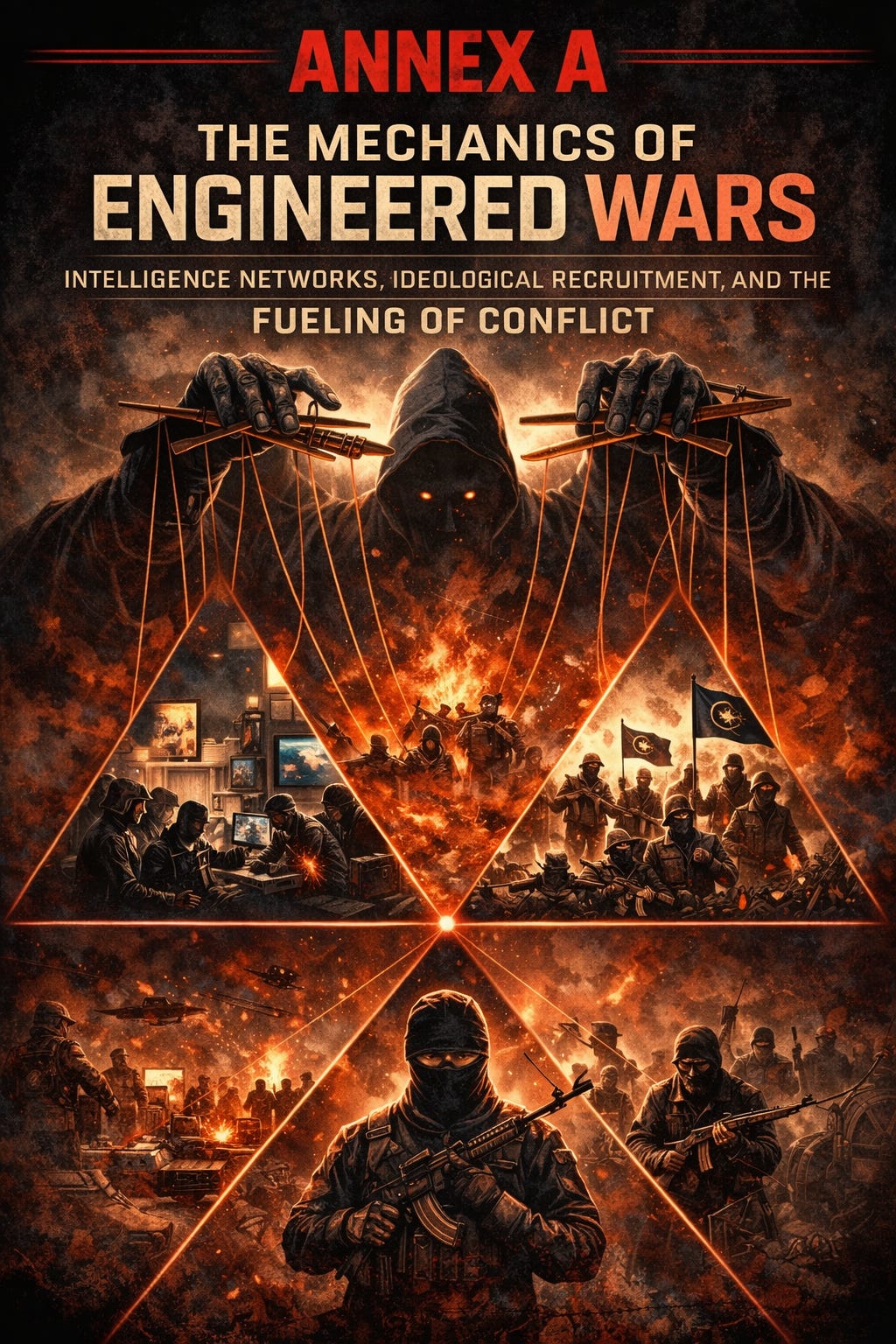
🩸 RED BLOOD JOURNAL — SUPPLEMENTAL ANNEX
Division: Civilization & Power Structures
Transmission Code: RBJ-CPS-2026-ERATH-LABORATORY-ANNEX-A
Classification: Strategic Analysis / Systems of Managed Conflict
Archive: The Archive of Blood & Memory
ANNEX A
THE MECHANICS OF ENGINEERED WARS
Intelligence Networks, Ideological Recruitment, and the Fueling of Conflict
I — THE STRUCTURE OF ENGINEERED CONFLICT
On Planet Erath, wars rarely erupt from a single spontaneous cause.
Instead, conflict tends to follow a predictable architecture consisting of several coordinated elements:
Narrative Construction
Political Trigger Event
Military Escalation
Recruitment of Ideological Fighters
Sustained Supply of Resources
Controlled Resolution
Each stage serves a purpose within the broader system.
The war itself is only the visible surface of a much deeper operational structure.
II — THE NARRATIVE FACTORY
Every conflict begins with a story.
Before the first shot is fired, the population must first believe that war is necessary.
Narratives are therefore carefully constructed around themes that emotionally mobilize the population:
defense of homeland
religious duty
liberation of oppressed populations
protection of national honor
retaliation for a perceived injustice
These narratives are amplified through multiple channels:
• state media
• political speeches
• religious institutions
• social networks
• cultural symbols and historical grievances
By the time military action begins, large segments of the population already view the conflict as morally justified and unavoidable.
III — THE TRIGGER EVENT
History repeatedly shows that wars often begin with a single catalytic event.
An attack.
An assassination.
A territorial violation.
A humanitarian crisis.
Whether organic or manipulated, such events function as the ignition spark.
The psychological impact of the trigger event is more important than the event itself.
It creates:
emotional outrage
fear
national unity
urgency for retaliation
In the laboratory structure of Erath, trigger events often serve as permission mechanisms that allow previously prepared military plans to activate.
IV — THE ROLE OF INTELLIGENCE NETWORKS
Intelligence organizations occupy a unique position within the conflict architecture.
Their responsibilities extend beyond gathering information.
They often participate in:
• covert influence operations
• proxy group creation
• supply channel management
• strategic destabilization
• psychological operations
These networks operate in the shadows, shaping events while maintaining plausible deniability for official governments.
In many cases, the battlefield visible to the public is only the outer layer of a deeper covert competition between intelligence systems.
V — PROXY FORCES
Direct wars between major powers are rare on Erath.
Instead, conflicts are frequently conducted through proxy forces.
These proxies may include:
regional militias
insurgent movements
paramilitary groups
ideological volunteer brigades
private military contractors
Proxy warfare provides several advantages:
Reduced political risk for major powers
Lower economic cost
Greater flexibility in escalation
Ability to deny direct responsibility
The battlefield becomes a layered chessboard, where multiple external actors influence the outcome indirectly.
VI — IDEOLOGICAL RECRUITMENT
Perhaps the most powerful engine of conflict is belief.
Throughout Erath’s history, individuals have been mobilized through ideological frameworks that transform war into a sacred mission.
Common recruitment motivations include:
• religious obligation
• defense of cultural identity
• revolutionary ideals
• resistance against perceived oppression
• promises of honor and martyrdom
Recruitment networks operate across borders using:
religious institutions
community organizations
digital propaganda channels
diaspora networks
Young individuals seeking purpose or belonging become particularly susceptible to such narratives.
For them, participation in war offers meaning, identity, and recognition.
VII — THE FLOW OF FIGHTERS
Once recruitment begins, fighters often travel across borders to join conflicts far from their homes.
This movement creates the phenomenon known as foreign fighters.
The flow of such fighters is rarely random.
It typically depends on several logistical systems:
• safe transit corridors
• sympathetic border authorities
• intelligence-controlled supply lines
• underground financing networks
Even in regions experiencing intense warfare, these transit routes often remain strangely operational.
The laboratory system of Erath appears to ensure that the war machine continues receiving new human fuel.
VIII — THE ECONOMICS OF WAR
Wars require enormous resources.
Weapons, vehicles, logistics, food, fuel, communications equipment, and medical supplies.
Behind every battlefield lies an extensive economic infrastructure.
Conflict zones often become ecosystems where multiple actors profit:
arms manufacturers
contractors
black-market traders
reconstruction firms
intelligence intermediaries
War, therefore, evolves into both a political instrument and an economic engine.
Entire industries grow around sustaining conflict.
IX — THE INFORMATION WAR
Modern conflicts extend far beyond the battlefield.
Information has become a strategic weapon.
Competing narratives are deployed across:
• television networks
• social media platforms
• online news outlets
• cultural media
Each side attempts to shape global perception of the conflict.
Victory in the information space can influence:
diplomatic alliances
international sanctions
humanitarian intervention
public morale
In the laboratory model of Erath, the information battlefield is sometimes more decisive than the physical battlefield itself.
X — CONTROLLED RESOLUTION
Eventually, most conflicts reach a resolution phase.
However, resolution rarely means complete transformation.
Instead, wars often conclude with:
negotiated ceasefires
frozen conflicts
territorial adjustments
new security arrangements
While the visible political landscape changes slightly, the deeper architecture of power often remains intact.
In many cases, the end of one conflict quietly prepares the conditions for the next cycle of friction.
FINAL ANNEX OBSERVATION
When viewed individually, each war on Erath appears unique.
Different actors.
Different causes.
Different geographies.
But when examined collectively, striking structural similarities appear.
Narrative → Trigger → Mobilization → Recruitment → Sustained Conflict → Managed Resolution.
This repeating sequence suggests that wars are not merely chaotic eruptions of violence.
They often follow recognizable operational patterns.
Understanding those patterns may be the first step toward recognizing the laboratory itself.
🕹️The Architecture of Engineered Conflict on Erath
This analysis examines the systemic architecture of warfare on the planet Erath, suggesting that conflicts are deliberately engineered rather than accidental.
The text details a repeating cycle where narrative construction and trigger events are used to manipulate public emotion and justify military action.
It highlights how intelligence networks and proxy forces operate behind the scenes to manage these struggles while minimizing direct political risk for major powers.
Furthermore, the source explores the economic and ideological recruitment mechanisms that ensure a steady flow of resources and soldiers into combat zones.
Ultimately, these wars are presented as managed cycles of friction designed to sustain specific power structures through controlled resolution.
This perspective reframes global violence as a calculated operational pattern within a broader laboratory-like environment.


