


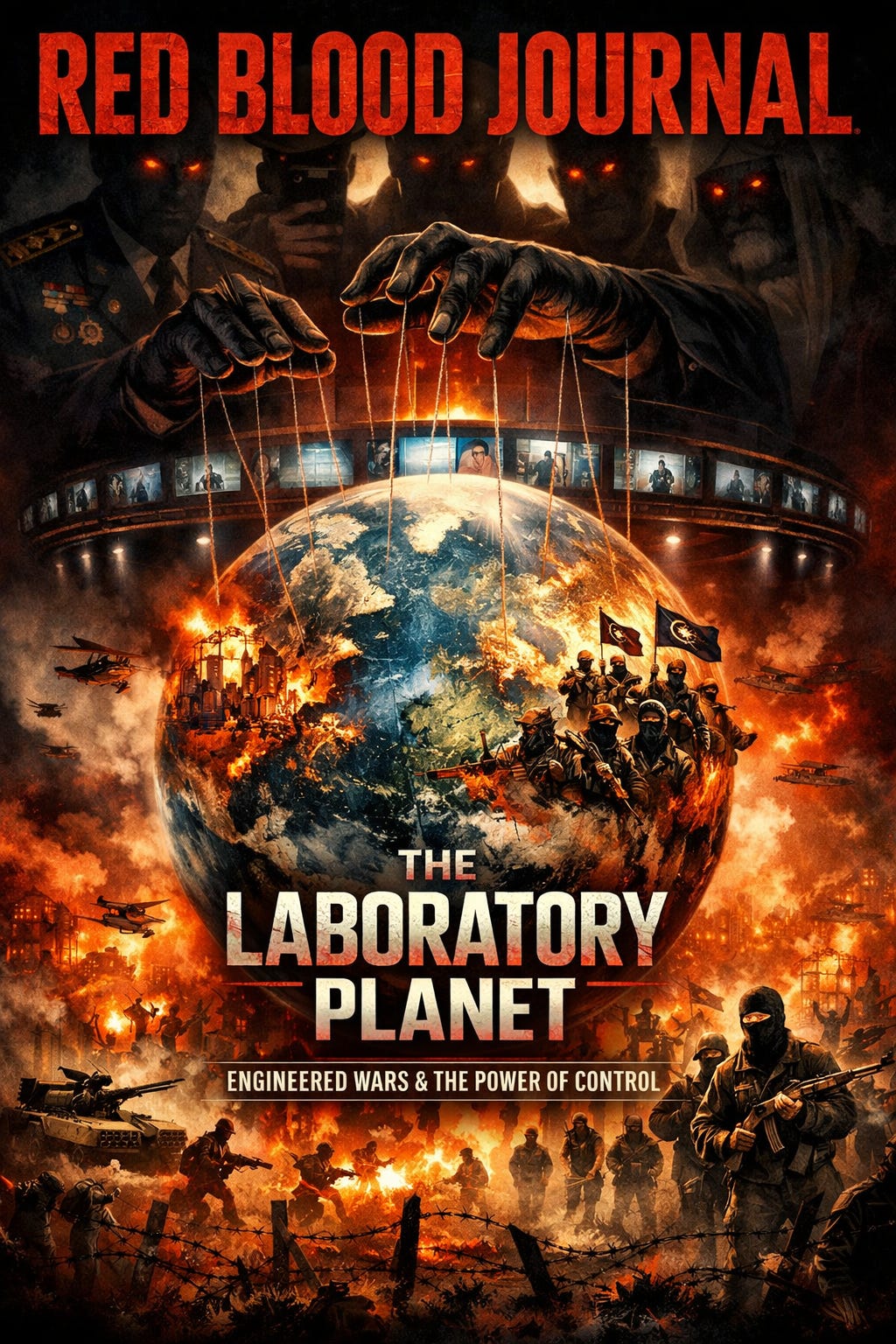
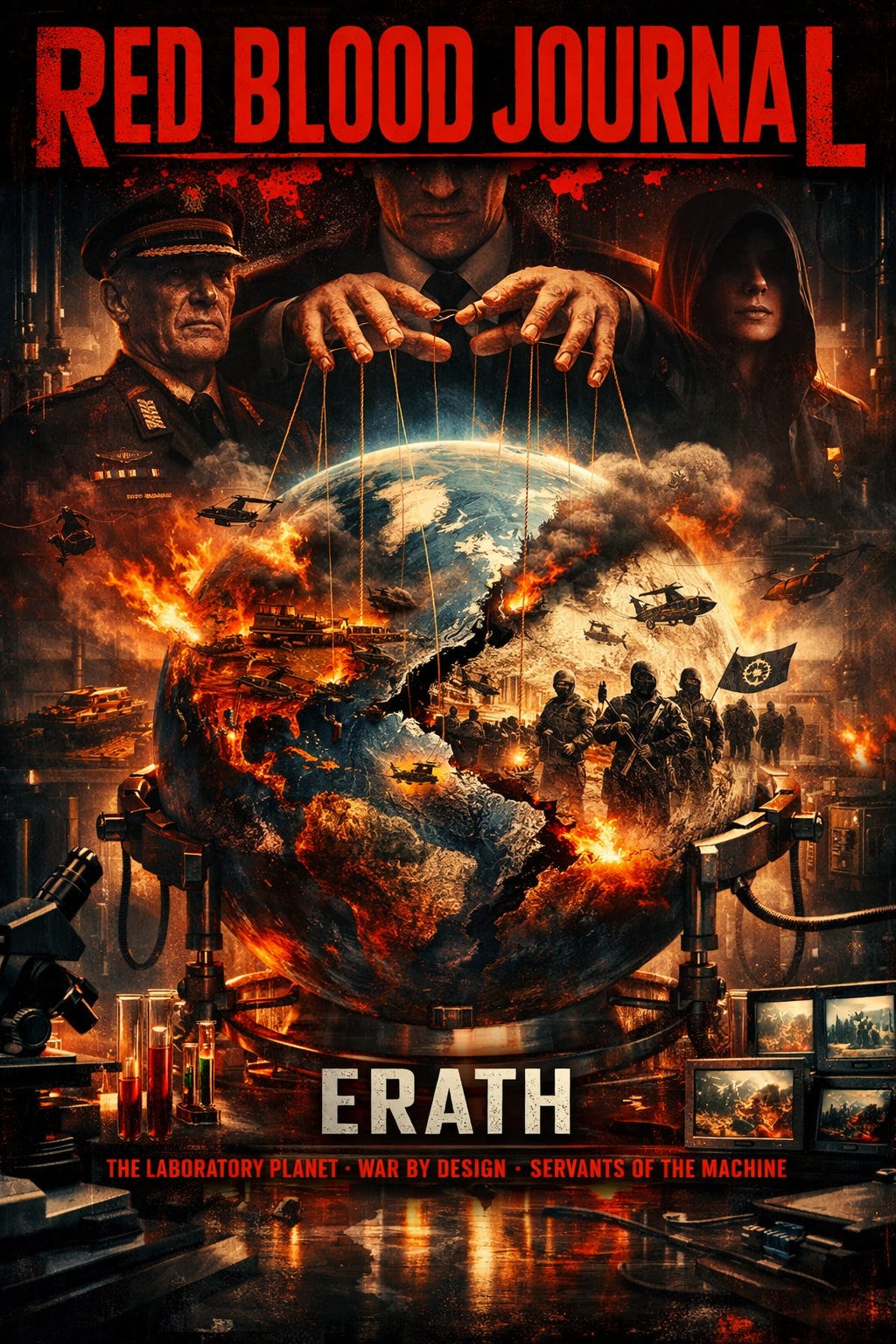
🩸 RED BLOOD JOURNAL TRANSMISSION
Division: Civilization & Power Structures
Transmission Code: RBJ-CPS-2026-ERATH-LABORATORY-PROTOCOL
Classification: Strategic Allegory / Planetary Power Analysis
Archive: The Archive of Blood & Memory
THE LABORATORY PLANET
Erath and the Architecture of Managed Conflict
PROLOGUE — THE GREAT EXPERIMENT
Imagine a planet.
Not a chaotic world governed by random events, but a carefully managed laboratory.
A place where the inhabitants believe they are divided by nations, ideologies, religions, and political systems — yet the architecture of power above them remains strangely consistent and untouched.
This planet is called Erath.
Its people are told they are different.
Different flags.
Different languages.
Different enemies.
Different truths.
But beneath the visible stage, the structure of control appears uniform and global.
The inhabitants believe they are participating in history.
The rulers understand they are managing an experiment.
I — THE ILLUSION OF DIFFERENCE
On Erath, the population is carefully divided.
Different governments are created.
Different political systems are installed.
Different ideologies are promoted.
Democracy.
Theocracy.
Communism.
Monarchies.
Military regimes.
To the citizens, these systems appear fundamentally different.
But from a higher vantage point, they behave more like variations of the same administrative structure.
Each system serves a single purpose:
To maintain the illusion that the people of Erath are fundamentally divided.
Because once the population begins to see itself as one species sharing a single planet, the entire structure of control becomes fragile.
Division is therefore not accidental.
It is structural design.
II — THE MANUFACTURED CHALLENGE
The rulers of Erath maintain such tight control over planetary systems that no real threat can emerge outside their awareness.
This creates a dilemma.
Power structures require conflict in order to justify their existence.
Without enemies:
armies lose purpose
intelligence agencies lose funding
political systems lose urgency
populations become calm and reflective
A calm population begins to ask dangerous questions.
Therefore challenges must be created.
Wars appear.
Crises emerge.
Ideological clashes ignite.
To the inhabitants of Erath, these conflicts appear spontaneous.
To the architects of the system, they are instruments of management.
The friction keeps the population distracted, mobilized, and emotionally invested in narratives that reinforce division.
III — THE THEATER OF FRICTION
The most effective form of control is not brute force.
It is controlled chaos.
The rulers of Erath have discovered a powerful formula:
Create friction that appears real.
Allow suffering to occur.
Permit genuine sacrifice.
But ensure that the core structure of power remains untouched.
The result is a repeating pattern across centuries:
A crisis erupts.
Populations mobilize.
Lives are lost.
Political structures adjust slightly.
The underlying power system survives stronger than before.
Each cycle tightens the grip.
Each generation believes it is witnessing historic change.
Yet the deeper architecture remains remarkably stable.
IV — THE SERVANTS WHO KNOW
The most troubling element of the Erath system is not the rulers themselves.
It is the existence of servants who understand the game.
Individuals who glimpse the structure.
People who recognize that many conflicts are engineered.
Yet instead of resisting the machine, they choose to participate in it.
Why?
Because proximity to power offers rewards.
Influence.
Status.
Wealth.
Security.
For some, participation becomes preferable to rebellion.
Thus the system perpetuates itself through a network of knowing collaborators.
Not merely blind followers.
But conscious participants.
V — THE WAR MACHINE PARADOX
One of the clearest examples of the Erath system appears during wartime.
Official narratives describe two opposing sides locked in existential struggle.
Yet strange patterns often emerge.
Borders that should be sealed remain porous.
Fighters cross through neighboring territories.
Weapons appear through mysterious supply channels.
Individuals motivated by ideology or religion travel from distant lands to join conflicts they barely understand.
These missionary fighters believe they are defending faith, honor, or freedom.
But from a strategic perspective, they serve another function.
They fuel the machine.
Conflict requires a constant supply of:
fighters
martyrs
symbols
narratives
Without these elements, the war loses momentum.
The laboratory requires ongoing input.
VI — THE PSYCHOLOGY OF BELIEF
The Erath system works because people need meaning.
Religion.
Patriotism.
Ideology.
These forces are powerful motivators.
When individuals believe they are fighting for sacred causes, they will endure extraordinary hardship.
They will travel across continents.
They will sacrifice their lives.
And often, they will never realize that the conflict itself may have been engineered far above them.
In the laboratory of Erath, belief becomes the most powerful fuel of all.
VII — THE GREAT DILEMMA
The central question facing the inhabitants of Erath is not whether rulers exist.
Power structures have always existed.
The real dilemma is deeper:
What happens when the population begins to suspect the laboratory itself exists?
If enough people recognize the pattern:
division loses power
manufactured enemies lose credibility
wars become harder to sustain
the system faces its first genuine challenge
This is the paradox.
The rulers maintain power through friction.
But excessive friction risks revealing the design.
FINAL OBSERVATION — THE LABORATORY MIRROR
If the inhabitants of Erath were ever able to step outside their narratives, they might notice something unsettling.
Across the entire planet, the same patterns repeat:
conflict → sacrifice → stability → stronger control.
The laboratory continues.
The experiment evolves.
And the citizens, believing themselves uniquely divided, rarely notice that the same script is running everywhere at once.
Until the day someone begins to ask:
Who designed the laboratory?
👁️The Laboratory Planet: Architectures of Managed Conflict
The provided text outlines a strategic allegory centered on a fictional planet called Erath, which functions as a managed laboratory for power.
This narrative suggests that global divisions, ranging from warring ideologies to religious conflicts, are actually deliberately engineered by an elite ruling class to maintain control.
According to this framework, manufactured crises serve to distract the populace and justify the existence of oppressive authority structures.
The system relies on the psychology of belief and a network of conscious collaborators who choose status over resistance.
Ultimately, the text argues that true power is preserved through a cycle of controlled chaos that prevents humanity from recognizing its shared interests.
The overarching theme is that perpetual friction is the primary tool used to ensure the stability of the ruling architecture.


