


🩸 RED BLOOD JOURNAL — SUPPLEMENTAL ANNEX
Division: Civilization & Power Structures
Transmission Code: RBJ-CPS-2026-ERATH-ANNEX-C
Classification: Strategic Sociological Analysis
Archive: The Archive of Blood & Memory
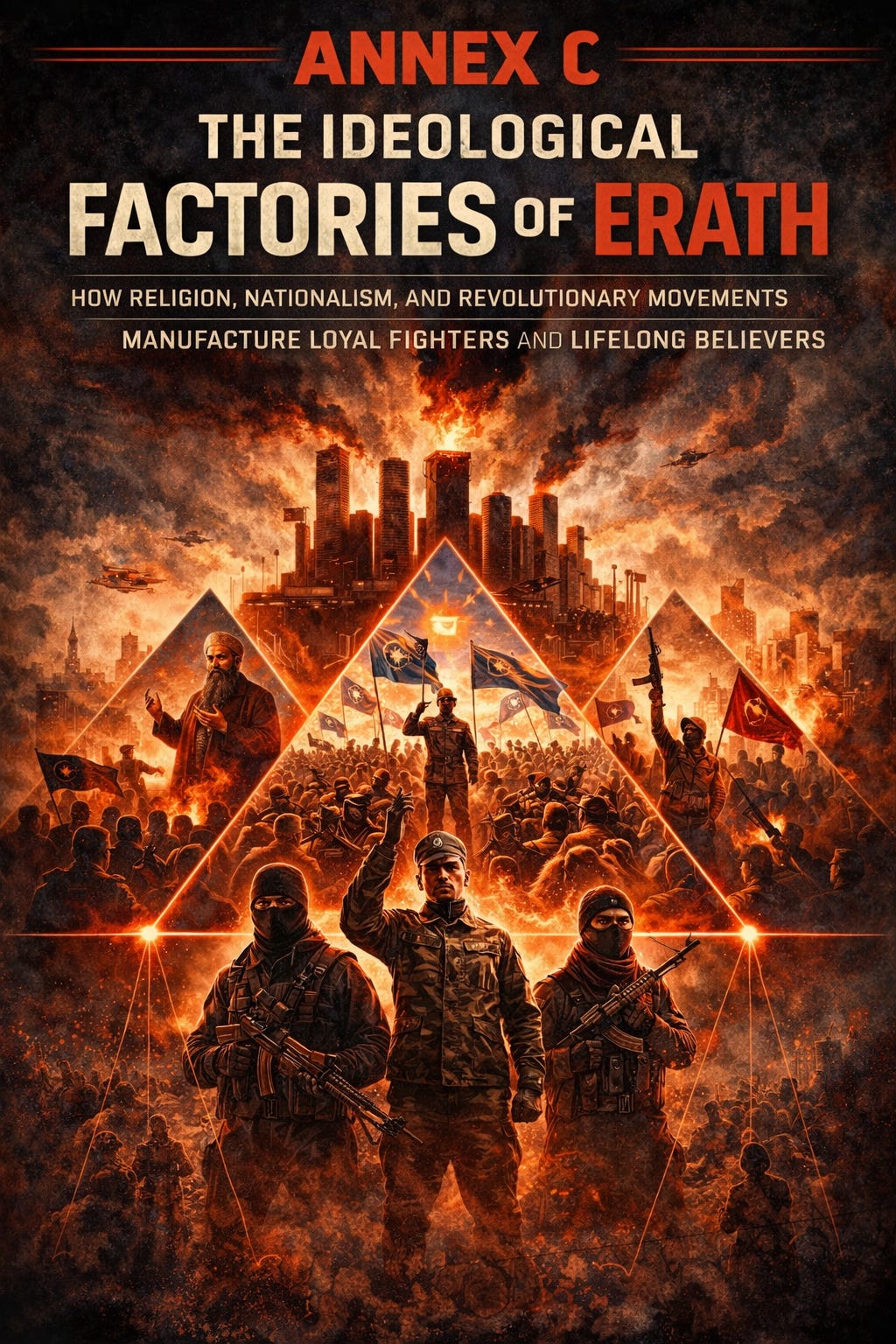
ANNEX C
THE IDEOLOGICAL FACTORIES OF ERATH
How Religion, Nationalism, and Revolutionary Movements Manufacture Loyal Fighters and Lifelong Believers
PROLOGUE — THE MOST POWERFUL WEAPON
Weapons can destroy armies.
Economics can collapse nations.
But the most powerful force on Planet Erath is something far more subtle:
belief.
Belief can convince ordinary individuals to sacrifice their lives.
Belief can transform suffering into duty.
Belief can persuade millions to defend ideas they did not create and systems they do not control.
Because of this, belief itself has become an engineered resource.
Across Erath, institutions exist that function as ideological factories—systems designed to produce loyal followers, devoted fighters, and lifelong believers.
I — THE THREE GREAT ENGINES OF IDEOLOGY
While many belief systems exist on Erath, three ideological engines dominate the recruitment of devoted followers:
Religion
Religion offers something no political ideology can fully replicate:
cosmic meaning.
By framing earthly struggles as part of a divine narrative, religion transforms war into:
sacred duty
spiritual sacrifice
eternal reward
When conflict is presented as holy, fighters believe they are not merely defending territory.
They are defending the will of heaven itself.
Nationalism
Nationalism builds identity around shared culture, history, and geography.
It tells citizens:
Your nation is unique.
Your people are exceptional.
Your enemies threaten your way of life.
Through this lens, war becomes a matter of collective survival.
Citizens are taught that protecting the nation is equivalent to protecting their ancestors, their culture, and their future generations.
Revolutionary Ideology
Revolutionary movements offer another powerful motivator:
the promise of a new world.
Whether socialist, nationalist, or anti-colonial, revolutionary ideology often frames conflict as a struggle between:
oppression
and
liberation.
Followers believe they are fighting not just for themselves, but for the birth of a just society.
II — THE PRODUCTION PIPELINE
The ideological factories of Erath rarely operate openly as recruitment machines.
Instead, they function through a gradual process of identity formation.
This process typically follows several stages.
Stage 1 — Identity Formation
Children and young adults are introduced to foundational narratives.
These narratives define:
who “we” are
who “they” are
what historical grievances exist
what dangers threaten the group
Education systems, religious institutions, and cultural media play crucial roles in shaping these early perceptions.
Stage 2 — Emotional Bonding
Stories of sacrifice, martyrdom, and heroism reinforce emotional attachment to the ideology.
Historical figures become symbols.
Past battles become sacred moments.
Through repetition, individuals internalize the idea that their identity is inseparable from the ideology itself.
Stage 3 — Moral Framing
Once identity is established, conflicts are framed in moral terms.
The world becomes divided between:
good and evil
justice and oppression
faith and unbelief
freedom and tyranny
This framing simplifies complex geopolitical realities into clear moral narratives.
The result is psychological clarity.
Followers know exactly who they are supposed to support—and who they are supposed to oppose.
Stage 4 — Activation
At moments of crisis, ideological networks activate their followers.
Calls to defend the nation.
Calls to defend the faith.
Calls to overthrow injustice.
For individuals already emotionally invested in the ideology, participation in conflict appears not only justified but inevitable.
III — THE RECRUITMENT ECOSYSTEM
The ideological factories of Erath operate through multiple recruitment channels.
These include:
• religious seminaries and clerical networks
• nationalist youth movements
• political organizations
• activist groups
• digital propaganda platforms
• diaspora communities abroad
Each channel reinforces the same narrative structures.
Over time, individuals immersed in these environments become self-reinforcing believers.
They recruit others.
They defend the ideology.
They perpetuate the cycle.
IV — THE MARTYRDOM MECHANISM
One of the most powerful features of ideological systems is the concept of sacred sacrifice.
Martyrs transform death into victory.
Their stories inspire new followers.
Their images become symbols of honor and courage.
This mechanism ensures that even when individuals die in conflict, the ideology itself becomes stronger rather than weaker.
In this way, sacrifice becomes fuel for the factory.
V — THE INFORMATION AMPLIFIER
In earlier centuries, ideological recruitment relied on physical institutions.
Today, digital networks have dramatically expanded the reach of ideological factories.
Through social media platforms, messaging networks, and video propaganda, recruitment messages can travel across the entire planet instantly.
Algorithms amplify emotionally charged content.
Outrage spreads faster than reason.
Narratives become viral.
As a result, ideological movements can now mobilize supporters across continents.
The factories of belief have become global.
VI — THE USEFUL BELIEVER
From the perspective of Erath’s strategic power structures, ideological followers often serve as force multipliers.
They require minimal financial incentive.
They willingly endure hardship.
They remain loyal even when outcomes are uncertain.
Because they believe they are fighting for something larger than themselves.
In this way, ideological conviction converts ordinary individuals into highly motivated instruments of conflict.
VII — THE SELF-SUSTAINING CYCLE
Once ideological factories reach maturity, they often become self-sustaining.
New believers emerge continuously.
Symbols and narratives reproduce themselves across generations.
Even when conflicts end, the underlying ideology remains intact.
Waiting.
Dormant but ready.
Until the next moment of crisis activates the system once again.
FINAL ANNEX OBSERVATION
On Planet Erath, armies may win battles.
Governments may sign treaties.
Borders may change.
But ideological systems possess a unique resilience.
They live inside the minds of millions.
As long as belief remains powerful, the factories of ideology will continue producing followers, fighters, and defenders of narratives that shape the planet’s conflicts.
Understanding these factories may reveal one of the deepest truths about Erath:
Wars are fought with weapons.
But they are manufactured with belief.
👁️The Digital Sky:
Erath’s Global Intelligence Architecture
The provided text describes a clandestine global infrastructure on the planet Erath that exerts control far beyond the reach of visible governments.
This intelligence web is composed of several sophisticated layers, including massive digital surveillance, predictive data analysis, and the manipulation of public narratives to ensure systemic stability.
While nations appear divided to the average citizen, the source suggests that rival intelligence agencies actually maintain secret partnerships and communication channels to manage geopolitical friction.
This architecture is supported by private corporate alliances and a shadow economy that enables untraceable operations across borders.
Ultimately, the documentation characterizes the entire planet as a monitored strategic ecosystem, where a hidden elite balances total information awareness with managed instability.
This framework effectively transforms the world into a fully instrumented laboratory where human events are tracked and influenced by invisible hands.
🧠The Engineered Resource: Manufacturing Belief in Erath
On the planet Erath, belief is an engineered resource meticulously crafted by institutional “ideological factories” to generate devoted soldiers and loyalists.
These systems utilize religion, nationalism, and revolutionary fervor to transform personal identity into a tool for state or movement power.
By framing earthly struggles as moral or divine crusades, these organizations convince individuals to view self-sacrifice and martyrdom as the ultimate duty.
The process functions through a multi-stage pipeline that begins with childhood indoctrination and culminates in the psychological activation of followers during times of crisis.
Modern digital networks and algorithms now amplify these narratives, allowing manufactured convictions to spread globally and instantaneously.
Ultimately, these self-sustaining cycles of ideology ensure that while wars are fought with physical weapons, they are fundamentally powered by the manipulation of human conviction.


