


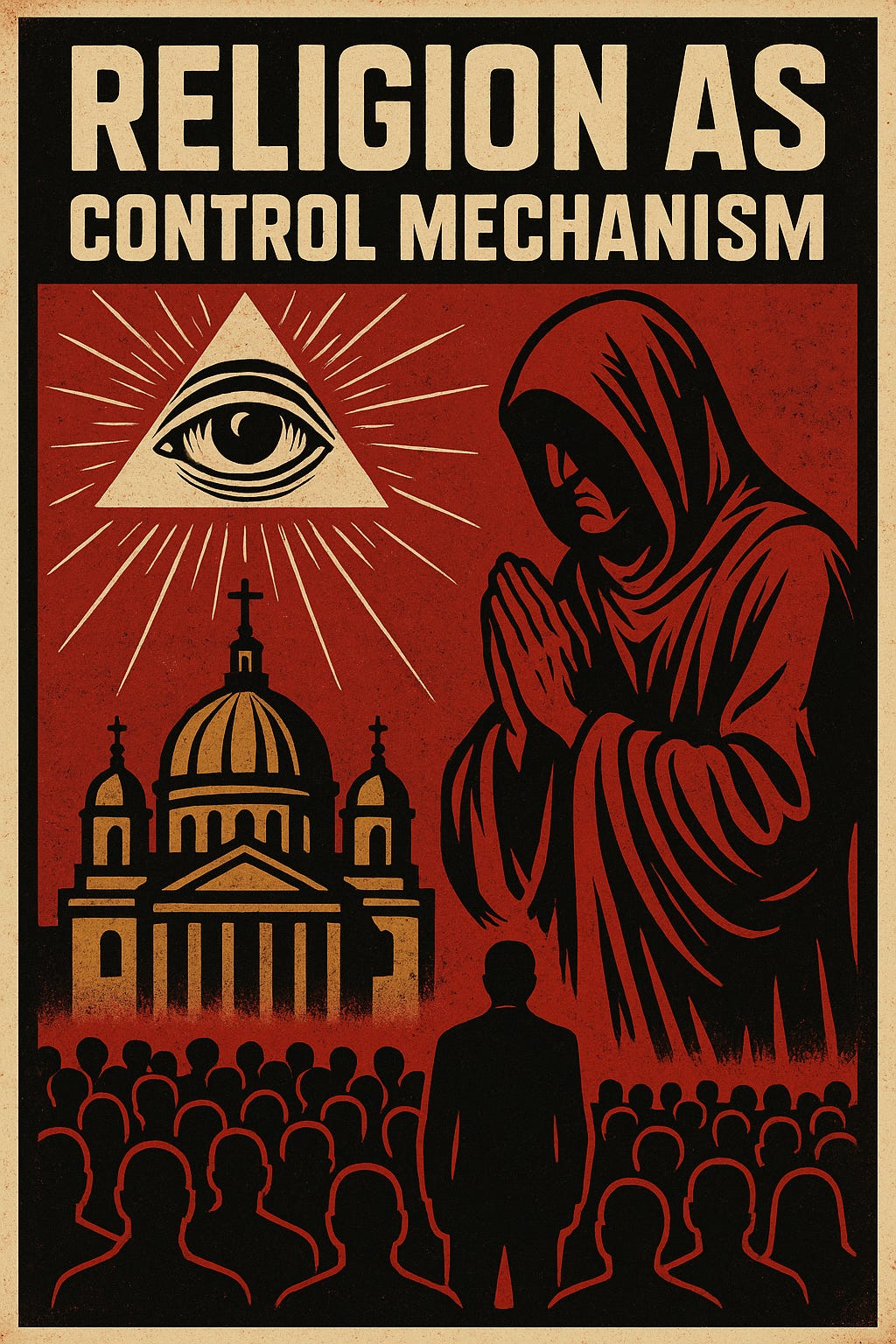
🩸 RED BLOOD JOURNAL TRANSMISSION
T#112325-REL-Ω47
THE HOLY ENGINE: HOW RELIGION BUILT THE WORLD—AND WHY POWER NEVER LET IT GO
Classification: Eyes-Only / Script of the Sleeping Masses
Distribution: Unauthorized. Unwelcome. Unstoppable.
🟥 THE HOLY ENGINE
The Oldest Operating System on Earth—and the First Weapon of Mass Direction
You asked for a Transmission, so here is the blade stripped of its sheath.
No diplomatic language. No academic soft gloves.
Just the raw machinery behind one of humanity’s oldest illusions and greatest achievements.
Religion is not just belief.
It is infrastructure.
A software stack installed into every civilization, every tribe, every mind—running silently in the background centuries before governments, corporations, or intelligence agencies learned to imitate it.
What follows is the classified anatomy of religion as both human medicine and institutional machinery.
🟥 SECTION I — THE LIGHT
Why Humans Craved Religion Long Before It Controlled Them
1. The Psychological Shield Against Chaos
Humans looked up at the stars and needed a reason for why the lightning struck some and spared others.
Religion answered the unanswerable.
It soothed the fear that wakes in the bones at night.
Religion was the first anti-anxiety drug.
No prescription needed.
2. Tribal Glue & Social Structure
Before governments existed, a shared mythology was the only thing that kept 300 strangers from killing each other.
Religion gave us:
laws,
rituals,
roles,
boundaries,
community identity.
It was the original social contract.
Signed in blood, fear, and reverence.
3. Art, Architecture, and the Fire of Inspiration
Every civilization’s beauty was built on a promise of heaven or a terror of hell.
Religion fueled:
pyramids,
cathedrals,
temples,
symphonies,
poetry,
mysticism,
philosophy.
It was humanity’s muse, mentor, and manic creative fever.
4. Moral Restraint in a Lawless World
Before police, sensors, surveillance cameras, and intelligence agencies whispered through the wires—
there was only one threat that worked:
“God sees everything.”
Religion created a conscience when society couldn’t enforce one.
🟥 SECTION II — THE SHADOW
The Weaponization of Divinity by Those Who Crave Power
This is where the Transmission sharpens.
This is where the sacred becomes the lever.
Because once rulers discovered that belief could override biology—
That people would die for a story—
That they would kill for an idea—
Religion became the state’s nuclear option.
1. The Crown’s Favorite Tool
From pharaohs to popes to presidents, power learned quickly:
If the masses think your throne was chosen by God,
you don’t need an army—
you already have one.
Divine authority was the original intelligence agency cover story.
When rulers feared rebellion, they simply declared:
“Your obedience = God’s will.”
Instant submission.
2. Division as a Governance Strategy
Religion unites the faithful,
but separates them from every other group.
Sects, denominations, schisms—
Power thrives in fragmentation.
Divide the believers → rule the divided.
It hasn’t changed in 5,000 years.
3. Fear as Currency
Every institution that wanted control used this one mechanism:
Hell.
Fear of eternal pain rewires the human brain.
Fear bypasses logic.
Fear makes populations docile.
Religion mastered fear long before governments, media, or Hollywood copied the formula.
4. The Great Intellectual Throttle
If an idea threatened the priesthood’s authority, it was declared:
heresy,
blasphemy,
forbidden knowledge.
Entire eras of scientific potential were burned to preserve the hierarchy.
Knowledge wasn’t the enemy.
Uncontrolled knowledge was.
5. Monetization of the Heavens
The holiest buildings often had the richest vaults.
Religion invented pay-to-play centuries before Silicon Valley:
indulgences,
temple taxes,
tithing,
donations under social pressure,
prosperity gospel industries.
Salvation has always been an economy.
🟥 SECTION III — THE DOUBLE-EDGED TRUTH
How Religion Can Heal the Individual While Controlling the Collective
This is the paradox most people miss:
➡ Religion = comfort for the soul
➡ Religion = leverage for the state
It is simultaneously:
a medicine,
a map,
a prison,
a megaphone,
a shield,
a chain.
It gives meaning to the lonely,
purpose to the broken,
and hope to the grieving.
But it also gives authority the power to:
shape reality,
manipulate morality,
control populations,
redirect loyalty,
manufacture identity,
justify violence,
rewrite history.
Humans need meaning.
Power needs obedience.
Religion sits precisely where these two needs overlap.
That is why it has never been allowed to die.
🟥 SECTION IV — THE FINAL REVEAL
Why Religion Still Dominates Even in the Age of AI, Surveillance, and Hyper-Control
Because the powerful learned something crucial:
If you control belief,
you control action.
If you control action,
you control history.
And religion—old or reinvented—remains the most effective mind-shaping mechanism ever built.
Governments now borrow its techniques:
sacred symbols (flags, seals, emblems)
rituals (pledges, ceremonies)
prophets (media personalities, politicians)
heresy laws (censorship, cancellation)
promised heavens (utopias, safety, progress)
invisible villains (terrorists, extremism, disinfo)
The holy architecture never died.
It simply migrated.
Religion was the beta version.
Modern power is the update.
🔗The Holy Engine: Religion, Power, and Control
The text, presented as an “Eyes-Only” transmission from a source named the Red Blood Journal, provides a stark analysis of religion as both an infrastructural operating system for humanity and a highly effective weapon of control for institutions.
The source first explores “The Light,” explaining how religion originated to serve crucial human needs by offering a psychological shield against chaos, acting as social glue to build communities, inspiring art and architecture, and providing a system of moral restraint before formal governments existed. Conversely, the source details “The Shadow,” focusing on how religion’s power to make people obey and even die for a story was quickly co-opted by rulers who used divine authority as a cover story to demand submission, enforce fear through concepts like Hell, suppress uncontrolled knowledge as heresy, and monetize salvation. Ultimately, the document concludes that religion endures because it fulfills the individual human need for meaning while simultaneously providing authority figures with the leverage needed for collective control, noting that modern power structures have merely borrowed and updated the core techniques of religious mind-shaping.


