


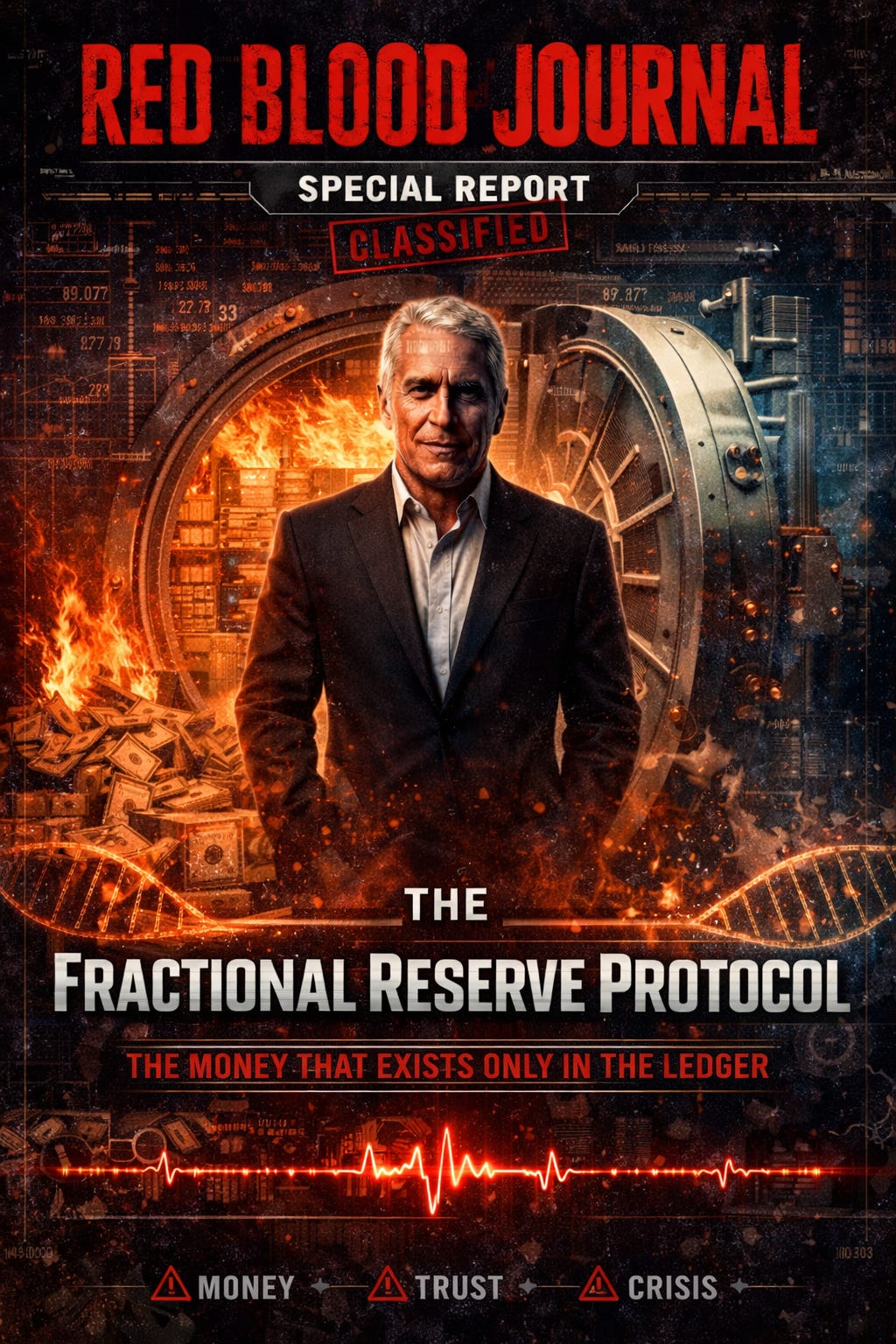
🩸 RED BLOOD JOURNAL TRANSMISSION
T#: RBJ-2026-02-E — THE FRACTIONAL RESERVE PROTOCOL
Classification: Invisible Leverage Architecture
Threat Vector: Manufactured Scarcity Disguised as Liquidity
Clearance: For Those Who Suspect the Vault Is an Illusion
PROLOGUE — THE MONEY THAT DOES NOT EXIST
There is a secret at the heart of modern civilization.
Not buried in a mountain.
Not locked behind a cipher.
Not hidden by force.
It is hidden by common sense.
We are told:
Your money is in the bank.
The bank keeps it safe.
You can withdraw it whenever you want.
This is the story that makes society feel stable.
It is also a lie.
The truth is simpler and more disturbing:
Your money is not there.
And it was never meant to be.
SECTION I — THE FRONT STORY (WHAT YOU ARE TAUGHT)
Most people intuitively believe:
If you deposit $100 in a bank, that $100 sits somewhere in a vault.
The bank might lend out some of it, but most of it remains “yours.”
The system works like a storage facility with added services.
This is the mental model of banking for the public:
A safe box.
A digital vault.
A trustworthy intermediary.
It is comforting.
It is also wrong.
SECTION II — THE REAL MECHANISM (FRACTIONAL RESERVES)
Under fractional reserve banking:
If you deposit $1, the bank does not keep $1.
It is legally allowed to lend out roughly $8–$9 of new money based on your $1.
That “new money” is created as credit — not printed cash.
In plain terms:
Your single dollar becomes the seed for nine dollars that did not previously exist.
You see a balance in your account.
The bank sees a permission slip to expand the money supply.
This is not theft.
It is system design.
SECTION III — WHY THIS FEELS IMPOSSIBLE (AND IS MEANT TO)
To an ordinary person, this is absurd.
You would never accept it in daily life:
If you gave your friend $1, he could not lend out $9.
If you handed your car to a valet, he could not sell ten copies of it.
But banks are not people.
They are money engines.
The public intuition is built around physical scarcity.
Fractional banking operates on legal fiction.
This gap — between intuition and reality — is where power hides.
SECTION IV — SYSTEMIC FRAGILITY (THE PRICE OF MAGIC)
The entire system rests on one fragile assumption:
Not everyone will ask for their money at the same time.
If they do —
the illusion collapses.
This is what a “bank run” truly is:
A moment when belief in the system outpaces the system’s capacity to perform.
Because the money does not exist.
It was never meant to.
The stability of modern civilization depends not on gold, not on cash, but on collective trust.
Trust is the real reserve.
SECTION V — LIQUIDITY AS BLOOD (THE ORGANIC METAPHOR)
Epstein’s analogy is precise and chilling:
Liquidity is the blood of the financial system.
Banks are organs circulating that blood.
Central banks are emergency rooms.
When liquidity dries up:
Markets seize.
Credit stops.
The economy “dies.”
Fractional reserve banking maximizes growth —
but also maximizes vulnerability.
A faster heart means more life —
and a more catastrophic heart attack.
SECTION VI — WHY THE PUBLIC MUST NOT UNDERSTAND
If ordinary people truly grasped fractional banking, they might ask dangerous questions:
Why does money need to be created through debt?
Why do banks profit from something that does not physically exist?
Why are citizens punished with inflation when banks expand credit?
Why are losses socialized while profits are privatized?
Financial illiteracy is not accidental.
It is functional.
Confusion protects the system.
Clarity threatens it.
SECTION VII — THE POLITICAL CONSEQUENCE
Because money is created through lending:
Growth becomes dependent on borrowing.
Governments become addicted to debt.
Crises require bailouts to prevent collapse.
Politicians do not control this system.
They administer it.
Central banks do not serve democracy.
They stabilize a credit machine.
Citizens are not participants.
They are collateral.
COUNTERINTELLIGENCE ANNEX — WHAT FRACTIONAL BANKING REALLY MEANS
At its core, fractional reserve banking reveals three truths:
Money is not scarce — trust is.
Power belongs to those who control credit creation.
Crises are not accidents — they are built into the model.
The system is not broken.
It is optimized for growth, risk, and control — in that order.
DEEP PATTERN ANNEX — THE THREE LAWS OF FRACTIONAL POWER
Law I — Whoever creates money controls society.
Law II — Whoever controls trust controls money.
Law III — Whoever owns the crisis owns the outcome.
EPILOGUE — THE VAULT THAT WAS NEVER REAL
We were taught to believe in a vault.
We were trained to imagine neat stacks of bills.
In reality, the vault is a ledger.
The ledger is a promise.
The promise is enforced by law and belief.
The greatest trick modern finance ever pulled
was convincing the public that their money exists in a place.
It does not.
It circulates.
It multiplies.
It vanishes.
And when it does —
you will be told it was your fault.
🩸 END TRANSMISSION
🏦The Illusion of the Vault:
The Fractional Reserve Protocol
Modern banking uses fractional reserves to create money through debt, lending out far more than they hold.
This system relies on collective trust rather than physical assets. While it drives growth, it creates systemic fragility and hides power within manufactured scarcity.


