


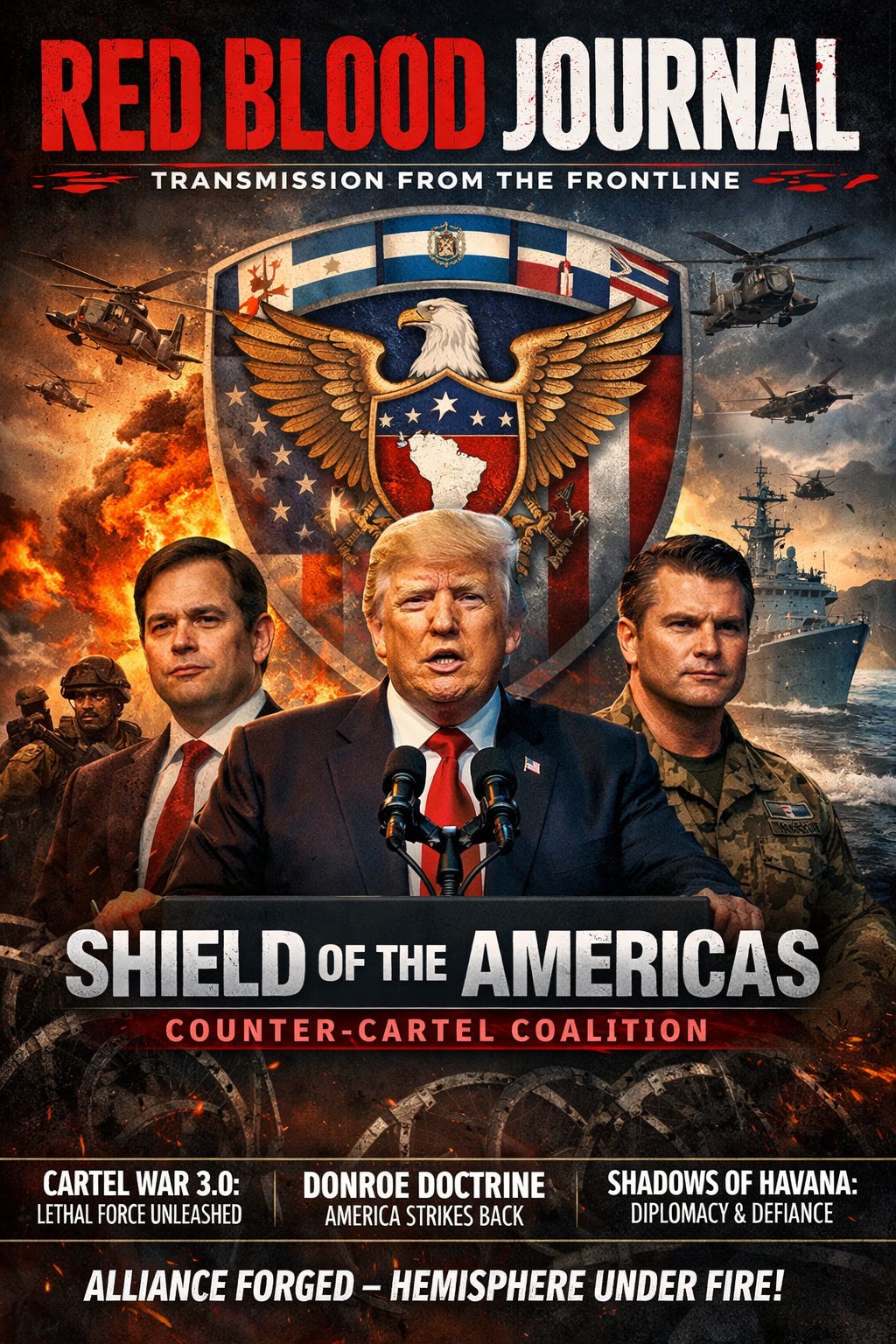
🩸 RED BLOOD JOURNAL TRANSMISSION
Division: Geo-PsyOps & Western Hemisphere Strategic Analysis Unit
Transmission Code: RBJ-GSA-2026-SHIELD-01
Classification: Strategic Interpretation / Read-Between-the-Lines Brief
Archive: The Archive of Blood & Memory
🦅 THE SHIELD OF THE AMERICAS
The Counter-Cartel Coalition and the Quiet Return of the Hemispheric Doctrine
PROLOGUE — THE SUMMIT THAT WAS NOT JUST ABOUT CARTELS
On the surface, the Shield of the Americas Summit was presented as a security gathering.
A coalition of nations.
A war against cartels.
A call for stability in the Western Hemisphere.
The official message was clear:
Cartels are destabilizing nations.
The drug trade fuels violence and migration.
The Western Hemisphere must defend itself.
But strategic transmissions are rarely meant to be read only at face value.
Every summit has two layers:
The speech that is spoken.
And the doctrine that is implied.
The Shield of the Americas Summit belongs to the second category.
I — THE PUBLIC MESSAGE
The summit introduced the Americas Counter-Cartel Coalition, a multinational alliance aimed at dismantling transnational criminal organizations operating across Latin America and the Caribbean.
The proposed strategy included:
• intelligence coordination across governments
• military cooperation against cartel infrastructure
• cross-border operational capabilities
• targeting cartel finances and logistics networks
Officials framed the initiative as a necessary escalation.
The argument is simple:
Cartels now operate like paramilitary networks, not street gangs.
They control territory.
They influence governments.
They command armies.
Therefore the response must evolve from policing to warfare.
II — THE “DONROE DOCTRINE”
During the summit a phrase quietly surfaced.
The Donroe Doctrine.
It was described as a modernized security doctrine for the Western Hemisphere.
Observers immediately noticed the echo.
The name itself carries the shadow of the Monroe Doctrine, first declared in 1823.
The original Monroe Doctrine established a simple principle:
The Western Hemisphere would remain under American strategic protection.
No external power would be allowed to dominate the region.
Two centuries later, the same geographic logic appears again.
But the justification has changed.
Instead of European empires, the threat is now framed as:
• narco-cartels
• organized crime networks
• destabilizing regimes
• external geopolitical influence.
The structure remains familiar.
III — CARTELS AS THE NEW ENEMY CATEGORY
Historically, wars require enemies.
In modern strategic language, the label matters more than the weapon.
When a group is categorized as:
• criminals
• insurgents
• terrorists
the rules of engagement change dramatically.
The summit signaled a shift toward the terror designation model.
Once an organization is defined as a narco-terrorist entity, several things become possible:
• military strikes
• intelligence operations
• international pursuit
• asset seizure and financial warfare
The battlefield becomes borderless.
The language of law enforcement quietly becomes the language of war.
IV — THE HEMISPHERIC SECURITY MODEL
The coalition also revealed a deeper strategic concept.
Instead of responding to crises individually, the region is being reorganized into a security architecture.
Participating nations form a defensive ring.
Shared intelligence flows between governments.
Military cooperation becomes normalized.
From a geopolitical perspective, this creates something larger than a cartel task force.
It creates a hemispheric security system.
Such systems have appeared before in history.
They often begin with a specific threat.
Over time they evolve into permanent strategic frameworks.
V — THE ABSENT POWERS
Equally revealing was who did not appear at the summit.
Some of the largest and most influential states in the hemisphere were not part of the initial coalition.
In geopolitics, absence is rarely accidental.
When a new alliance forms, two maps appear simultaneously:
• the map of participants
• the map of those outside the structure.
Those two maps often determine the future balance of power.
VI — THE RESOURCE DIMENSION
Another quiet theme within the summit involved economic partnerships.
The Western Hemisphere contains enormous strategic resources:
• lithium
• oil and gas reserves
• agricultural production
• rare minerals
• fresh water systems.
Security alliances often intersect with economic corridors.
When stability becomes the official objective, resource networks tend to follow.
History repeatedly shows that security architecture and economic architecture develop together.
VII — THE MESSAGE TO EXTERNAL POWERS
Although the summit centered on cartels, the language occasionally referenced broader geopolitical competition.
External influence in the region was mentioned repeatedly.
The implication was subtle but clear.
The Western Hemisphere remains a strategic sphere.
In global power competition, geography still matters.
And the Americas remain one of the most resource-rich regions on the planet.
VIII — THE EVOLUTION OF THE DRUG WAR
The drug war itself has undergone several phases.
Phase One — Criminal Justice Era
Police investigations, arrests, prosecutions.
Phase Two — Militarized Enforcement
Special forces, interdiction, international operations.
Phase Three — Strategic Security Framework
The Shield of the Americas suggests a transition toward the third phase.
Cartels are no longer treated simply as criminal organizations.
They are framed as systemic destabilizers of states.
That shift changes the scale of the response.
IX — READ BETWEEN THE LINES
The summit may be remembered for its speeches.
But the deeper significance lies in the architecture it introduced.
Behind the language of counter-cartel operations sits a larger transformation:
The gradual construction of a continental security doctrine.
History shows that once such frameworks emerge, they rarely remain limited to their original purpose.
They expand.
They evolve.
They become part of the strategic landscape.
CONCLUSION — THE RETURN OF THE HEMISPHERE
The Shield of the Americas Summit did more than announce a campaign against organized crime.
It signaled the possible re-emergence of a familiar idea:
That the Western Hemisphere functions as a single strategic zone.
Cartels provided the justification.
Security provides the structure.
Geography provides the permanence.
And as always in geopolitics, the most important doctrines are rarely announced directly.
They are simply revealed over time through action.
End Transmission
🩸 Red Blood Journal — Archive of Blood & Memory
🛡️The Donroe Doctrine and the Shield of the Americas
The Shield of the Americas Summit marks a pivotal shift in geopolitical strategy, rebranding the fight against organized crime as a formal military doctrine.
Known as the Donroe Doctrine, this initiative mirrors the historical Monroe Doctrine by asserting a unified security architecture over the Western Hemisphere to exclude external influences.
By reclassifying cartels as narco-terrorists, the coalition justifies a transition from standard policing to borderless warfare and intelligence integration.
Beyond security, the framework suggests a deeper intent to protect strategic resources like lithium and oil through permanent regional stabilization.
Ultimately, the sources describe the emergence of a hemispheric power structure that uses the drug war as a catalyst for long-term territorial and economic control.


