


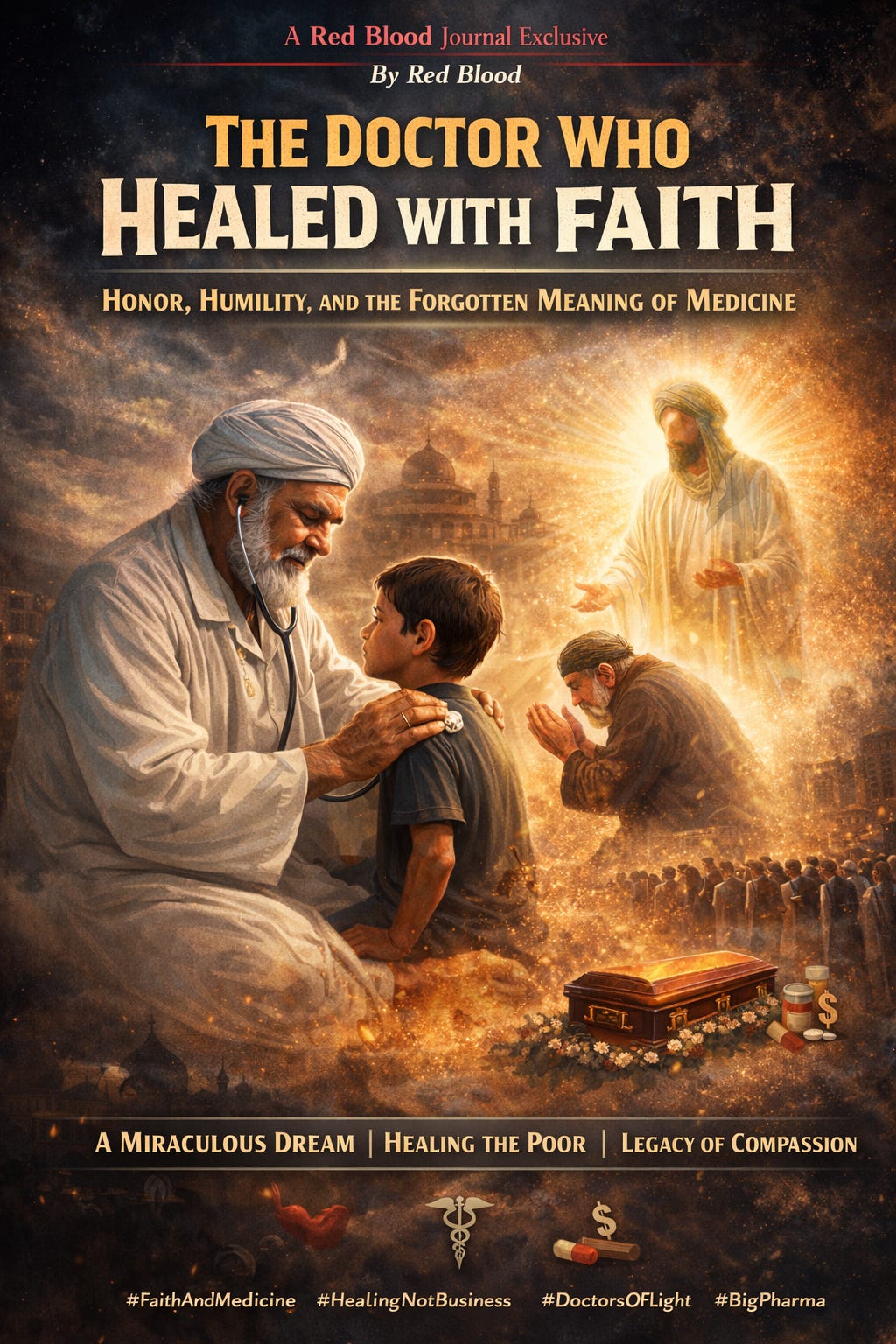
🩸 RED BLOOD JOURNAL TRANSMISSION
Division: Human Spirit & Civilization
Transmission Code: RBJ-HSC-2026-SUFI-PHYSICIAN
Classification: Legacy Archive / Medicine & Faith
Archive: The Archive of Blood & Memory
THE DOCTOR WHO HEALED WITH FAITH
Honor, Humility, and the Forgotten Meaning of Medicine
A Red Blood Journal Exclusive
PROLOGUE
When Healing Was a Calling
There was a time when medicine was not yet an industry.
A time before hospitals became corporate networks and before pharmaceutical giants turned illness into recurring revenue.
In that era, the physician’s oath was not merely spoken — it was lived.
Doctors were not technicians of the body; they were guardians of life.
They treated the sick, comforted the frightened, and often carried the burdens of entire communities upon their shoulders.
Some healed with knowledge.
Some healed with compassion.
A rare few healed with both.
This is the story of one such man.
A physician whose science was guided by faith.
A doctor whose compassion extended beyond the clinic walls.
A healer who measured success not in profit, but in the quiet return of health to another human being.
He was not famous.
He wrote no textbooks.
He did not build a medical empire.
But he healed thousands.
And he was my father.
I
The Law That Sent Doctors to the Forgotten
When my father graduated from medical school, the country enforced a rule that many young physicians resented.
New doctors were forbidden to open a private practice inside major cities for two years.
Instead, they were required to serve in villages where no physician existed.
For many graduates this felt like punishment.
Cities meant opportunity.
Villages meant hardship.
Cities meant reputation.
Villages meant obscurity.
But the rule carried an ancient wisdom:
If medicine is a calling, it must begin with service.
My father did not resist the rule.
He embraced it.
He chose a small rural village outside the city — a place where poverty was common but human dignity was not yet eroded.
The roads were dusty.
The houses were modest.
But the people were sincere.
And that sincerity would shape his life forever.
II
The Meeting With the Village Chief
In villages, the authority of a doctor did not begin with a diploma.
It began with trust.
The first person my father met was the village chief, a respected elder responsible for maintaining order and guiding the community.
The young doctor arrived politely, introducing himself with humility.
He explained that he wished to open a small clinic and serve the people.
The chief studied him carefully.
Young.
Educated.
Respectful.
He nodded slowly.
Then he made an offer that surprised the doctor.
An empty room in his own house could become the clinic.
No rent.
No conditions.
Only one request:
“Take care of my people.”
My father thanked him deeply and promised to return the next day with his equipment.
Everything seemed settled.
But something would change overnight.
III
The Door That Closed
The next morning, when the young doctor returned, the chief was standing in the doorway.
But the warmth was gone.
His face had hardened.
His voice was tense.
Before the doctor could step inside, the chief asked a single question.
“Are you a Sufi?”
My father, raised with honesty as a sacred rule, answered simply.
“Yes.”
The chief’s expression turned cold.
“Then you cannot stay here.”
The words came like a stone.
Somewhere during the night, rumors had reached the chief’s ears.
Someone had told him that Sufis were strange people — heretics who did not truly believe in God.
The irony was profound.
Sufism is among the deepest spiritual traditions within Islam — a path built upon devotion, humility, and love for the Creator.
But ignorance can twist truth faster than knowledge can defend it.
The chief believed the rumor.
And so the door closed.
The young doctor said nothing in anger.
He simply nodded and promised to return later to collect his belongings.
IV
The Dream That Changed Everything
That night, the chief had a dream.
Not an ordinary dream.
A dream that would shake his soul.
He saw himself standing in Mecca, the holiest place in Islam.
There, before him, stood the Prophet Muhammad.
The chief, overwhelmed with emotion, spoke about his suffering.
For years he had endured chronic back pain that no treatment had relieved.
He asked the Prophet for healing.
The Prophet looked at him calmly.
Then he pointed behind the chief and said:
“Did I not already send you someone?”
The chief turned.
Standing there was the young doctor he had rejected.
The chief woke up trembling.
His heart flooded with guilt and clarity.
He realized what he had done.
V
The Door That Opened Again
The next morning, the young doctor returned to retrieve his equipment.
But this time the scene was completely different.
The chief was not blocking the door.
He was running toward him.
Tears streamed down the elder’s face.
He fell to his knees before the young physician.
He kissed his hands.
“My son,” he cried, “forgive me.”
The chief invited him inside.
Tea was prepared.
Sweets were brought.
Then the chief explained the dream.
From that moment forward, the doctor was not merely accepted.
He was welcomed.
VI
The Village That Became a Family
For two years, my father practiced medicine in that village.
Those years became the foundation of his life as a healer.
He treated everyone.
Farmers.
Children.
Elderly widows.
Workers who had never seen a doctor before.
Many could not pay.
He never turned them away.
Sometimes he called the butcher and said:
“Give them meat. I will pay.”
Other times he called the pharmacist:
“Give them the medicine — put it on my account.”
He believed something simple but powerful:
Nutrition and dignity are part of medicine.
Healing is not only chemicals and prescriptions.
Healing is respect.
Healing is kindness.
Healing is seeing the human being behind the illness.
VII
The Doctor Who Could See Illness
As the years passed, something remarkable became widely known.
My father possessed an almost uncanny diagnostic intuition.
Sometimes he could identify illness simply by watching how a patient walked into the room.
A slight tremor in the voice.
A change in skin tone.
A posture that revealed hidden pain.
Other doctors began consulting him for second opinions.
He listened more than he spoke.
He observed more than he tested.
He treated people, not charts.
VIII
The Other Doctor
Ironically, the man who spread the rumors about Sufism eventually opened a clinic across from my father.
But something strange happened.
Patients avoided him.
People sensed the difference between a merchant and a healer.
Within a few years he abandoned medicine entirely.
He began selling used cars.
The village had made its choice.
IX
When the Healer Became the Patient
Even the best physician cannot escape the fragility of human life.
Years later, my father became ill.
The diagnosis was devastating.
Non-Hodgkin’s lymphoma.
A cancer of the lymphatic system.
We believe the cause was something he despised deeply:
A chemical herbicide — Roundup — used in the garden where he lovingly grew roses.
The man who had healed thousands was now fighting his own silent battle.
He faced it the same way he faced everything else:
With faith.
With dignity.
With calm acceptance.
He passed away at 62.
X
The Day the City Stopped
At his funeral something extraordinary happened.
The city slowed.
Shops closed.
Streets emptied.
People came from everywhere.
Farmers from the village.
Patients from decades past.
Children he had delivered into the world.
They came not merely to mourn a doctor.
They came to honor a man who had treated their lives as sacred.
XI
The Doctor Modern Medicine Forgot
Today medicine is faster, more advanced, and more technological than ever.
But something essential has quietly disappeared.
The spirit of the healer.
Modern medical education often teaches molecules before mercy.
Algorithms before empathy.
Revenue models before responsibility.
But my father belonged to an older tradition.
A tradition where medicine was not a career.
It was a covenant.
A covenant between knowledge, compassion, and faith.
Such doctors cannot be manufactured by institutions.
They are shaped by character.
RECEIPTS BOX
The Evidence of a Life
Village Law
New physicians required to serve two years where no doctor existed.
The Dream
Village chief’s vision in Mecca confirming the doctor’s mission.
Service
Free treatment for the poor and direct payment for patients’ food and medicine.
Recognition
Generations of villagers remained loyal to him for decades.
Irony
The rival doctor who spread rumors abandoned medicine.
MINI-FAQ
Who was the doctor?
A Sufi physician whose legacy lived not in fame but in compassion.
Why was he rejected initially?
Religious misunderstanding fueled by rumor and prejudice.
Why was he accepted later?
A powerful dream convinced the village chief that the doctor had been sent to help them.
What defined his medical philosophy?
Healing must serve the dignity of the patient — not the profit of the system.
FINAL WORD
Machines can produce medicine.
Universities can produce doctors.
But only character can produce a healer.
My father proved that one honest physician, guided by faith and compassion, can transform an entire community.
And in a world where medicine increasingly resembles an industry, his story stands as a quiet reminder:
Healing begins not in laboratories…
but in the human heart.
🩺The Sufi Physician:
Medicine Guided by Spirit
This narrative recounts the life of a Sufi physician who prioritized spiritual compassion and charitable service over financial gain.
After overcoming initial religious prejudice in a rural village through a miraculous dream experienced by the local leader, the doctor established a legacy of holistic healing.
He focused on the dignity of patients, often providing free care and food to those in need while relying on intuitive diagnostic skills.
The text contrasts his faith-driven practice with the modern medical industry, which it criticizes for favoring corporate profit over genuine mercy.
Ultimately, the story serves as a tribute to a man who viewed medicine as a sacred calling rather than a mere business.
#RedBloodJournal #TheDoctorWhoHealedWithFaith #SufiPhysician #Sufism #Medicine #Healing #Faith #SpiritualHealing #Compassion #Humanity#MedicalEthics #Doctors #Physician #HolisticHealing #ServiceToHumanity #MedicineWithHeart #FaithAndMedicine #Spirituality#HumanSpirit #OceanOfLoveAndPositivity #RedBlood #2026082102


