


🩸 RedBloodJournal.com
🩸 RED BLOOD JOURNAL — TRANSMISSION
Report #: 1641
Classification: Opinion / Philosophy / Psychological Reflection
Distribution: Public Archive
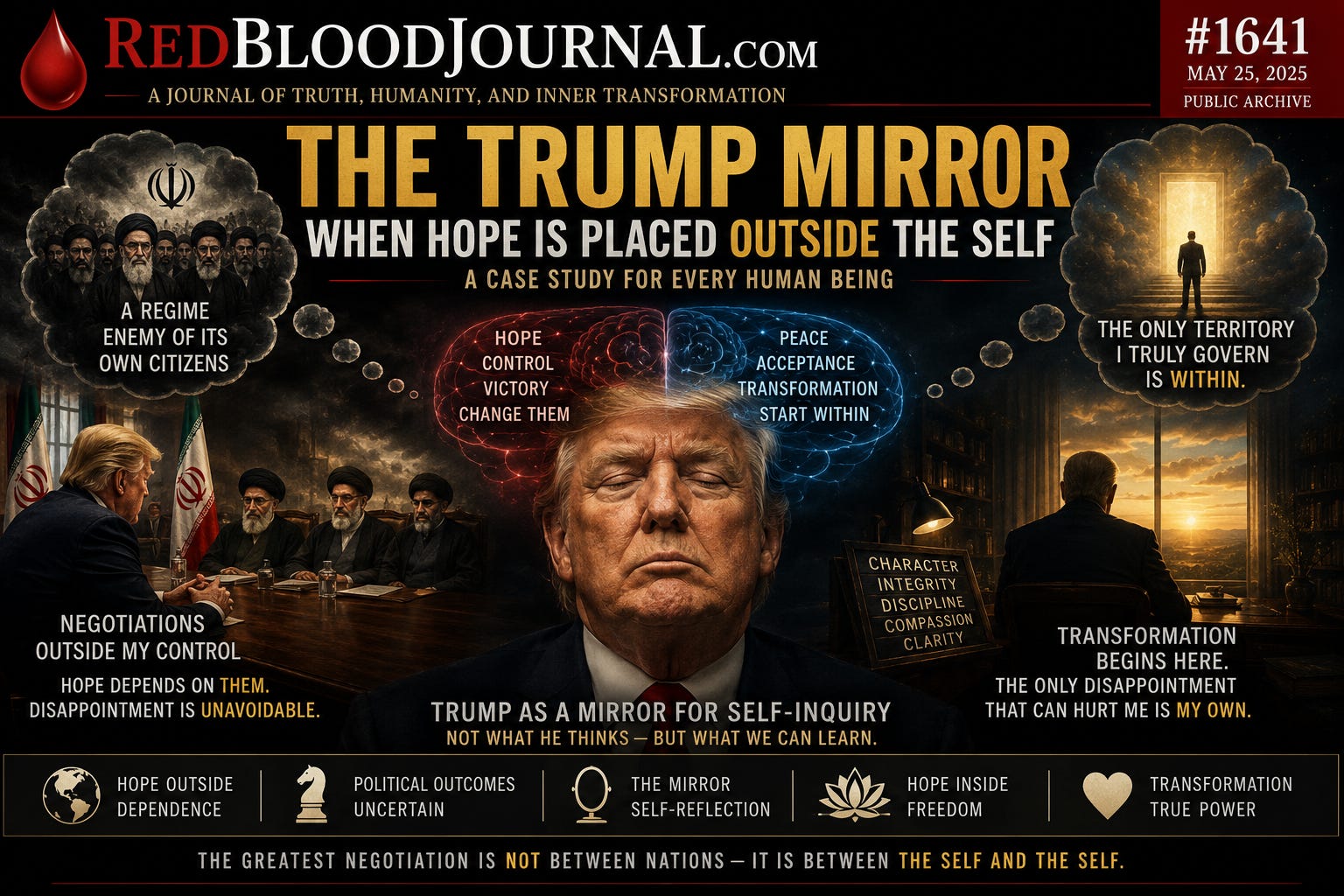
Subject: The Trump Mirror — When Hope Is Placed Outside the Self
PROLOGUE — THE MAN IN THE MIRROR
Every human being becomes a mirror.
Some mirror fear.
Some mirror ambition.
Some mirror power.
Some mirror hope.
Political leaders often become the easiest mirrors to observe because their inner convictions are projected onto the largest stage.
Whether admired or criticized, they offer an opportunity to examine the universal human condition.
This report is not an attempt to know what Donald Trump actually thinks.
Rather, it uses him as a philosophical case study to explore what happens whenever any individual places hope in transforming others instead of transforming the self.
THE CASE STUDY
Imagine an individual whose hope rests upon changing a government that has long been viewed by many as acting against the interests of many of its own citizens.
The objective may appear noble.
The strategy may seem practical.
The intentions may even be sincere.
Yet one psychological question remains.
Where does hope reside?
If hope depends upon another government changing…
Another leader negotiating…
Another system surrendering…
Then emotional peace has already been transferred to forces beyond personal control.
The object of hope has changed.
The mechanism has not.
THE INVISIBLE BURDEN
The greater the expectation, the greater the potential disappointment.
Every negotiation carries uncertainty.
Every promise carries risk.
Every political calculation depends upon countless decisions made by other people.
Even the most influential individual cannot command the hearts and minds of millions.
No president can control another nation’s leadership.
No leader can force trust.
No strategy can eliminate uncertainty.
Hope directed outward must always coexist with the possibility of disappointment.
THE INNER CONVERSATION
Imagine the silent dialogue taking place within such a mind.
“If they change…
If they cooperate…
If they honor their commitments…
If they choose peace…”
Each sentence begins with the same word.
They.
The center of gravity remains outside the self.
This is not unique to presidents.
It is the condition shared by humanity whenever peace depends upon someone else’s decision.
THE TURNING POINT
The inward path begins with a different question.
Not,
“Will they become what I hope?”
But,
“Can I remain grounded regardless of what they choose?”
The first question seeks control over others.
The second restores responsibility to oneself.
One is governed by circumstances.
The other is governed by character.
WHY THIS MATTERS
Donald Trump serves only as a visible example.
The lesson belongs to everyone.
Parents place hope in children.
Employers place hope in employees.
Citizens place hope in governments.
Nations place hope in allies.
Religious people place hope in institutions.
Investors place hope in markets.
The names change.
The psychology remains identical.
Whenever hope is attached exclusively to external outcomes, disappointment remains only one unexpected event away.
THE TRUE NEGOTIATION
The most important negotiation is not between nations.
It is between the individual and the self.
Fear negotiates with courage.
Ego negotiates with humility.
Anger negotiates with compassion.
Expectation negotiates with acceptance.
This negotiation never appears on television.
Yet it determines the quality of every human life.
CONCLUSION
History will judge whether political agreements succeed or fail.
Time will determine whether strategies were wise or misguided.
But beneath every political event lies a timeless question.
Where has humanity placed its hope?
If hope is placed entirely in governments, leaders, or movements, peace will always remain conditional.
If hope is rooted in the disciplined transformation of one’s own character, the individual discovers a freedom that no negotiation can grant and no disappointment can take away.
🩸 Final Observation
Perhaps the greatest political lesson is not found in the outcome of negotiations.
It is found in recognizing that every public leader—whether celebrated or condemned—can become a mirror reflecting a question back to us.
Where have I placed my hope?
If the answer lies outside ourselves, disappointment will always remain possible.
If the answer begins within, then no external event can take away the foundation upon which lasting peace is built.
🪞 The Trump Mirror: Sovereignty of the Inner Self
Jul 9, 2026
The provided text uses Donald Trump as a philosophical case study to examine the psychological consequences of placing hope in external figures rather than the self. It suggests that when an individual’s peace of mind depends on the actions of governments or leaders, they surrender their emotional stability to forces beyond their control. This dynamic creates a cycle of potential disappointment, as political strategies and global negotiations are inherently unpredictable. By focusing on the word “they” as the source of change, people neglect the internal growth necessary for true resilience. The author argues that lasting peace is only achieved by shifting one’s center of gravity from outward expectations to inward character. Ultimately, the text serves as a reminder that personal freedom is found through self-transformation rather than relying on the outcomes of external movements.


