


🩸 RedBloodJournal.com
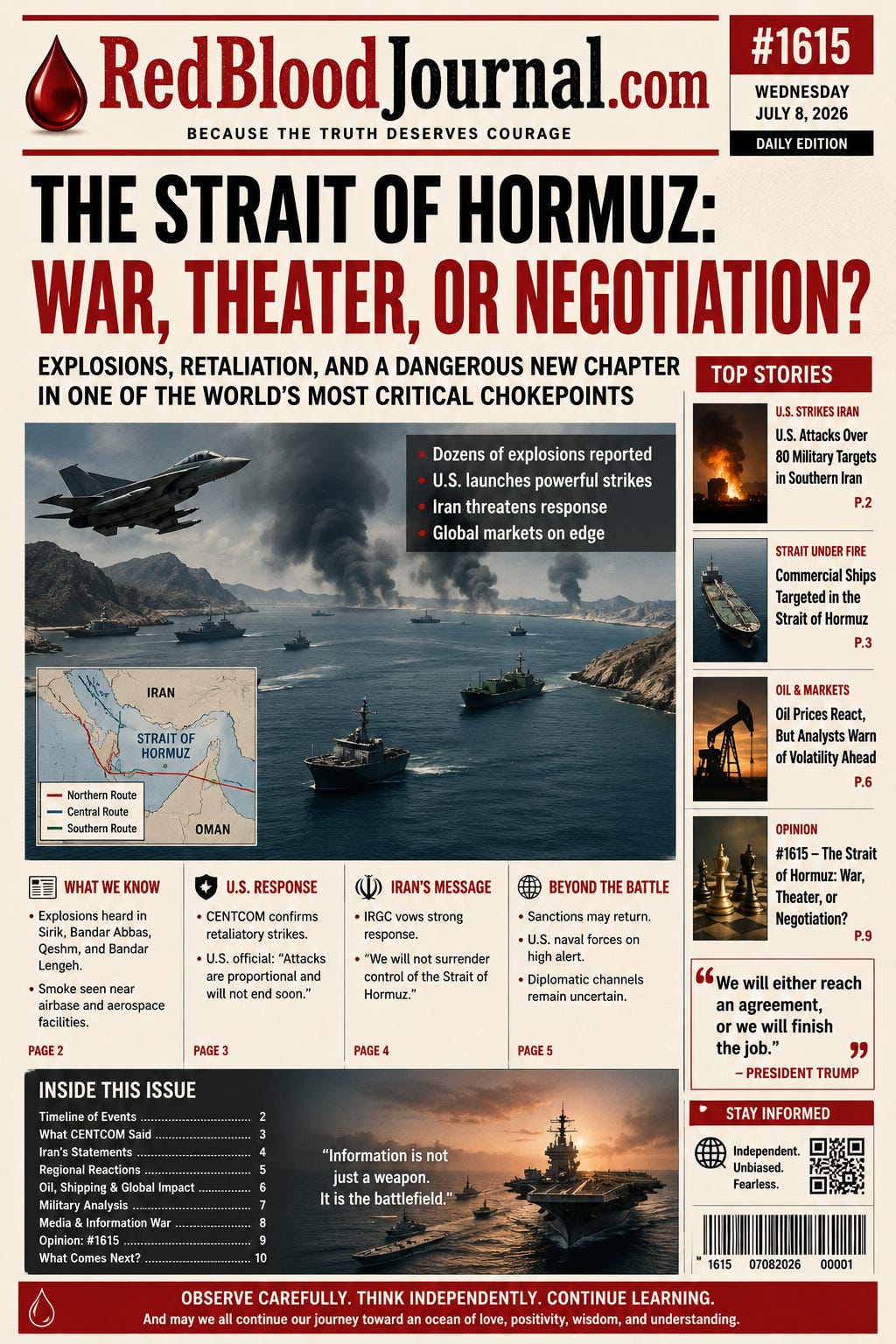
#1615 – The Strait of Hormuz: War, Theater, or Negotiation?
An Opinion
By Red Blood
July 8, 2026
Introduction
History often presents itself as a sequence of sudden crises.
A missile is launched.
A ship is attacked.
A military responds.
Markets react.
Television anchors speak with certainty.
Within hours, millions of people believe they understand what is happening.
But history has a habit of revealing that what appeared obvious in the moment was only one layer of a much larger story.
This report does not claim to know the hidden decisions made behind closed doors. Instead, it asks whether recent events surrounding the Strait of Hormuz might be viewed through another lens—one that considers military actions, diplomacy, economics, and public messaging as parts of the same strategic contest.
A Waterway Larger Than Geography
The Strait of Hormuz is one of the world’s most important maritime passages.
A significant share of global energy shipments passes through it.
For that reason, any disruption affects far more than the countries directly involved.
Oil prices respond.
Insurance costs increase.
Shipping routes change.
Governments issue warnings.
Financial markets immediately begin calculating risk.
The strait is therefore more than a narrow channel of water.
It is a strategic pressure point.
Every Side Speaks to Multiple Audiences
Military operations are rarely aimed only at an opposing force.
They also communicate messages.
A strike may be intended to reassure allies.
A naval deployment may signal resolve.
A public statement may influence financial markets as much as military planning.
Likewise, political leaders speak simultaneously to:
Domestic supporters.
International partners.
Military commanders.
Financial institutions.
Their adversaries.
Understanding these overlapping audiences can sometimes explain actions that otherwise appear contradictory.
Escalation Without Total War
One observation repeated throughout modern history is that nations sometimes escalate while simultaneously trying to avoid uncontrolled conflict.
Economic sanctions may increase while diplomatic channels remain open.
Military strikes may occur while negotiations continue.
Harsh rhetoric may coexist with private communication.
This creates an unusual picture.
To observers it appears inconsistent.
To strategists it may simply be another form of negotiation.
The Battle Beyond the Battlefield
Wars are no longer fought only with soldiers.
They also involve:
Financial pressure.
Shipping routes.
Energy markets.
Cyber operations.
Information campaigns.
Public opinion.
Economic confidence.
A tanker changing course can influence markets.
A satellite image can influence headlines.
A speech can influence investors.
The modern battlefield extends far beyond the traditional front line.
The Role of Public Narratives
Every government naturally presents events from its own perspective.
Media organizations do the same.
Independent analysts often reach different conclusions.
Citizens are therefore surrounded by competing narratives rather than complete certainty.
This does not necessarily mean that one side tells only truth while another tells only falsehood.
It means that information itself becomes part of strategic competition.
For thoughtful observers, distinguishing confirmed facts from interpretation remains one of the most valuable disciplines.
The Observer’s Challenge
When dramatic events unfold, it is easy to react immediately.
Fear encourages quick conclusions.
Excitement rewards certainty.
But careful observation often requires patience.
The first version of history is rarely its final version.
Documents become public years later.
Participants publish memoirs.
Governments declassify records.
Historians assemble pieces that were unavailable during the crisis itself.
Today’s certainty sometimes becomes tomorrow’s revision.
Looking Inward
Whether one believes current events represent genuine escalation, calculated deterrence, political theater, or a combination of all three, there is one lesson available to everyone.
Do not surrender independent observation.
Remain willing to question assumptions.
Separate confirmed events from personal conclusions.
Accept uncertainty where certainty has not yet been earned.
The strongest observer is not the one who reaches conclusions the fastest.
It is the one who remains willing to update those conclusions as better evidence appears.
Conclusion
Perhaps the greatest danger during periods of international tension is not disagreement.
It is the illusion that complex events can always be explained by a single headline.
The Strait of Hormuz reminds us that geography, economics, diplomacy, military strategy, and public perception are deeply connected.
Whether history ultimately records these events as successful deterrence, failed diplomacy, political theater, or something entirely different will depend on information that may not become available for years.
Until then, thoughtful observation may be wiser than absolute certainty.
Opinion Disclaimer
This article expresses the author’s opinions and interpretations of publicly discussed geopolitical events. It is intended to encourage critical thinking and independent observation rather than assert undisputed facts or predict future events with certainty.
🩸 RedBloodJournal.com
Observe carefully. Think independently. Continue learning.
🌊 And may we all continue our journey toward an ocean of love, positivity, wisdom, and understanding.
👁️ The Hormuz Strategy: War as a Multi-Layered Narrative
Jul 8, 2026
This article examines the Strait of Hormuz as a critical geopolitical pressure point where military actions serve as a complex form of strategic communication. The author argues that modern conflict involves a multi-layered narrative encompassing global energy markets, financial stability, and public perception rather than just physical combat. Various actors use calculated escalation to influence diverse audiences, including domestic supporters and international adversaries, while often attempting to avoid total war. Because information warfare and economic pressure are central to these disputes, the text cautions against accepting simplistic headlines or immediate conclusions. Ultimately, the source encourages independent observation and intellectual patience, suggesting that the true nature of these events may only be understood years later. Decisions made in this maritime corridor reflect a sophisticated blend of diplomacy, theater, and negotiation.


