


🩸 RedBloodJournal.com
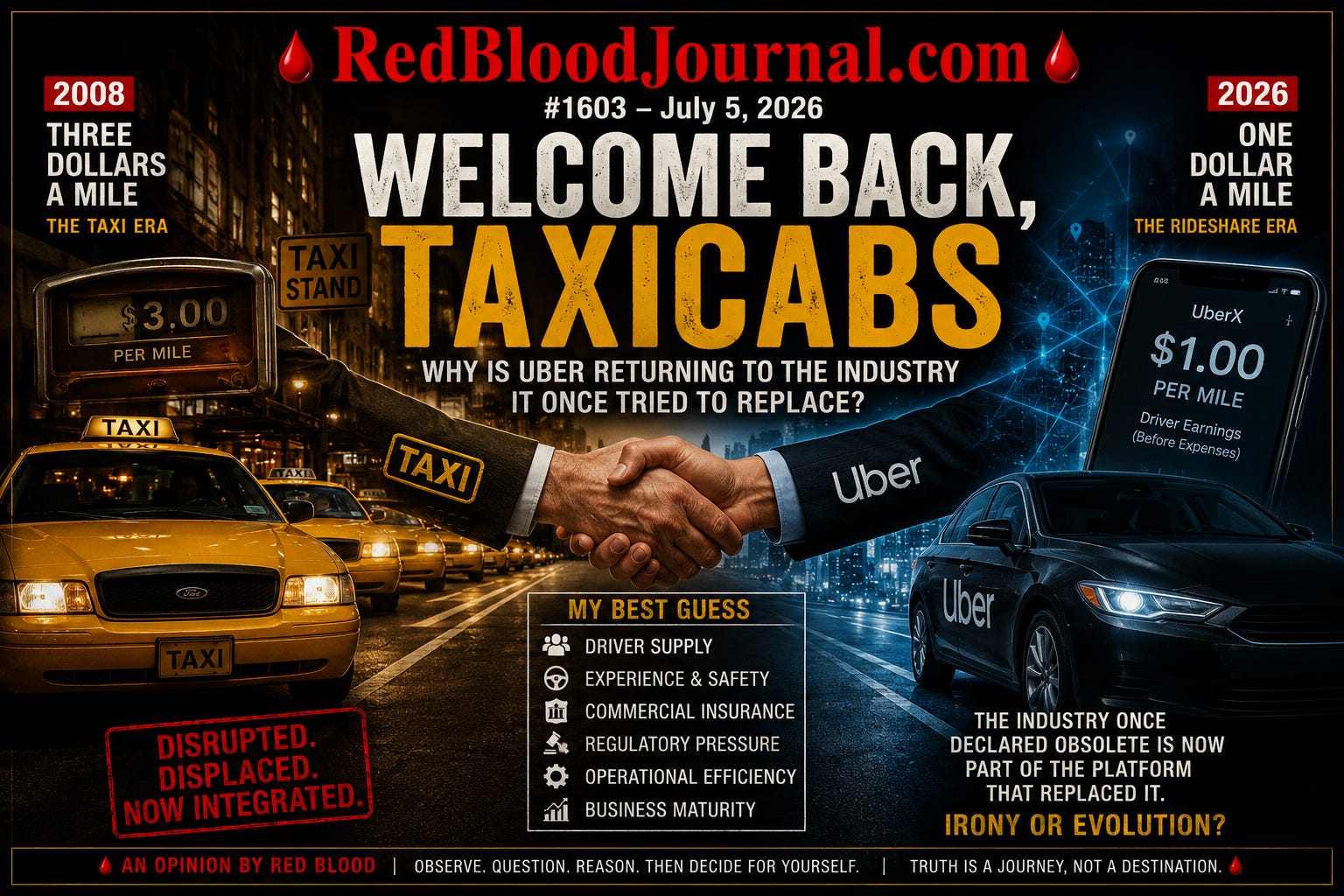
#1603 – Welcome Back, Taxicabs
Why Is Uber Returning to the Industry It Once Tried to Replace?
An Opinion
By Red Blood
July 5, 2026
Introduction
I do not claim to know the absolute truth.
I do not have access to Uber’s board meetings, executive discussions, financial models, or internal strategy documents.
Like everyone else outside the company, I can only observe what is publicly visible and attempt to reason toward the explanation that best fits those observations.
This article is not presented as fact.
It is my attempt to make the closest approximation to reality that the available evidence allows.
If better evidence appears tomorrow, I will gladly change my opinion.
The Transportation Revolution
Before Uber entered the market in 2009, taxicabs dominated urban transportation.
In many American cities, taxi fares averaged roughly three dollars per mile, although rates varied by local regulation.
Taxi companies carried enormous operating expenses:
Commercial insurance
Licensed professional drivers
Vehicle inspections
Government permits
Fleet maintenance
Dispatch operations
Then Uber arrived.
Passengers loved it.
Lower prices.
Shorter wait times.
Free ride promotions.
Cashless payments.
Within only a few years, thousands of taxi drivers found themselves unable to compete with a company willing to aggressively discount rides while expanding at extraordinary speed.
Many taxi companies disappeared.
Others barely survived.
The Driver Today
Ironically, today’s Uber driver often earns around one dollar per mile—or even less—before deducting expenses such as fuel, maintenance, tires, depreciation, insurance, and taxes.
Meanwhile, passengers frequently pay significantly more than the driver ultimately receives.
Many drivers have begun asking a simple question:
Who is really making the money?
Something Changed
For years Uber and taxicabs were portrayed as enemies.
Now something unexpected is happening.
Uber is increasingly partnering with taxi companies in many cities.
The obvious question becomes:
Why?
My Best Guess
Since Uber is a private company, the public is unlikely to ever see the internal discussions behind this decision.
That leaves us with only observation and reasoning.
Perhaps there are several reasons.
Taxi drivers are experienced professionals.
They already understand city streets.
They already operate commercially.
Taxi companies already maintain commercial insurance.
Taxi fleets already satisfy many regulatory requirements.
Instead of recruiting and training thousands of new drivers, Uber can instantly increase available vehicles simply by adding existing taxi fleets to its platform.
That alone may make sound business sense.
Another possibility is risk.
Every inexperienced driver placed on the road increases the possibility of accidents, injuries, lawsuits, and insurance costs.
Taxi drivers spend years learning the profession.
Many drive full time rather than occasionally.
Whether this difference influenced Uber’s decision is something only Uber truly knows.
Coming Full Circle
History has a habit of repeating itself.
The company that disrupted the taxi industry now appears to be welcoming that same industry back into its own platform.
Perhaps Uber has discovered that replacing an industry is different from sustaining one.
Perhaps experienced professionals still provide value that technology alone cannot replace.
Or perhaps the transportation business has simply matured beyond the “grow at any cost” philosophy that defined its early years.
Only those inside Uber know the real answer.
The rest of us can only observe the outcome.
Final Thoughts
One lesson stands out regardless of the explanation.
Competition changes industries.
Innovation changes industries.
But eventually every business must confront reality.
If the industry that was once considered obsolete is now becoming part of the future, perhaps it was never as obsolete as many believed.
As with everything I write, I offer this not as certainty, but as an invitation to think.
Observe.
Question.
Reason.
Then decide for yourself which explanation comes closest to reality.
🩸 Red Blood Journal
“I do not claim to know the truth. I simply try to move one step closer to it by observing what is visible, questioning what is hidden, and remaining willing to change my conclusions whenever better evidence appears.”
🚕 The Full Circle:
Uber’s Return to the Taxicab
Jul 5, 2026
The provided text explores the cyclical evolution of the ride-sharing industry, specifically focusing on Uber’s recent strategic shift toward partnering with traditional taxicabs. While Uber initially gained dominance by undercutting taxi prices and disrupting established regulatory models, the author suggests that the company is now integrating its former rivals to bolster its fleet. This transition may be driven by the need for experienced professional drivers, existing commercial insurance frameworks, and a more stable regulatory foundation that traditional taxis already possess. Ultimately, the source argues that the transportation market is moving away from aggressive growth toward a more mature model that acknowledges the enduring value of the taxi industry. This “full circle” moment indicates that the very services once considered obsolete are now becoming essential to the future of modern transit platforms.


