


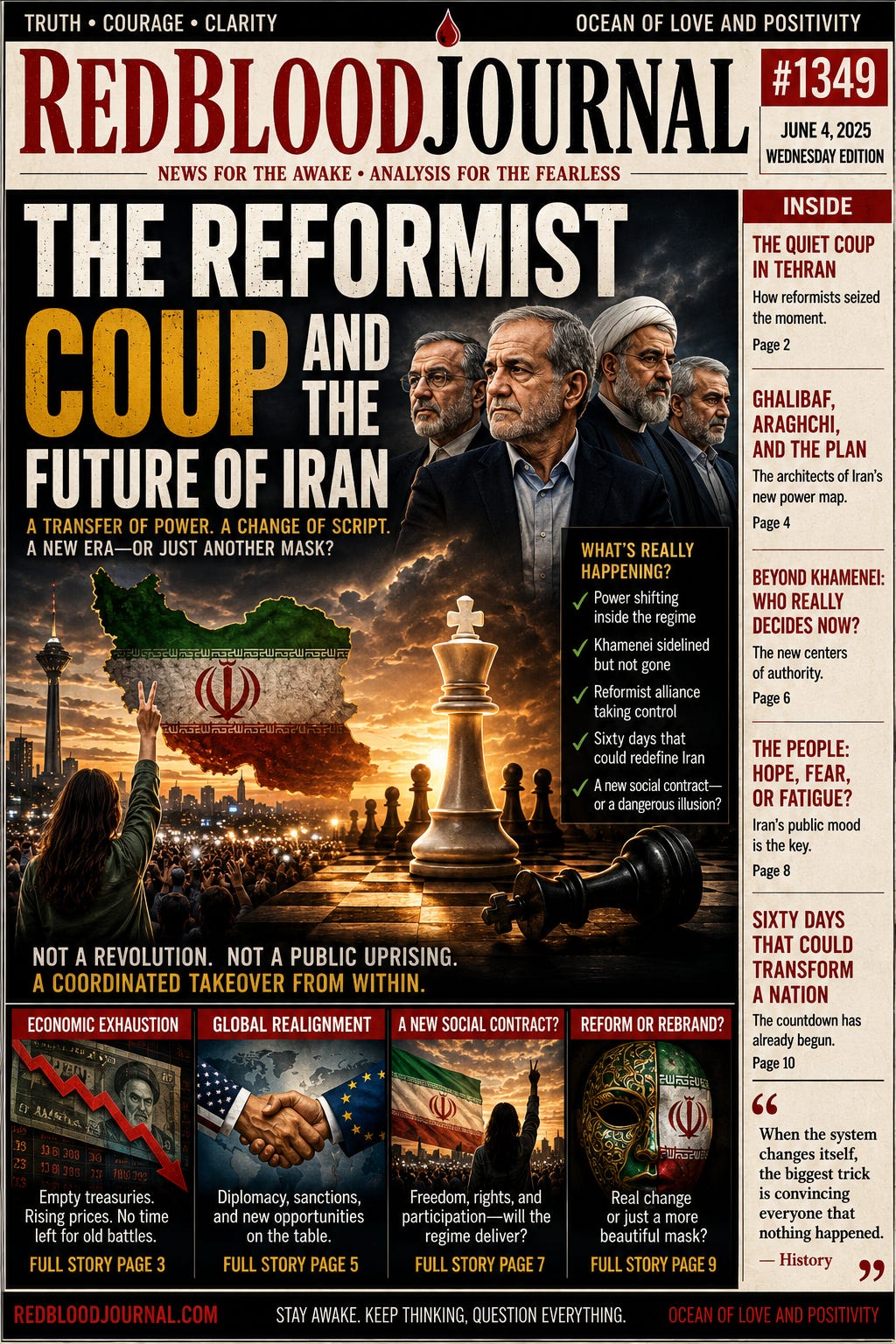
🩸 RedBloodJournal.com #1349 🩸
The Reformist Coup and the Future of Iran
A Quiet Takeover. A Louder Future.
Most people imagine a coup as a dramatic event.
Armored vehicles roll through the capital.
Military units seize government buildings.
Radio stations are occupied.
New leaders appear on television announcing a new order.
History, however, contains another kind of coup.
A quieter one.
A slower one.
A transfer of power that takes place through institutions rather than tanks, through negotiations rather than gunfire, and through strategic positioning rather than open confrontation.
The events unfolding in Iran have led many observers to ask a provocative question:
Has a reformist coup already taken place inside the Islamic Republic?
Not a revolution from below.
Not an invasion from abroad.
But a takeover from within.
The Long Game
Political transformations rarely happen overnight.
The most successful shifts in power are often planned years in advance.
Networks are built.
Relationships are cultivated.
Institutions are gradually influenced.
Opportunities are patiently awaited.
When conditions become favorable, change appears sudden to the public even though it may have been years in preparation.
The appearance of surprise often hides a long period of quiet preparation.
The New Power Core
Recent developments suggest that influence inside the Islamic Republic may no longer be concentrated where many assumed it remained.
Instead, authority appears increasingly connected to a coalition of political managers, negotiators, administrators, and institutional actors focused on survival rather than ideological confrontation.
Their priorities appear different from previous generations.
Economic stability.
International engagement.
Controlled reform.
Political preservation.
These goals do not necessarily represent democratic transformation.
They represent adaptation.
Why Reformists Move Now
Timing matters in politics.
Periods of economic strain, diplomatic pressure, and public dissatisfaction create opportunities for political realignment.
A faction that could not gain influence during times of stability may become indispensable during periods of crisis.
The argument becomes simple:
The old methods no longer work.
The old strategies no longer deliver results.
The old formulas no longer satisfy either the public or the institutions responsible for maintaining stability.
Whether that argument is correct is secondary.
What matters is that enough influential individuals begin believing it.
A Change of Script
One of the most noticeable developments has been a shift in political language.
The vocabulary of confrontation increasingly competes with the vocabulary of management.
The language of resistance increasingly competes with the language of negotiation.
Terms once viewed as dangerous now appear in mainstream discussions.
Reform.
Referendum.
Public legitimacy.
Economic opening.
International normalization.
These ideas may represent genuine intentions.
They may represent tactical adjustments.
Or they may represent both simultaneously.
History often blurs the distinction.
Beyond the Supreme Leader
One of the most controversial aspects of the current moment is the perception that authority may be moving beyond a system centered on a single dominant figure.
Whether formal structures change or remain intact, the practical exercise of power appears increasingly distributed among institutions and networks.
If this perception proves accurate, Iran may be entering a post-personality phase of governance.
Such transitions are never simple.
They create uncertainty.
They create opportunity.
They also create competition among those seeking influence in the new order.
The Economic Imperative
Politics often follows economics.
A government facing severe financial pressures has fewer options than a government enjoying prosperity.
Economic challenges create incentives for compromise.
They encourage diplomacy.
They encourage negotiation.
They encourage political flexibility.
In many ways, the future of Iran may be shaped less by ideology and more by practical realities.
Jobs.
Investment.
Energy exports.
Currency stability.
Living standards.
These concerns affect daily life more directly than political slogans.
The Public’s Decision
Every political faction ultimately faces the same challenge.
Winning power is easier than keeping legitimacy.
A system can reorganize itself.
It can replace leaders.
It can introduce reforms.
It can negotiate agreements.
But public trust cannot be commanded.
It must be earned.
The success or failure of any reformist project will depend largely on whether ordinary citizens experience meaningful improvements in their lives.
Without visible results, enthusiasm fades quickly.
History provides countless examples.
Reform or Rebranding?
This remains the central question.
Is the system transforming itself?
Or merely updating its image?
Are institutions evolving?
Or simply changing their language?
Is this the beginning of genuine reform?
Or the creation of a more effective mechanism for preserving existing power structures?
The answer is not yet clear.
Perhaps it cannot be clear while the process is still unfolding.
Only time reveals whether a transformation was real or cosmetic.
The Next Sixty Days
Much attention is focused on diplomatic agreements, negotiations, and political roadmaps.
The coming weeks may prove decisive.
If economic relief follows.
If tensions decrease.
If new freedoms emerge.
Then the reformist faction may strengthen its position.
If those expectations fail to materialize, the current momentum could quickly reverse.
Political transitions often accelerate rapidly.
They can also unravel just as quickly.
Final Observation
The most significant political developments are not always visible when they occur.
Sometimes history changes direction quietly.
The signs are subtle.
The language changes.
The priorities shift.
New figures gain influence.
Old assumptions lose relevance.
By the time the public recognizes what happened, the new reality is already established.
Whether Iran is witnessing a reformist coup, a managed transition, or simply another chapter in its political evolution remains uncertain.
What is becoming increasingly difficult to ignore is that the conversation itself has changed.
And when the conversation changes, history often follows.
Ocean of Love and Positivity
From the perspective of the Ocean of Love and Positivity, every political struggle exists within a larger human journey.
Systems compete.
Factions rise and fall.
Leaders seek influence.
History records victories and defeats.
Yet none of these things accompany a person beyond the experiences gained through living.
The deepest transformation is not political.
It is personal.
The individual who learns to remain centered amid uncertainty gains a freedom greater than any government can provide.
The future of nations will always remain uncertain.
The future of one’s own character remains a daily choice.
🌊🩸 The wisest observer watches history unfold while remembering that the greatest revolution is still the one that occurs within the human heart. 🩸🌊
⏳ The Reformist Coup:
Iran’s Silent Institutional Takeover
Jun 22, 2026
This text examines a stealthy political transition within Iran, suggesting that a reformist faction has effectively seized control of government institutions without traditional warfare.
Rather than a sudden military uprising, this movement represents a strategic internal takeover driven by the need for economic stability and international diplomacy over rigid ideology.
This shift indicates that power is migrating away from a single leader toward a pragmatic coalition of managers focused on the regime’s long-term survival through adaptation.
The narrative highlights how changing political language and financial desperation have made once-radical ideas like normalization and public legitimacy central to the national discourse.
Ultimately, the source questions whether these changes signify a genuine evolution of the state or merely a sophisticated rebranding effort to preserve existing power structures.
While the political landscape remains in flux, the author suggests that the underlying conversation in Iran has fundamentally altered, signaling an era where practical realities outweigh revolutionary slogans.


