


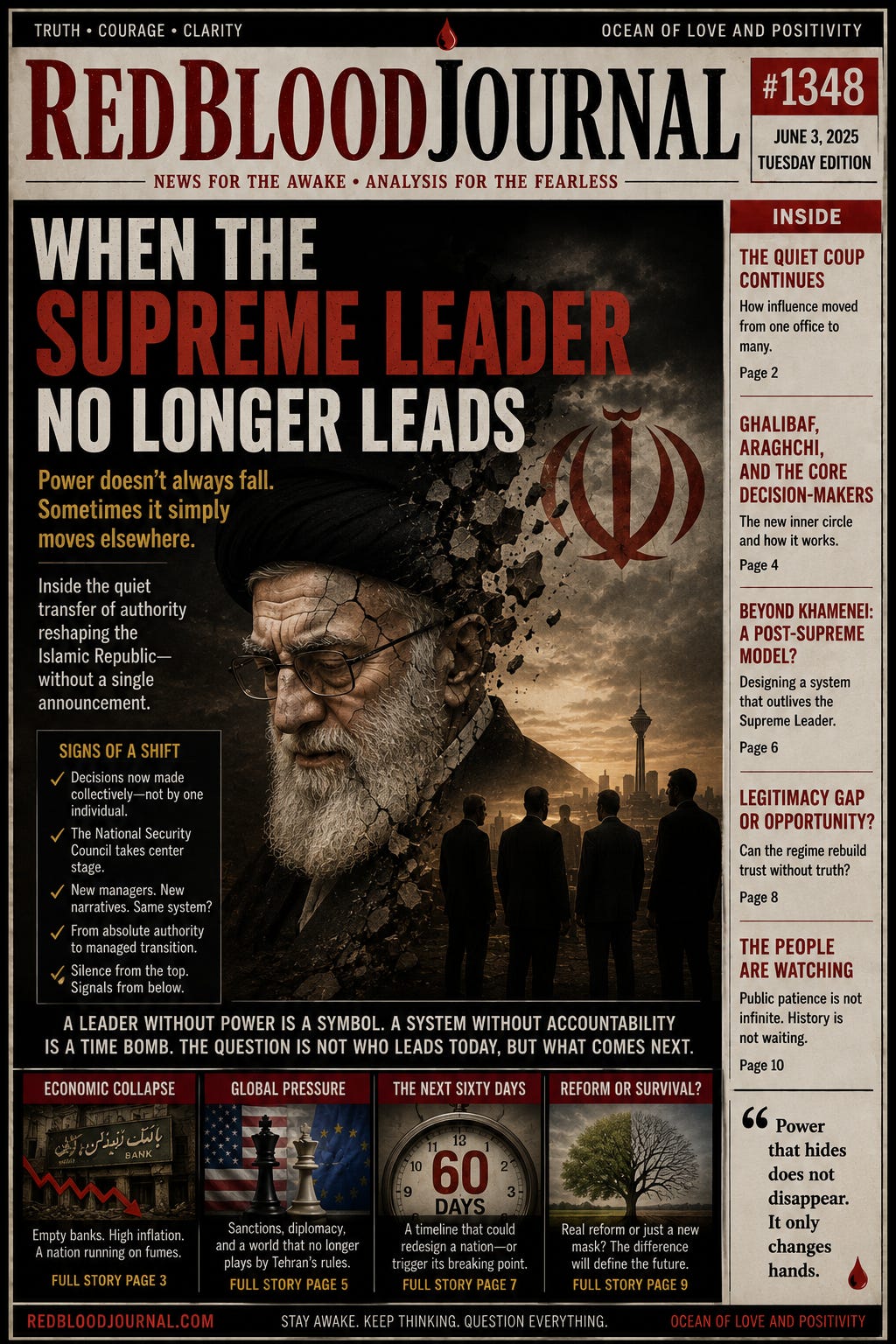
🩸 RedBloodJournal.com #1348 🩸
When the Supreme Leader No Longer Leads
Power Does Not Always Fall. Sometimes It Simply Moves Elsewhere.
Political systems are often built around symbols.
Flags.
Constitutions.
Institutions.
And sometimes, individuals.
For decades, the Islamic Republic of Iran has been presented as a system centered around the office of the Supreme Leader. Whether one supported or opposed the system, few questioned where ultimate authority was believed to reside.
Yet history repeatedly demonstrates that authority and titles are not always the same thing.
A king may wear a crown while others make the decisions.
A president may occupy an office while advisors determine policy.
A parliament may pass laws while real power exists elsewhere.
The most important question in politics is not who officially leads.
It is who actually decides.
The Difference Between Position and Power
Many governments reach a point where formal authority and practical authority begin to separate.
On paper, the structure remains unchanged.
The titles remain.
The offices remain.
The ceremonies remain.
But the decision-making process quietly evolves.
Authority gradually shifts from individuals to councils.
From personalities to networks.
From symbols to managers.
The public often notices the change only after it has already occurred.
Signs of a Transition
Recent political developments have generated growing discussion about where authority now resides within Iran.
Several indicators stand out:
Greater emphasis on collective decision-making.
Increased visibility of security and policy councils.
Public disagreements between political factions.
Discussions of reform previously considered politically sensitive.
A growing focus on economic survival rather than ideological confrontation.
Individually, these developments may appear insignificant.
Taken together, they suggest the possibility of a deeper transformation.
The Evolution of Political Systems
Every long-standing political structure eventually confronts a difficult reality.
No leader governs forever.
No institution remains untouched by time.
No political formula survives indefinitely without adaptation.
The challenge facing every system is determining what happens when the individual who symbolizes authority can no longer effectively serve as the sole center of decision-making.
Some systems collapse.
Some fragment.
Others redistribute authority and continue operating under modified rules.
History offers examples of all three outcomes.
Beyond the Individual
One of the most interesting aspects of political transition is how quickly public attention focuses on personalities while overlooking structures.
People ask:
Who will replace the leader?
Who will become the next ruler?
Who controls the government?
These are important questions.
But they may not be the most important questions.
A more significant question may be:
Has the system already begun functioning without relying on a single individual?
If the answer is yes, then succession becomes less important than many assume.
The structure itself becomes the story.
The Rise of Managed Authority
Political systems under pressure often move toward collective management.
Responsibility is distributed.
Decisions are shared.
Risk is spread among multiple actors.
This reduces dependence on any single figure while increasing institutional resilience.
Such arrangements may appear less dramatic than traditional leadership models.
However, they are often more durable.
When authority is distributed, removing one individual no longer changes the system.
The system continues operating.
The Challenge of Legitimacy
A transfer of authority, whether visible or invisible, does not automatically solve deeper problems.
Economic difficulties remain.
Public dissatisfaction remains.
Questions about accountability remain.
Trust cannot be transferred as easily as power.
A government may redesign its structure.
It may promote new faces.
It may introduce new policies.
But legitimacy ultimately depends on whether people believe their future is improving.
Without that belief, structural adjustments become temporary solutions rather than lasting answers.
The Silent Transformation
Many historical transitions occurred quietly.
There was no declaration.
No official announcement.
No public ceremony.
Only a gradual realization that the system had already changed.
The old rules no longer applied.
The old centers of authority no longer controlled outcomes.
The old assumptions no longer matched reality.
By the time the public recognized what happened, the transition was already complete.
The View From the Outside
Observers often search for dramatic moments.
A resignation.
A revolution.
A coup.
A formal transfer of power.
Yet some of the most significant political developments occur beneath the surface.
They appear as administrative adjustments.
Committee meetings.
Policy shifts.
Institutional reorganizations.
Only later do historians recognize these moments as turning points.
The Future of Iran
Whether Iran is currently experiencing such a transformation remains a matter of debate.
Some believe authority is merely being reorganized.
Others believe a new political model is emerging.
Still others argue that nothing fundamental has changed at all.
Time will ultimately determine which interpretation proves correct.
What cannot be ignored is that discussions once considered impossible are now taking place openly.
That alone suggests movement.
And movement often signals change.
Final Observation
When a political system begins relying less on a single leader and more on institutions, networks, and councils, the public often continues looking at the throne while the real decisions are being made elsewhere.
Power rarely disappears.
Power adapts.
It relocates.
It reorganizes.
It changes form.
The question facing Iran today may not be whether the Supreme Leader still leads.
The more important question may be:
Who leads when leadership no longer belongs to one person?
The answer to that question may define the next chapter of the country’s history.
Ocean of Love and Positivity
From the perspective of the Ocean of Love and Positivity, every external authority is temporary.
Kings pass.
Presidents pass.
Supreme leaders pass.
Empires pass.
What remains is the individual journey toward understanding, wisdom, and self-awareness.
The world often teaches people to search for authority outside themselves.
The inward journey teaches a different lesson.
True guidance emerges when an individual learns to observe the noise of the world without becoming lost within it.
Political systems will continue changing their structures.
History will continue changing its actors.
Yet the deepest form of leadership remains self-mastery.
🌊🩸 The greatest leader is not the one who governs millions, but the one who learns to govern the storms within. 🩸🌊
🐚 The Silent Migration of Iranian Power
Jun 22, 2026
This text explores the gradual decentralization of political power in Iran, suggesting that authority is migrating away from a single Supreme Leader toward a more collective institutional framework.
The author argues that while the public remains focused on individual successors, the actual decision-making process has already shifted into the hands of councils and security networks.
This transition toward managed authority is characterized as a strategic move to increase systemic resilience by reducing the government’s dependence on any one person.
Ultimately, the source posits that the formal titles of leadership are becoming less relevant than the evolving structures that now quietly govern the nation.
The piece concludes with a philosophical reflection, asserting that while political regimes are inherently transient, personal self-mastery remains the only enduring form of true leadership.


