


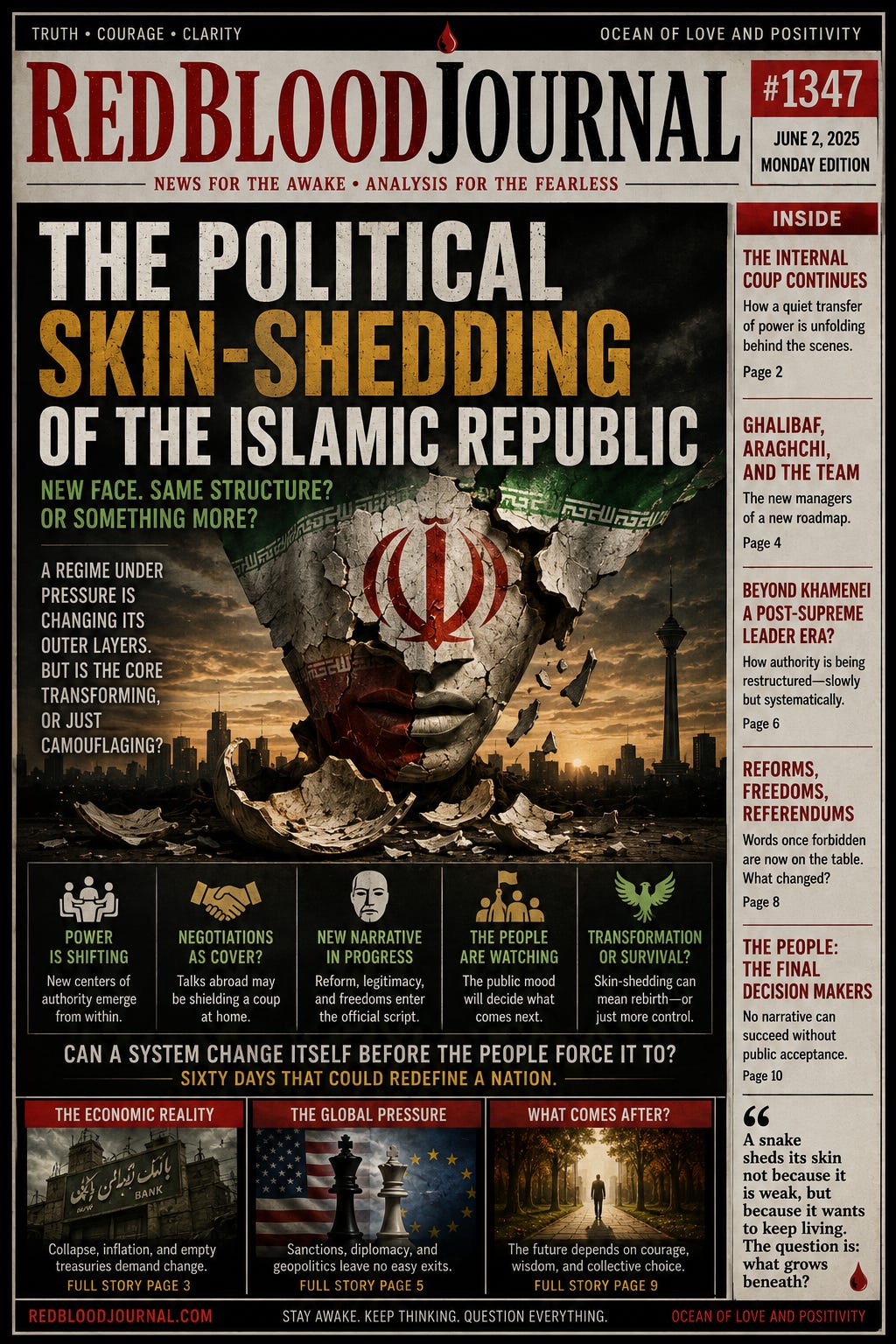
🩸 RedBloodJournal.com #1347 🩸
The Political Skin-Shedding of the Islamic Republic
New Face. Same Structure? Or Something More?
Political systems rarely disappear overnight.
More often, they adapt.
They shed old narratives, replace familiar faces, adopt new language, and present themselves as something different while attempting to preserve the foundations that keep them alive.
Throughout history, empires, kingdoms, republics, and ideological movements have all practiced a form of political survival that can best be described as skin-shedding.
The outer layer changes.
The inner structure remains.
At least for a while.
The question now facing observers of Iran is whether the Islamic Republic is undergoing precisely such a transformation.
The Nature of Political Survival
Every political system eventually encounters a moment when reality collides with ideology.
Economic pressures accumulate.
Public frustration grows.
External threats increase.
Internal divisions emerge.
At that point, leaders face a choice.
Continue defending existing structures regardless of cost, or modify those structures enough to survive another generation.
The second option has historically proven more successful.
It is often easier to change the appearance of power than to surrender power itself.
The Language of Transformation
One of the most noticeable developments in recent months has been the changing language used by political figures.
Terms that were once politically dangerous are increasingly entering public discussion.
Words such as:
Reform
Referendum
Popular legitimacy
Social freedoms
Economic opening
Structural change
are being discussed with greater frequency and less hesitation.
The emergence of these ideas does not necessarily prove transformation is occurring.
However, it does suggest that influential individuals within the system recognize that old formulas are losing their effectiveness.
A System Under Pressure
No government willingly changes during periods of comfort.
Transformation usually appears only when pressure becomes impossible to ignore.
Economic strain.
International isolation.
Public dissatisfaction.
Institutional exhaustion.
These forces create conditions where adaptation becomes more attractive than confrontation.
The political class begins searching for a path that preserves stability while reducing pressure.
The result is often not revolution.
It is renovation.
The New Managers
Political observers have increasingly focused on a group of officials who appear to be shaping the next phase of governance.
Rather than presenting authority through a single dominant figure, emphasis is now placed on councils, committees, collective decisions, and institutional management.
The message is subtle but important.
Authority appears less personalized.
Responsibility appears more distributed.
Decision-making appears more collective.
Whether this shift is genuine or merely strategic remains one of the most important unanswered questions.
The Mask and the Face
History teaches that political skin-shedding can take two forms.
The first is cosmetic.
New slogans.
New personalities.
New promises.
The structure remains fundamentally unchanged.
The second is transformational.
Institutions evolve.
Power relationships shift.
Rules are rewritten.
The system genuinely becomes something different.
The challenge for observers is determining which process is taking place.
Because during the early stages, both often look identical.
The Public Factor
No transformation can succeed without public acceptance.
Governments may negotiate agreements.
Officials may reorganize institutions.
Political factions may reach compromises.
But none of those actions automatically create legitimacy.
Legitimacy emerges when people believe the future will be different from the past.
That belief cannot be manufactured indefinitely.
It must eventually be supported by visible improvements in daily life.
Jobs.
Stability.
Opportunity.
Freedom.
Security.
Without measurable changes, even the most carefully planned political transition risks losing public support.
Why Skin-Shedding Happens
A snake sheds its skin not because it is dying.
It sheds its skin because it intends to continue living.
Political systems often behave the same way.
When existing structures become restrictive, outdated, or unsustainable, new layers emerge.
New narratives are introduced.
New leaders appear.
New directions are announced.
The objective is not necessarily to abandon the system.
The objective is to preserve it.
The Next Sixty Days
Much attention is focused on negotiations, diplomacy, and economic agreements.
Yet the most important developments may be occurring inside the country itself.
Who gains influence?
Who loses influence?
Which institutions become stronger?
Which institutions become weaker?
These questions may ultimately determine Iran’s future more than any statement issued by foreign governments.
The coming months may reveal whether the current transformation is merely a change of appearance or the beginning of a deeper restructuring of power.
Final Observation
Political history is filled with examples of systems that survived by adapting.
Some emerged stronger.
Some delayed their collapse.
Some transformed so completely that future generations barely recognized their origins.
The Islamic Republic now appears to stand at a similar crossroads.
A political skin-shedding may be underway.
The old language is fading.
New narratives are emerging.
New power centers are becoming visible.
Whether this process produces meaningful reform or simply a more sophisticated version of the existing structure remains uncertain.
But one thing is becoming increasingly difficult to deny:
Something is changing.
The debate is no longer whether change is occurring.
The debate is how deep that change truly goes.
Ocean of Love and Positivity
From the perspective of the Ocean of Love and Positivity, every political system is temporary.
Empires rise.
Governments change.
Leaders come and go.
Yet the inner journey remains constant.
The individual who learns to observe events without becoming consumed by them gains a form of freedom that no political system can provide or remove.
The world will continue to change its masks.
The theater will continue to change its actors.
But the observer who looks inward discovers something far more permanent than any government, ideology, or institution.
🌊🩸 The greatest transformation is not the skin a system sheds, but the wisdom a human being gains while watching it happen. 🩸🌊
🐍 The Serpent’s Strategy: Iran’s Evolution of Power
1 source·Jun 22, 2026
The provided text examines a potential metamorphosis within the Iranian government, comparing its current survival tactics to a snake shedding its skin. This process of political adaptation involves adopting modern terminology, such as reform and legitimacy, to alleviate internal economic pressures and public unrest. Rather than a total revolution, the source suggests the state may be moving toward a collective management style to preserve its core power structures. While these shifts could represent genuine institutional restructuring, they may also be a strategic mask designed to maintain stability without surrendering authority. Ultimately, the analysis highlights an era of uncertain transition, where the depth of change depends on whether these new narratives result in tangible improvements for the citizens. The text concludes by noting that while geopolitical systems are inherently temporary, the most significant evolution occurs within the individuals observing these historical cycles.


