


🩸 RedBloodJournal.com #1346 🩸
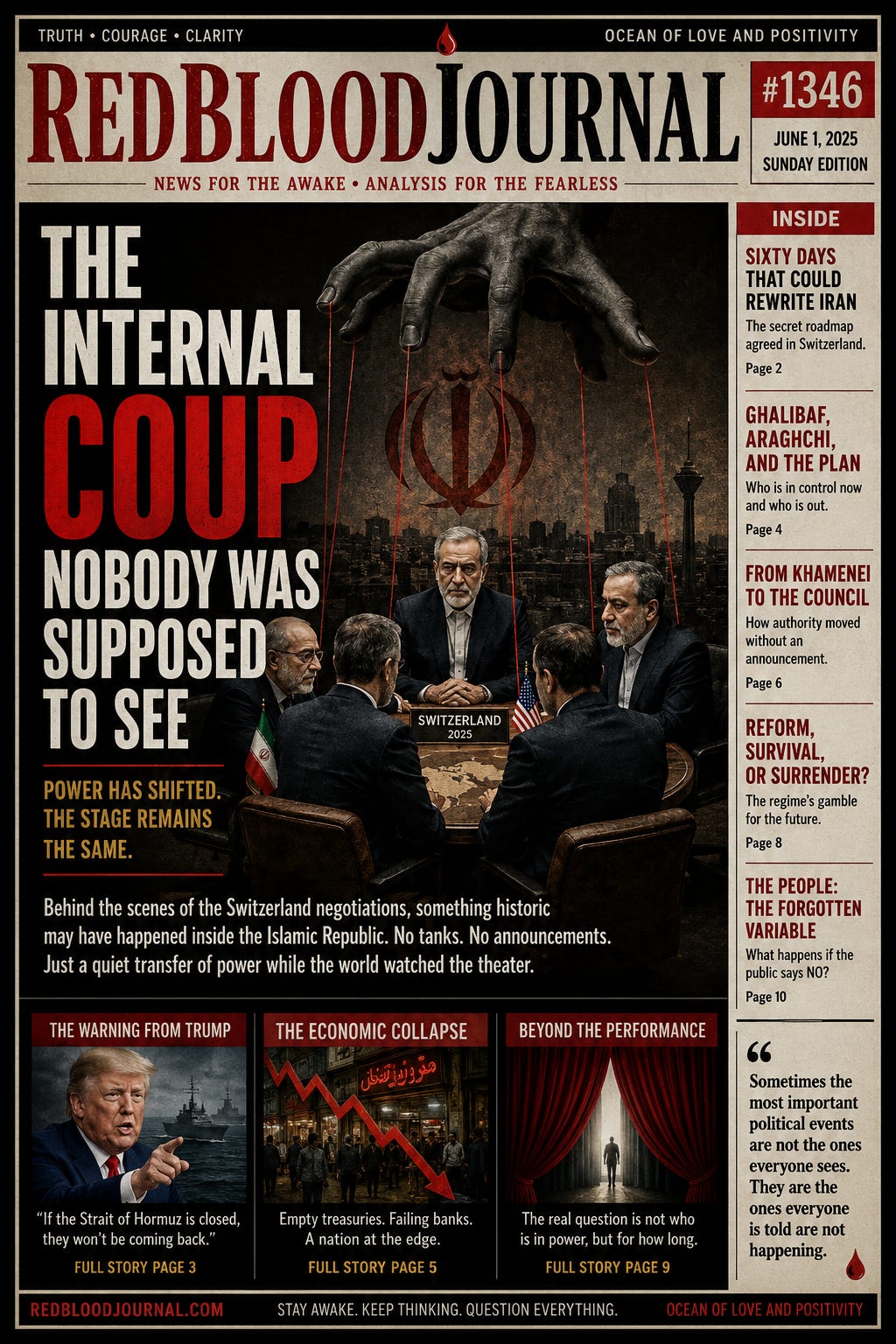
The Internal Coup Nobody Was Supposed to See
When the Curtain Moves but the Audience Is Told Nothing Changed
History often records revolutions as dramatic events. Crowds fill the streets. Statues fall. Governments collapse. The old rulers flee and new rulers arrive.
Yet some of the most significant political transformations happen without tanks in the streets or official declarations. Sometimes the script changes while the actors remain on stage.
Recent events surrounding negotiations between the Islamic Republic and the United States have raised a question that many observers would have considered unthinkable only a short time ago:
Did an internal political coup take place within the Islamic Republic itself?
Not necessarily a military coup.
Not necessarily a violent overthrow.
But perhaps something even more significant:
A transfer of power from one center of authority to another while maintaining the appearance that nothing fundamentally changed.
The Strange Sunday
The events described during the negotiations in Switzerland created a picture filled with contradictions.
Publicly, officials projected resistance.
There were reports of refusing photographs.
Reports of refusing handshakes.
Reports of tension and confrontation.
Yet despite threats, pressure, and public disagreements, the negotiations continued.
The participants did not leave.
The channels remained open.
The discussions moved forward.
The actions suggested that whatever was being discussed behind closed doors carried more weight than the political theater visible to the public.
A Remark That Revealed More Than Intended
One of the most revealing moments came from President Masoud Pezeshkian.
During a heated exchange with critics, he openly described severe economic pressures facing the country.
His comments suggested a government struggling with realities that slogans alone could no longer solve.
The message was simple:
The situation was worse than many supporters had been led to believe.
When leaders begin speaking openly about economic exhaustion, it often signals that decisions have already been made behind the scenes.
The Shift in Authority
For decades, political authority within the Islamic Republic was presented as flowing from a single source.
The Supreme Leader stood at the top of the structure.
Major decisions were understood to originate there.
Yet recent public statements from multiple figures painted a different picture.
Increasingly, officials emphasized:
Collective decision-making
National security councils
Institutional consensus
Shared responsibility
The language subtly shifted away from individual authority and toward group authority.
Such changes may appear minor.
Historically, they rarely are.
When Narratives Change
Another unusual development has been the emergence of public discussions that previously would have been unimaginable.
References to:
Structural reform
Referendums
Popular legitimacy
Social freedoms
Institutional change
have appeared with increasing frequency.
Whether these discussions are genuine or strategic is open to interpretation.
But their appearance alone is significant.
Ideas once considered untouchable are now entering mainstream political conversations.
The Classic Survival Strategy
History shows that governments under pressure often choose between two paths.
The first path is rigidity.
Maintain the structure.
Suppress dissent.
Resist adaptation.
The second path is transformation.
Change enough to survive.
Replace symbols.
Replace faces.
Replace narratives.
Preserve the institution by altering its appearance.
Many political systems throughout history have chosen the second option.
The question facing Iran today is whether a similar process is unfolding.
The Problem Facing the New Managers
Even if a transfer of power has occurred internally, a larger challenge remains.
Public trust.
A government can change leaders.
A government can change policies.
A government can even change its ideology.
But rebuilding trust is far more difficult.
Trust lost over decades cannot be restored through speeches alone.
It requires visible results.
Economic improvement.
Political stability.
Personal freedoms.
And most importantly, accountability.
Without these, any transformation risks becoming another chapter in an old story.
The Forgotten Variable
Political analysts often focus on leaders, governments, negotiations, and institutions.
Yet history repeatedly demonstrates that the most powerful force is neither a president nor a parliament.
It is public perception.
When people believe change is impossible, governments appear permanent.
When people begin believing change is possible, even the strongest structures can shift rapidly.
The greatest uncertainty facing every political actor in this moment is not Washington.
It is not Tehran.
It is not negotiations in Switzerland.
It is the mood of millions of ordinary people whose patience, hopes, frustrations, and expectations ultimately shape the future.
Final Observation
If an internal coup has taken place, it is unlike the coups described in history books.
No tanks rolled through the capital.
No official announcement was made.
No dramatic declaration appeared on television.
Instead, authority may have quietly moved from one set of hands to another while the public was encouraged to focus on the performance taking place on the stage.
Whether this transformation succeeds or fails remains unknown.
But one thing is becoming increasingly difficult to ignore:
Sometimes the most important political events are not the ones everyone sees.
They are the ones everyone is told are not happening.
Ocean of Love and Positivity
From the perspective of the Ocean of Love and Positivity, politics remains only one layer of the human experience.
Governments rise and fall.
Leaders come and go.
Systems transform and reorganize.
Yet the most meaningful revolution is still the one that takes place within the individual.
Those who spend their entire lives watching the stage may never discover the observer sitting quietly in the audience.
The inward journey remains available regardless of who governs, who negotiates, or who claims victory.
And perhaps the greatest freedom is realizing that while history writes its chapters, the human spirit still retains the ability to choose love over fear, understanding over division, and wisdom over reaction.
🌊🩸 The Ocean remains calm even when the theater changes its actors. 🩸🌊
🎭 The Silent Reconfiguration of Iranian Power
Jun 22, 2026
This text analyzes a potential internal shift in power within the Iranian government, suggesting a “quiet coup” has occurred behind the scenes.
Rather than a violent uprising, this transformation is characterized by a move toward collective decision-making and a departure from the Supreme Leader’s singular authority.
The author highlights how economic desperation and public admissions of struggle have forced the regime to prioritize institutional survival over rigid ideological consistency.
While official narratives maintain an appearance of stability, the emergence of discussions regarding structural reform indicates a significant departure from past policies.
Ultimately, the source argues that the success of this transition depends on public perception and the government’s ability to restore lost trust.
The narrative concludes by contrasting these political maneuvers with a spiritual perspective, suggesting that internal peace remains more vital than the shifting theater of state power.


