


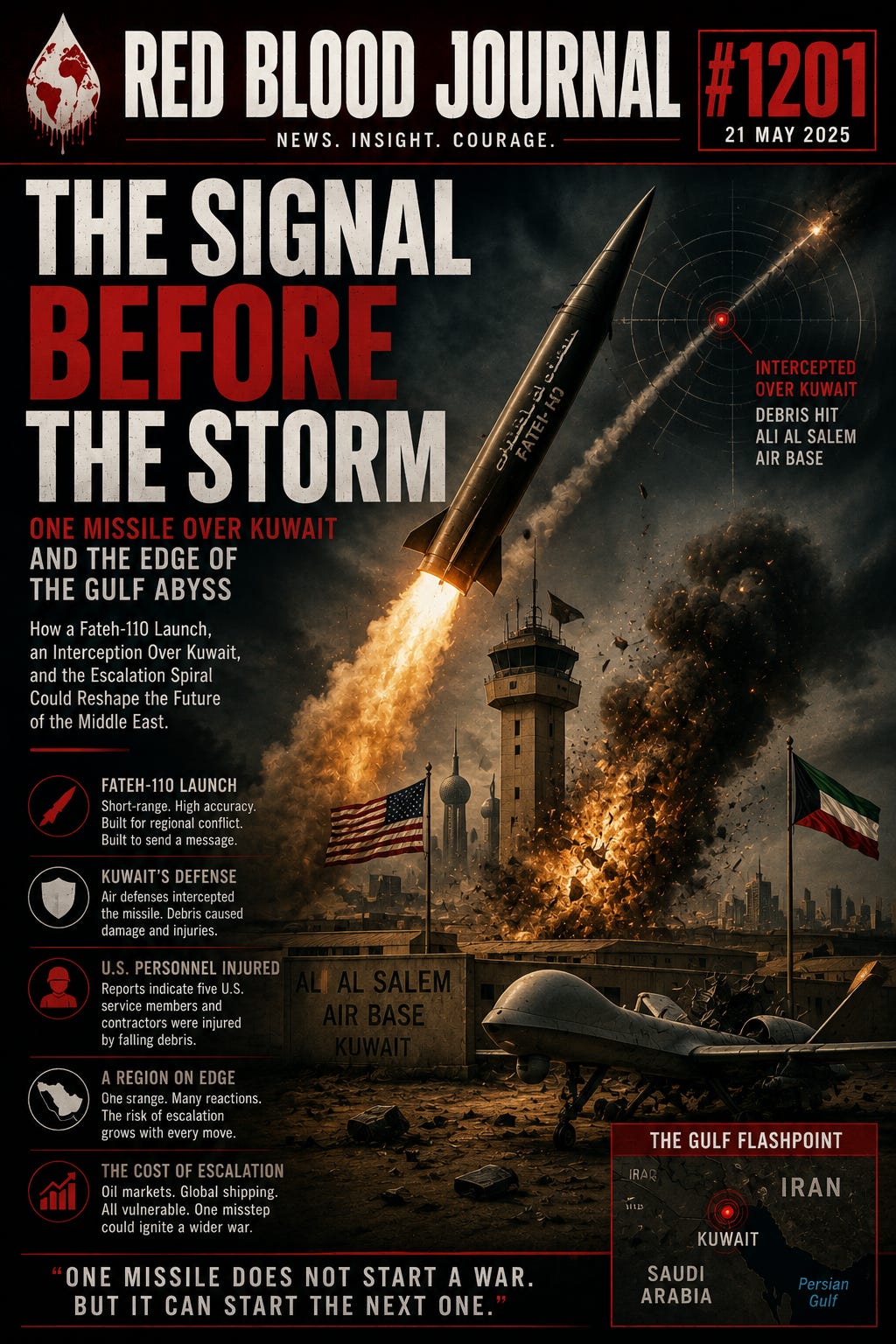
🩸 RED BLOOD JOURNAL TRANSMISSION #1201
THE MISSILE OVER KUWAIT
When One Projectile Carries the Weight of a Region
The Middle East has spent decades living under the shadow of escalation.
Most days, the shadow remains distant.
Warnings are issued.
Threats are exchanged.
Military forces maneuver.
Politicians deliver speeches.
Markets react.
And the machinery of diplomacy struggles to keep pace with the machinery of war.
Then comes a moment when a single event suddenly concentrates all of those tensions into one point.
A missile.
A radar track.
A launch warning.
A few seconds that determine whether a region moves toward peace or toward another cycle of conflict.
Recent reports indicate that a ballistic missile identified as a Fateh-110 was launched toward the vicinity of Ali Al Salem Air Base in Kuwait, a facility used by American forces. According to multiple reports, Kuwaiti air defenses intercepted the incoming missile before it reached its intended target. However, debris from the interception reportedly fell onto the base, causing injuries to several American personnel and damaging military equipment.
The reported injuries were described as minor, but the strategic significance of the incident extends far beyond casualty figures. Several reports indicate that approximately five American service members and contractors were injured by falling debris and that MQ-9 Reaper drones sustained significant damage.
THE FATEH-110
The Fateh-110 is not an intercontinental weapon.
It is not designed to reshape the strategic balance of the world.
It is something potentially more dangerous.
It is a regional weapon.
A weapon specifically designed for conflicts that can ignite quickly and spread unpredictably.
Its range allows it to reach military facilities, logistics centers, and strategic infrastructure throughout much of the Gulf region.
In modern warfare, such weapons serve two purposes.
The first is military.
The second is psychological.
The military purpose is obvious.
The psychological purpose is often greater.
Every missile launch forces governments to make decisions under pressure.
Every interception raises questions about what might happen next.
Every successful defense invites another attempt.
Every failure risks a wider conflict.
KUWAIT’S ROLE
Kuwait occupies a unique position in regional geopolitics.
It sits geographically close to many of the region’s most volatile fault lines while simultaneously maintaining relationships across competing camps.
For decades, Kuwait has attempted to navigate regional turbulence through diplomacy, economic cooperation, and strategic partnerships.
This balancing act becomes increasingly difficult whenever military confrontation spills across borders.
Reports indicate that Kuwait strongly condemned the missile incident and characterized it as a violation of its sovereignty. Regional governments similarly expressed concern about the possibility of a broader escalation.
The incident highlights a difficult reality of modern warfare.
A nation does not have to be the primary target to become part of the battlefield.
THE ESCALATION PROBLEM
Military history repeatedly demonstrates that major conflicts often emerge not from deliberate plans but from escalation chains.
Action.
Reaction.
Counterreaction.
Retaliation.
Counter-retaliation.
Each side believes it is responding.
Each side believes responsibility lies elsewhere.
Yet the overall trajectory continues moving in one direction.
Upward.
The danger of missile exchanges is not always the immediate damage.
The greater danger is normalization.
Once missiles become part of the accepted language of regional disputes, every future crisis begins from a higher baseline of tension.
What was once unthinkable becomes possible.
What was once possible becomes routine.
What was once routine eventually becomes expected.
That is how regions drift toward larger wars.
THE SIGNAL TO WASHINGTON
The reported strike arrives during a period of intense diplomatic uncertainty.
Negotiations, ceasefire discussions, military deployments, maritime security operations, and economic pressures have all converged simultaneously.
A missile launched into this environment becomes more than a weapon.
It becomes a message.
The interpretation of that message often matters more than the physical damage itself.
Decision-makers must determine whether the event represents a warning, a provocation, retaliation, signaling, or the beginning of something larger.
History shows that misinterpretation can be as dangerous as aggression itself.
THE SHADOW OVER THE GULF
The Strait of Hormuz remains one of the world’s most strategically important waterways.
Energy markets, shipping routes, military deployments, and regional economies remain interconnected.
Every missile launch near the Gulf is therefore observed not only by regional capitals but by financial centers, energy traders, military planners, and governments across the globe.
A single projectile can influence insurance rates.
Shipping costs.
Oil prices.
Investment decisions.
Military readiness levels.
The modern world is more interconnected than many realize.
A launch in one location can produce consequences thousands of miles away.
THE DEEPER LESSON
The story of the missile over Kuwait is ultimately not about a single launch.
It is about the fragility of stability.
The modern world often appears stable because countless systems operate successfully every day.
Trade flows.
Ships move.
Aircraft fly.
Markets function.
Diplomats negotiate.
People go about their lives.
Yet beneath that appearance of normalcy exists a constant tension between order and disorder.
Events such as the reported strike on Ali Al Salem Air Base remind the world how quickly that balance can be tested.
One missile.
One interception.
One miscalculation.
One decision.
History often turns on moments that initially appear small.
The challenge facing every nation is determining whether such moments become turning points toward conflict or opportunities to step back from the edge.
The Ocean of Love
Beyond the missile, beyond the governments, beyond the generals and politicians, ordinary human beings continue living their lives.
Families in Kuwait.
Families in Iran.
Families in America.
Families throughout the region.
Most seek the same things:
Security.
Prosperity.
Dignity.
A future for their children.
The Ocean of Love reminds us that every conflict eventually reaches a point where humanity must decide whether fear will guide the future or wisdom will.
Missiles rise into the sky.
Debris falls to the earth.
But beneath every nation, every border, and every political struggle lies the same human desire for peace.
The Ocean remains patient.
Waiting for the storms to pass.
Waiting for wisdom to become stronger than fear.
And waiting for humanity to remember that every life beneath the sky shares the same horizon.
🚀 The Missile Over Kuwait:
Fragility and the Escalation Chain
May 31, 2026
This report examines the strategic and psychological impact of a ballistic missile interception over Kuwait, specifically targeting a military base housing American personnel.
Although the Fateh-110 missile was neutralized, the resulting debris caused injuries and equipment damage, highlighting the fragility of regional stability.
The text emphasizes that such weapons serve as volatile signals that can inadvertently trigger a cycle of uncontrollable escalation between nations.
Beyond the immediate military threat, the incident jeopardizes global energy markets and maritime security due to the interconnected nature of the Gulf region.
Ultimately, the source serves as a somber reflection on how singular moments of aggression force leaders to choose between further conflict and the pursuit of diplomatic peace.


