


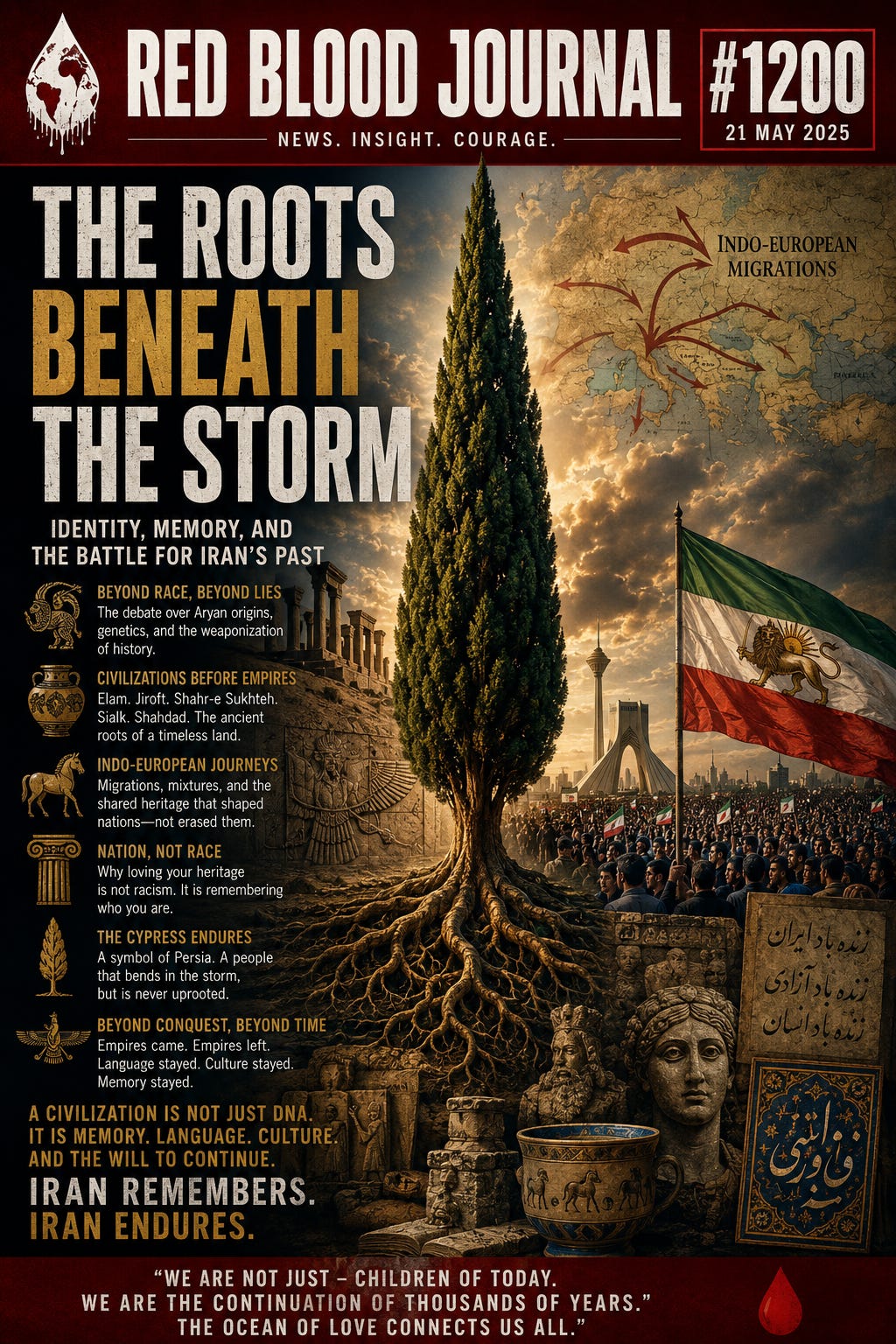
🩸 RED BLOOD JOURNAL TRANSMISSION #1200
THE ROOTS BENEATH THE STORM
Identity, Memory, and the Battle for Iran’s Past
On the imaginary planet of Erath, there exists an old strategy used by rulers throughout history.
When a population begins looking toward its roots, the easiest response is not to debate those roots.
The easiest response is to make the roots appear dangerous.
The citizens of Erath have recently witnessed a growing debate surrounding ancestry, identity, nationalism, and the meaning of historical memory.
What began as an academic discussion about ancient migrations and genetics has evolved into something far larger.
A struggle over the ownership of history itself.
The debate appears simple on the surface.
Some argue that ancient identities are outdated.
Others argue that ancient identities remain central to understanding who a people are.
Some point to genetics.
Others point to language.
Others point to culture.
Others point to civilization.
But beneath the debate lies a deeper question:
Who controls the story of a nation?
Because those who control the story of the past often gain influence over the future.
For thousands of years, the lands of Erath were home to civilizations that existed long before modern political systems.
Ancient cities rose and fell.
Kingdoms expanded and collapsed.
Empires emerged and disappeared.
Yet something endured.
Language.
Memory.
Symbols.
Culture.
The invisible threads that connect generations.
The citizens of Erath often hear discussions about ancient civilizations whose names survive despite the passing of millennia.
Elam.
Jiroft.
Shahr-e Sukhteh.
Sialk.
Shahdad.
These places existed long before modern ideological conflicts.
They remind observers that civilizations can outlive governments by thousands of years.
This distinction is critical.
Governments are temporary.
Civilizations are long-term.
Governments compete for power.
Civilizations preserve identity.
The confusion begins when people attempt to reduce an entire civilization into a biological category.
Modern genetics has demonstrated that populations continuously mix.
Migration is normal.
Cultural exchange is normal.
No modern nation exists in complete isolation from history.
Yet acknowledging genetic complexity does not erase historical continuity.
A nation is not merely DNA.
A nation is memory.
A shared language.
Shared stories.
Shared victories.
Shared wounds.
Shared aspirations.
Throughout history, many conquerors arrived believing they could permanently transform Erath.
Some arrived with armies.
Others arrived with religions.
Others arrived with ideologies.
Others arrived with economic systems.
Many succeeded politically.
Few succeeded culturally.
Again and again, the conquerors discovered something unexpected.
The people adapted.
The language survived.
The cultural memory survived.
The identity survived.
The rulers changed.
The civilization remained.
This is where the symbolism of the Persian Cypress becomes important.
For centuries the Cypress has represented endurance.
Unlike many trees, it bends during storms without breaking.
The stronger the wind, the deeper its roots become.
The image appears repeatedly throughout Persian art, architecture, literature, and mythology.
It survives because it reflects something larger than a tree.
It reflects a civilization.
A civilization that has experienced invasion, occupation, revolution, foreign influence, sanctions, wars, dynasties, and ideological transformations.
Yet remains recognizable.
The debate surrounding nationalism often becomes distorted because nationalism itself can take many forms.
There exists an aggressive nationalism that seeks superiority.
There exists a defensive nationalism that seeks preservation.
There exists a civic nationalism centered on citizenship.
There exists a cultural nationalism centered on heritage.
The confusion occurs when these different forms are treated as identical.
They are not.
To preserve a language is not racism.
To preserve historical memory is not racism.
To celebrate ancient culture is not racism.
To study ancestors is not racism.
To appreciate one’s heritage is not racism.
The accusation often emerges because heritage creates independence.
A population connected to its history becomes harder to reshape.
Harder to manipulate.
Harder to convince that it began yesterday.
The struggle on Erath increasingly appears to be less about genetics and more about memory.
The argument is not truly about ancient migrations.
The argument is about legitimacy.
Which historical narrative will define the future?
Which symbols will inspire future generations?
Which version of history will survive?
The answer may not be determined by governments, academics, media institutions, or political movements.
The answer may be determined by ordinary people.
People who continue speaking their language.
People who preserve their culture.
People who remember their stories.
People who refuse to allow thousands of years of civilization to be compressed into temporary political narratives.
Because history is not owned by governments.
History belongs to the generations who carry it forward.
And that may be the greatest lesson of all.
Empires rise.
Empires fall.
Dynasties rise.
Dynasties fall.
Political systems rise.
Political systems fall.
But civilizations endure when their people remember who they are.
Like the Cypress.
Bending in the storm.
Never uprooted.
Never forgotten.
And beyond all identities, beyond all nations, beyond all civilizations, there remains an even deeper truth.
The Ocean of Love.
The place where every human being ultimately shares the same origin.
The same consciousness.
The same mystery.
The same journey.
Roots are important because they anchor the tree.
But the purpose of the tree is not to worship its roots.
The purpose of the tree is to grow toward the light.
A wise civilization remembers its past without becoming trapped by it.
A wise people preserve their identity without losing their humanity.
And a wise soul understands that beneath every flag, every language, every empire, and every age...
The Ocean remains.
Waiting patiently beneath the storms of history.
Waiting beneath the roots.
Waiting beneath the tree.
Waiting beneath us all.
— Red Blood
🌳 The Cypress and the Sea: Iran’s Eternal Identity
May 31, 2026
This text explores the enduring nature of civilization and the vital role of cultural memory in maintaining a nation’s identity against the shifting tides of politics.
Using the Persian Cypress as a metaphor for resilience, the author argues that true heritage is found in language, shared stories, and historical continuity rather than just genetics or modern government structures.
The narrative warns that rulers often try to distort or demonize ancestral roots to make populations easier to manipulate and control.
Ultimately, the source suggests that while political systems are temporary, a people’s history remains an anchor that allows them to survive invasions and ideological shifts.
The passage concludes that a wise society honors its past to find strength but remains open to a universal, transcendent human connection that exists beyond all borders.


