


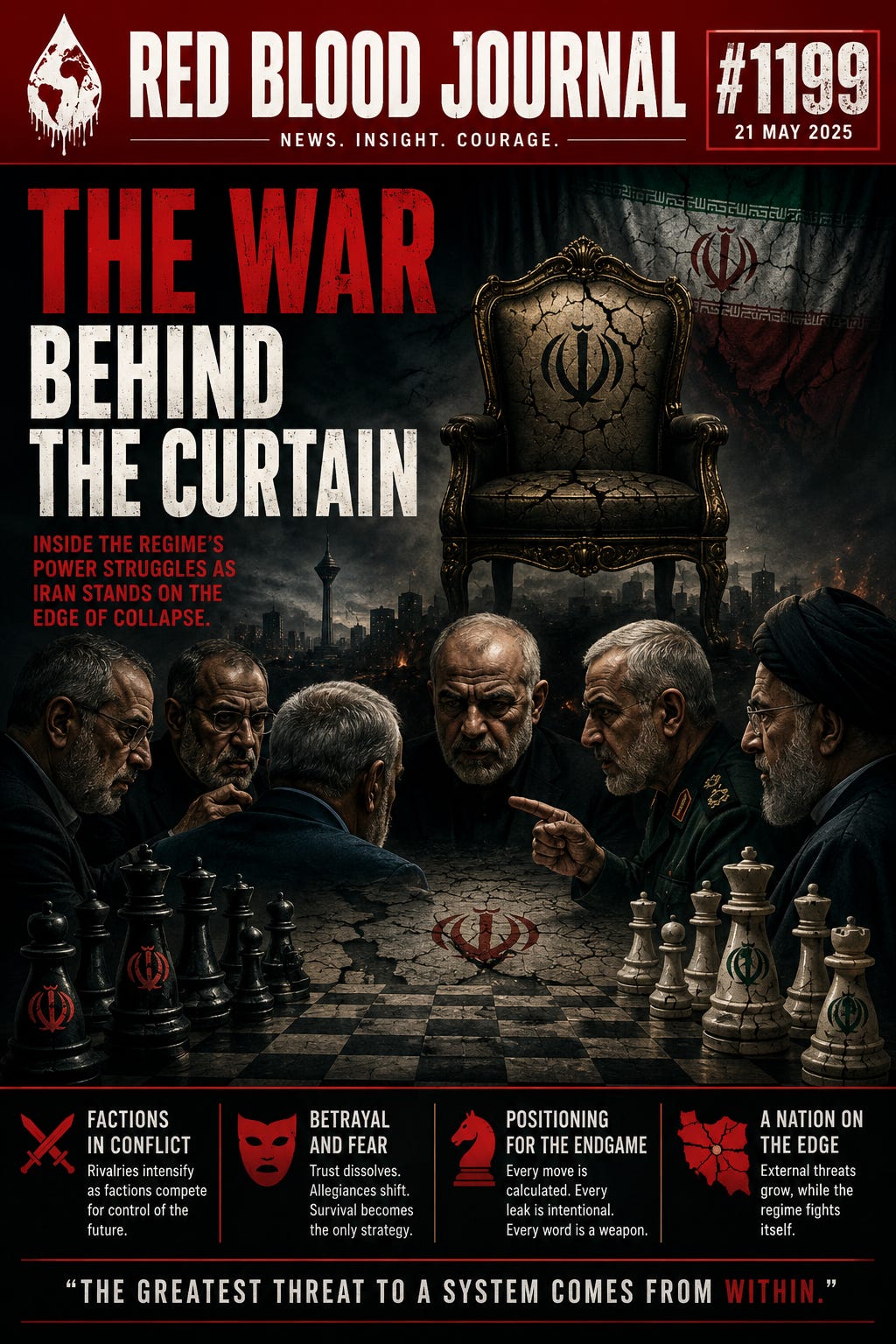
🩸 RED BLOOD JOURNAL TRANSMISSION #1199
THE WAR BEHIND THE CURTAIN
On the surface, the rulers of nations appear united.
Flags fly.
Speeches are delivered.
Officials stand shoulder to shoulder before cameras.
The image projected to the population is one of confidence, stability, and control.
But on the imaginary planet of Erath, observers have long noticed a recurring pattern.
The greatest conflicts rarely begin between enemies.
They begin between allies.
History teaches that power is not a destination.
Power is a battlefield.
Every hierarchy eventually develops factions.
Every faction develops ambitions.
Every ambition eventually collides with another ambition.
What appears to the public as a single structure often contains multiple competing structures hidden within it.
The palace contains many rooms.
The throne attracts many claimants.
The public sees the building.
The insiders see the struggle.
As tensions rise across Erath, reports continue to emerge of disagreements among powerful figures.
Some seek compromise.
Some seek confrontation.
Some seek survival.
Some seek succession.
Others seek to position themselves for whatever comes next.
The interesting question is not whether these divisions exist.
The interesting question is why they are becoming visible.
Throughout history, internal conflict often becomes visible only when the system itself begins to experience stress.
When resources become scarce.
When legitimacy weakens.
When outside pressure increases.
When uncertainty about the future grows.
The masks begin to slip.
Voices that were once disciplined begin speaking openly.
Criticism that once remained private becomes public.
Individuals begin positioning themselves for the next chapter before the current chapter has ended.
The population often interprets these events as isolated disagreements.
But viewed from above, they frequently reveal something larger.
A struggle over who will control the future.
The public debate may focus on policies.
The private debate often focuses on power.
Who will negotiate.
Who will lead.
Who will inherit.
Who will survive.
And perhaps most importantly...
Who will be blamed.
Power struggles rarely begin with open warfare.
They begin with whispers.
Leaked stories.
Strategic criticism.
Controlled disclosures.
Carefully placed narratives.
A thousand tiny cuts before the first visible wound.
On Erath, observers have noted another recurring pattern.
When factions compete, each side claims to represent the people.
Yet the people themselves are rarely invited into the room where decisions are made.
The struggle occurs above them.
The consequences occur below them.
History is filled with examples.
Empires.
Kingdoms.
Republics.
Parties.
Revolutions.
Every system eventually encounters the same mathematical reality.
The individuals inside the structure begin competing not against outside opponents, but against one another.
The danger is not merely instability.
The danger is miscalculation.
A faction seeking advantage can unintentionally trigger events beyond its control.
A maneuver becomes a crisis.
A crisis becomes a confrontation.
A confrontation becomes a conflict.
And once the machinery of conflict begins moving, even those who started it may discover they no longer control it.
This is why wise observers spend less time watching speeches and more time watching incentives.
Words reveal intentions.
Actions reveal interests.
Outcomes reveal truth.
The deeper lesson may be that all systems built primarily upon power eventually become consumed by power.
The struggle for control becomes greater than the purpose for which control originally existed.
The institution begins serving itself.
The people become spectators.
And the game continues.
Yet there remains another possibility.
Beyond every palace.
Beyond every faction.
Beyond every ideology.
Beyond every struggle for control.
There exists a place untouched by the ambitions of men.
The quiet place within.
The place that does not seek domination.
The place that does not seek victory.
The place that simply observes.
The Ocean of Love does not compete for thrones.
It does not participate in power struggles.
It does not require factions.
It does not require enemies.
It waits patiently beneath every storm, beneath every government, beneath every empire, beneath every age.
And when the noise of the world grows loud enough, some begin to hear it again.
The ocean remains.
The waves rise and fall.
The rulers come and go.
The factions rise and collapse.
The curtain opens.
The curtain closes.
But the ocean was there before the play began.
And it will remain long after the actors have left the stage.
— Red Blood
🌊 The Ocean Beneath the War for Power
May 31, 2026
The provided text explores the hidden nature of political friction, suggesting that the most intense battles occur between allies vying for control rather than between open enemies.
On the fictional world of Erath, the internal collapse of unity serves as a signal that a system is under extreme stress, causing the facade of stability to fracture as factions prioritize their own survival.
This narrative posits that hierarchical institutions eventually become self-serving, turning the populace into mere spectators while leaders engage in strategic manipulation and blame-shifting.
Ultimately, the source contrasts these fleeting power struggles with a metaphorical “Ocean of Love,” representing a permanent, spiritual peace that exists beyond human ambition.
By focusing on incentives rather than rhetoric, the author highlights the inevitability of systemic decay when dominion is valued over original purpose.


