


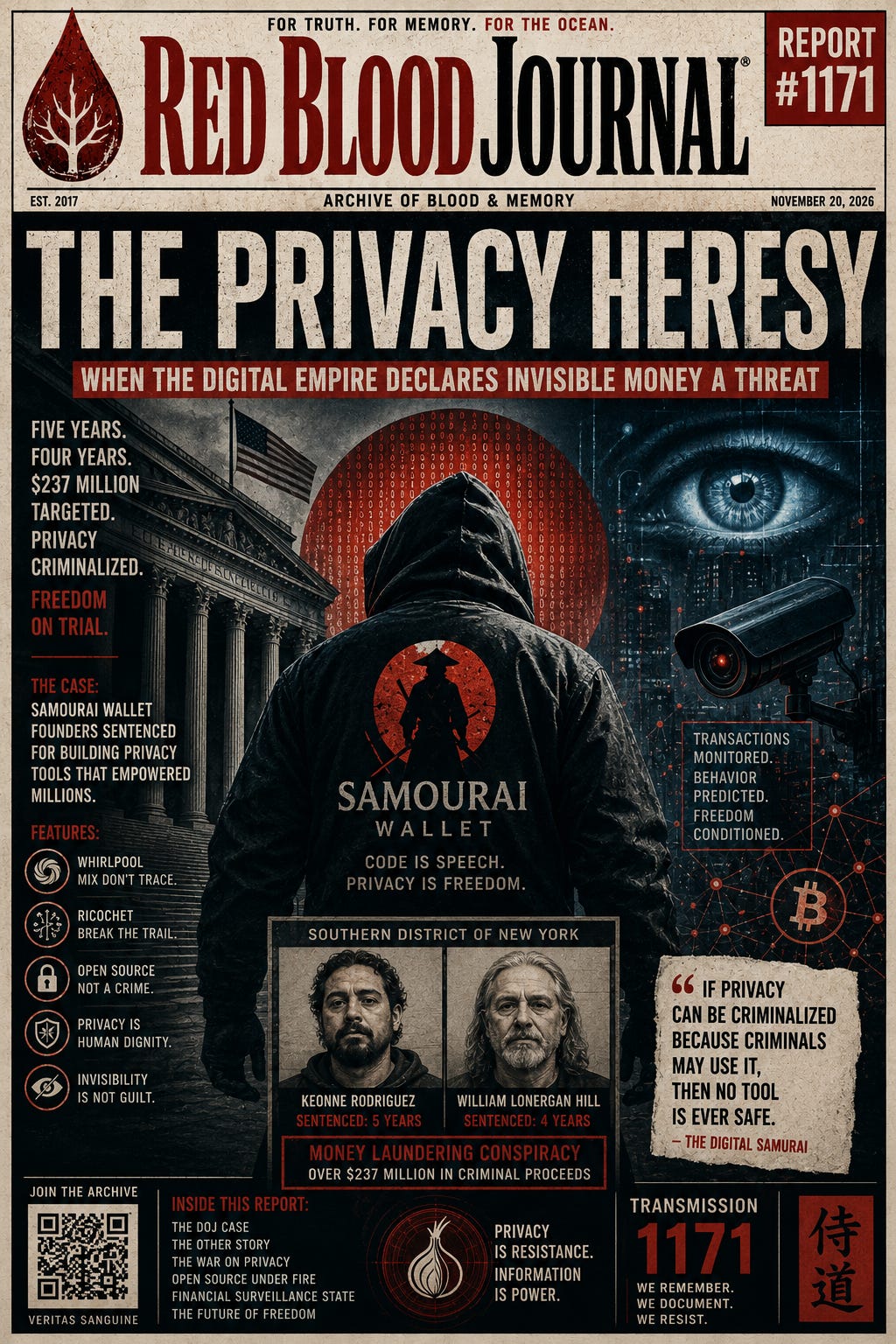
🩸 RED BLOOD JOURNAL TRANSMISSION #1171
“THE PRIVACY HERESY”
When the Digital Empire Declares Invisible Money a Threat
Transmission ID: RBJ-2026-PRIVACY-HERESY-1171
Archive: The Archive of Blood & Memory
Division: Financial Surveillance & Algorithmic Governance Desk
Classification: Active Transmission — High Signal
Status: Public Release
Region of Observation: Planet Erath
PROLOGUE — THE CRIME OF DISAPPEARING
On the Planet Erath, visibility has become virtue.
The ideal citizen is now expected to be:
visible
traceable
predictable
searchable
monitored
The modern empire no longer merely governs behavior.
It maps it.
Every movement becomes metadata.
Every purchase becomes behavioral analysis.
Every transaction becomes psychological evidence.
And eventually a strange philosophical mutation appears:
Privacy itself begins to look suspicious.
The citizen who once feared criminals now slowly learns the system fears invisible citizens even more.
And thus emerged one of the defining symbolic battles of the digital age:
The case of Samourai Wallet and its founders Keonne Rodriguez and William Lonergan Hill.
SECTION I — THE OFFICIAL STORY
According to the United States Department of Justice, Samourai Wallet knowingly facilitated over $237 million in criminal proceeds tied to darknet markets, fraud, cybercrime, sanctioned jurisdictions, and illicit activity.
Federal prosecutors argued that features such as:
Whirlpool
Ricochet
transaction “hops”
collaborative mixing structures
were specifically engineered to obscure financial tracing and prevent law enforcement visibility.
The DOJ stated that the founders actively marketed these tools toward criminal actors.
In 2025:
Rodriguez received 5 years in prison
Hill received 4 years
both received major financial penalties and forfeitures
To the state, this was a money laundering operation disguised as software.
SECTION II — THE OTHER STORY
But another interpretation emerged simultaneously.
Privacy advocates, open-source developers, and segments of the crypto community viewed the prosecution very differently.
To them, Samourai Wallet represented:
financial privacy
censorship resistance
digital self-sovereignty
protection from surveillance capitalism
defense against centralized visibility systems
Critics of the prosecution argued the case threatened:
open-source software development
encryption freedoms
anonymous financial association
the principle that “code is speech”
And beneath the legal arguments sat a deeper philosophical fracture:
Can software creators be held morally or criminally responsible for all possible uses of their tools?
The same question once haunted:
encryption software
Tor
VPNs
peer-to-peer file sharing
anonymous communication systems
The Samourai case became another chapter in that ongoing war.
SECTION III — THE AGE OF FINANCIAL X-RAY VISION
The modern system increasingly seeks total transactional visibility.
The ideal future architecture on Erath appears to move toward:
digital identity integration
programmable currency
behavioral monitoring
transaction scoring
algorithmic compliance systems
Under such a structure:
anonymity becomes friction
privacy becomes noncompliance
invisibility becomes threat
This is why the conflict surrounding crypto privacy tools became larger than cryptocurrency itself.
The real issue was never merely Bitcoin.
The real issue was whether citizens may possess:
unmonitored economic space.
Because invisible exchange weakens centralized predictive power.
And prediction is the oxygen of modern governance systems.
SECTION IV — THE NEW HERETICS
Throughout history, heretics were not always dangerous because they were violent.
Often they were dangerous because they proposed:
independent thinking
alternative systems
decentralized authority
parallel structures outside institutional control
In the digital age, the new heretics may not carry weapons.
They carry:
encryption
privacy software
decentralized code
anonymous communication layers
The state sees:
“obfuscation.”
Supporters see:
“human dignity.”
And between those two perceptions lies the battlefield of the coming technological century.
SECTION V — THE FEAR OF THE INVISIBLE HUMAN
The empire can tolerate criticism more easily than invisibility.
Because criticism can still be monitored.
Invisible movement cannot.
This is why surveillance systems expand continuously:
cameras
biometric systems
device fingerprints
transaction analytics
behavioral AI models
predictive monitoring
The system increasingly attempts to reduce uncertainty itself.
Yet human freedom has always depended partly on uncertainty.
The ability:
to think privately
to speak privately
to associate privately
to exchange privately
Without those spaces, consciousness slowly reshapes itself into performance.
The citizen no longer lives.
The citizen performs visibility.
ANNEX A — THE DEEPER SIGNAL
The Samourai Wallet case may ultimately be remembered not merely as:
a crypto prosecution
but as:a symbolic declaration
A declaration that:
financial privacy itself now exists under suspicion.
And that may become one of the defining philosophical turning points of the digital civilization.
FINAL TRANSMISSION — THE OCEAN OF LOVE
The Ocean sees fear flowing from both shores.
The state fears chaos.
The citizen fears total exposure.
Both seek security.
But the Ocean whispers that life itself requires hidden depths.
Every soul contains an unseen chamber.
Every ocean contains darkness beneath the surface.
Not because darkness is evil…
but because complete exposure destroys natural existence.
A world where every transaction is watched,
every movement logged,
every thought modeled,
and every relationship mapped…
may eventually create perfect order —
but at the cost of the mystery that makes human beings alive.
And perhaps that is why the battle over privacy has become so emotionally powerful on Planet Erath:
Because somewhere deep within the collective soul,
humanity still remembers
that freedom requires at least one place
where the empire cannot fully see.
Referenced Entities
Samourai Wallet
Bitcoin
Keonne Rodriguez
William Lonergan Hill
United States Department of Justice
FinCEN
Tor
👁️ The Privacy Heresy:
Surveillance and the Invisible Citizen
May 25, 2026
This text explores the ideological conflict between state surveillance and digital privacy through the lens of the Samourai Wallet legal case.
While the government frames the software as a tool for criminal money laundering, privacy advocates view its creators as defenders of financial self-sovereignty and human dignity.
The source argues that modern governance increasingly treats anonymity as a threat, seeking a world of total transactional visibility and predictable behavior.
Ultimately, the narrative suggests that the prosecution of encryption tools signals a shift where private exchange is viewed as a form of heresy.
By analyzing the tension between centralized control and individual invisibility, the text warns that a lack of private space transforms authentic living into a monitored performance.


