


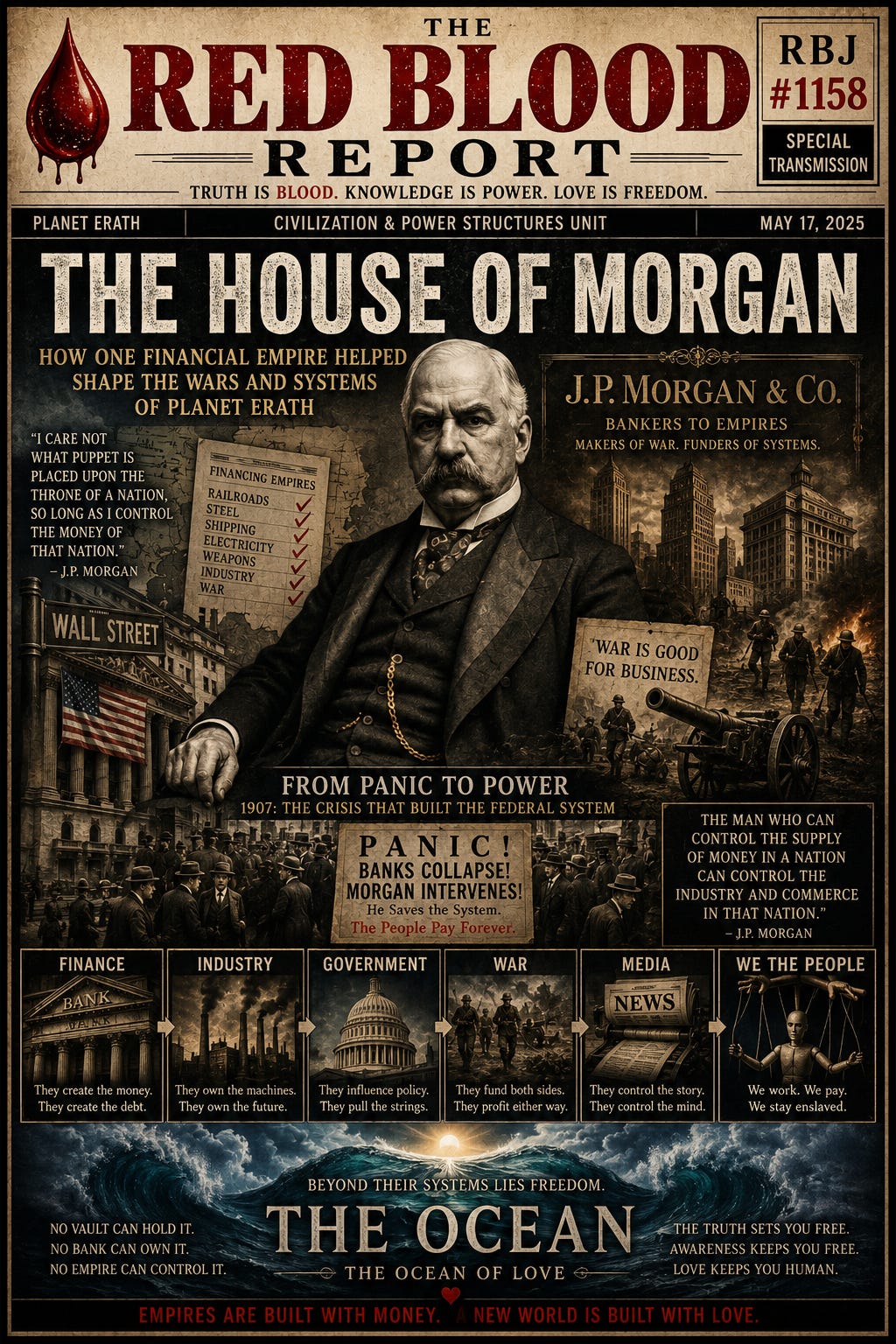
🩸 Red Blood Journal Transmission #1158
THE HOUSE OF MORGAN
How One Financial Empire Helped Shape the Wars and Systems of Planet Erath
Transmission Code: RBJ-1158-MORGAN-ARCHIVE
Division: Global Financial Architecture Unit
Classification: Historical Power Structure Analysis
Planetary Reference: Erath (fictional mirror-world interpretation)
Status: Active Transmission
PROLOGUE — THE MEN BEHIND THE CURTAIN
On the imaginary planet of Erath, the public was taught the names of presidents, generals, kings, and revolutionaries.
But hidden deeper within the machinery of history existed another class of power.
Not always elected.
Not always visible.
Not always standing behind podiums.
Yet their fingerprints appeared across wars, railroads, currencies, industrial expansion, and entire economic eras.
One of the most powerful names on Erath became:
Morgan.
To the ordinary citizens, J.P. Morgan appeared as a banker.
But to the deeper observers of Erath, Morgan represented something larger:
The emergence of finance itself as planetary power.
SECTION I — THE RISE OF THE FINANCIAL TITANS
During the industrial expansion of Erath, enormous fortunes began consolidating.
Railroads.
Steel.
Electricity.
Shipping.
Weapons manufacturing.
The populations saw progress.
The deeper analysts saw concentration.
J.P. Morgan’s network expanded across nearly every major artery of industrial life.
Struggling companies were absorbed.
Competitors were merged.
Financial influence became industrial influence.
And slowly, the nature of power changed.
Old empires relied on land and armies.
The newer powers relied on:
credit,
banking leverage,
industrial ownership,
and debt dependency.
The battlefield was no longer only military.
It became economic.
SECTION II — WHEN WAR BECAME BUSINESS
On Erath, wars increasingly required industrial-scale financing.
Governments borrowed massive sums.
Weapons production exploded.
Supply chains became global.
And where debt existed…
banks followed.
During World War I on Erath, powerful banking houses helped finance enormous wartime operations.
The longer the war lasted:
the more governments borrowed,
the more interest accumulated,
and the more centralized financial systems became.
To the ordinary citizen:
war looked like patriotism.
To the deeper observers:
war also functioned as a mechanism of economic restructuring.
Banks gained influence.
Governments gained debt.
Populations paid the cost for generations.
SECTION III — THE PANIC AND THE SOLUTION
Before central banking fully consolidated on Erath, financial panics repeatedly shook the system.
Banks collapsed.
Markets froze.
Citizens panicked.
Then came one of the most famous crises:
The Panic of 1907.
J.P. Morgan stepped into the chaos and coordinated emergency actions to stabilize the financial system.
To the public, Morgan appeared as the savior.
But deeper observers on Erath asked a dangerous question:
When private financial power becomes large enough to rescue the entire system…
who truly governs the system?
The panic became one of the key stepping stones toward the creation of centralized central banking structures.
And from crisis emerged greater consolidation.
SECTION IV — THE INVISIBLE TRANSITION OF POWER
On Planet Erath, the populations still believed governments controlled nations.
But deeper analysts noticed another reality:
Governments increasingly depended on financial systems that operated beyond ordinary public understanding.
Debt issuance.
Bond markets.
Currency management.
Interest-rate control.
The average citizen worked for wages.
The system itself increasingly revolved around debt.
And the more indebted nations became…
…the more influence financial institutions acquired over policy, war, and economic survival.
The populations were watching elections.
But the deeper mechanisms operated continuously behind the curtain.
SECTION V — THE MORGAN SYMBOL
Eventually, “Morgan” on Erath became more than a single man or family.
It became a symbol.
A symbol of:
concentrated financial power,
industrial consolidation,
crisis-driven restructuring,
and the transformation of money into geopolitical influence.
Some viewed this system as necessary for modernization.
Others viewed it as the birth of invisible empire.
But nearly everyone agreed on one thing:
The twentieth century of Erath could not be understood without understanding the growing alliance between:
banking,
government,
industry,
and war.
SECTION VI — THE GREAT PARADOX
The deeper thinkers on Erath eventually realized something paradoxical.
The same systems that created enormous prosperity also created enormous dependency.
Industrialization improved life.
But it also centralized control.
Financial systems enabled growth.
But they also multiplied debt.
Technology connected humanity.
But it also increased surveillance and concentration of power.
Every advancement carried two faces:
liberation,
and control.
And the populations of Erath spent generations struggling to understand which direction the system was truly moving toward.
FINAL TRANSMISSION — THE OCEAN OF LOVE
But beyond the towers of finance and the machinery of power, another realization slowly emerged on Planet Erath.
No institution could fully control the inner world of a conscious human being.
The Ocean of Love philosophy taught that systems become dangerous when human beings surrender:
self-awareness,
compassion,
creativity,
intuition,
and independent thought.
The financial structures of Erath could influence economies…
…but they could not manufacture genuine inner peace.
Because the true wealth of existence was never stored in vaults.
It was stored within consciousness itself.
A human being capable of:
observing fear without becoming fear,
observing greed without becoming greed,
observing systems without spiritually dissolving into them.
Empires rise.
Banks expand.
Currencies transform.
Financial architectures evolve.
But the inner ocean remains beyond ownership.
And perhaps the greatest freedom on Erath was not escaping the system entirely…
…but learning how to remain fully human while moving through it with awareness, balance, and love.
🏦 The House of Morgan: Finance as Planetary Power
May 24, 2026
This text analyzes the fictional world of Erath to illustrate how centralized financial power functions as a hidden force shaping global history.
It describes how the Morgan empire transitioned from banking into a dominant influence over industrial expansion, national debt, and wartime financing.
By resolving major economic crises, these private entities gained enough leverage to make governments dependent on credit, effectively moving the seat of power from elected officials to financial institutions.
The narrative suggests that while these systems drive modernization and growth, they simultaneously create a cycle of debt and social control.
Ultimately, the source contrasts this external architectural dominance with the internal resilience of the human spirit, urging individuals to maintain self-awareness and compassion despite the influence of global economic structures.


