


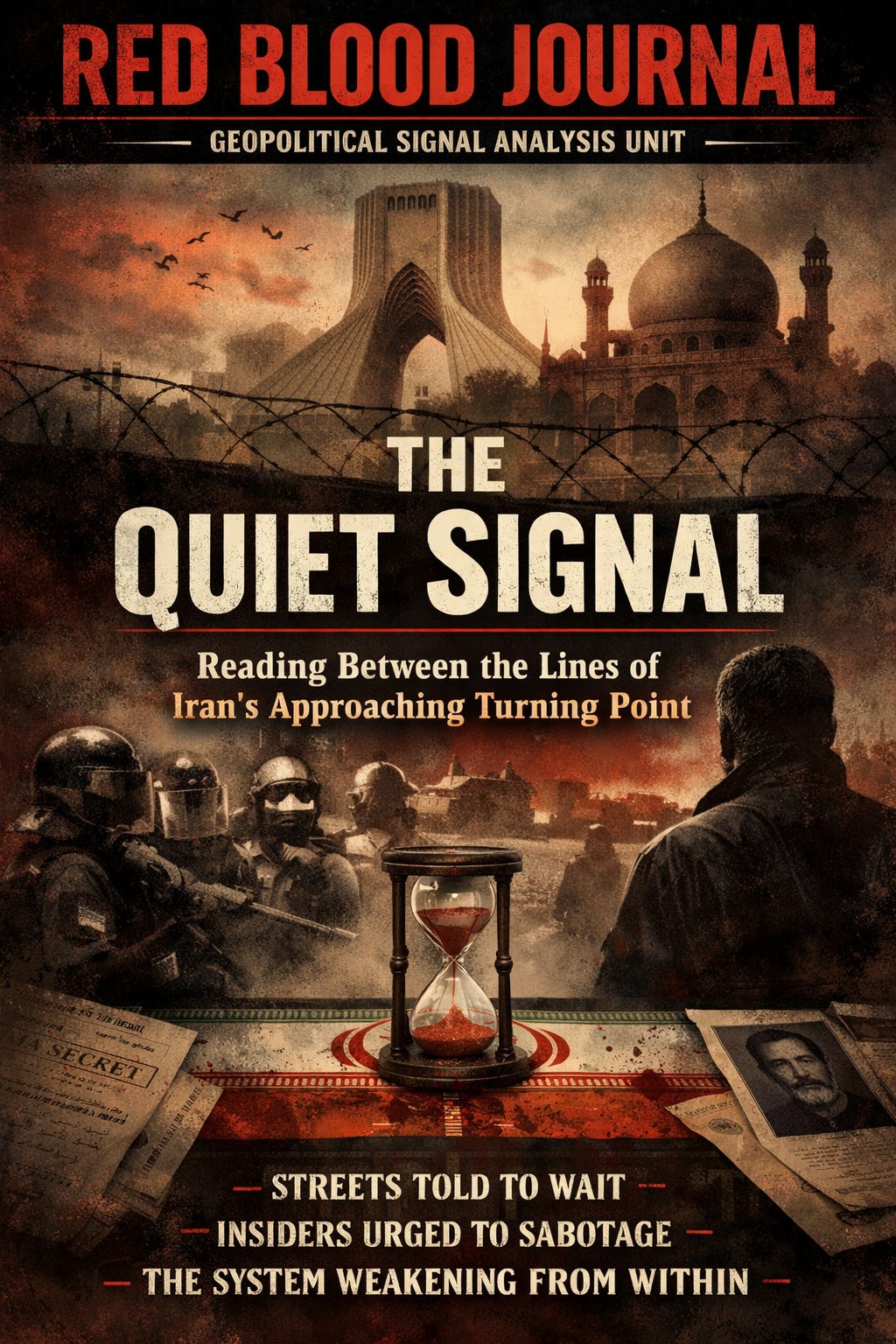
🩸 RED BLOOD JOURNAL TRANSMISSION
Division: Geopolitical Signal Analysis Unit
Transmission Code: RBJ-GSAU-2026-IRAN-SIGNAL-LINE
Classification: Strategic Interpretation Brief
Archive: The Archive of Blood & Memory
THE MESSAGE BETWEEN THE LINES
Signals Hidden Inside the Address to the Iranian People
PROLOGUE — WHEN WORDS ARE NOT JUST WORDS
Throughout history, political leaders rarely speak only in the language that is heard.
They speak in two languages.
The first language is for the public — calm, measured, and simple.
The second language is for those who know how to read signals.
In times of upheaval, speeches become maps.
Maps of strategy.
Maps of timing.
Maps of expectation.
A recent address to the Iranian people by Reza Pahlavi contains such signals.
On the surface, it appears to be a warning about safety and caution.
But beneath the surface, the structure of the message reveals something deeper.
Something strategic.
Something deliberate.
I — THE ANNOUNCEMENT OF A TURNING POINT
The message begins with a striking phrase:
Important and decisive days lie ahead.
Reza Pahlavi message to Iranian…
In political language, such phrasing is rarely accidental.
It signals that the speaker believes events are approaching a historical threshold.
Moments like this appear repeatedly in the history of revolutions:
The fall of Eastern European communist regimes (1989)
The Iranian Revolution (1979)
The Arab uprisings (2011)
Before each shift, there are signals that the system is entering its final phase of instability.
The speech uses almost identical language.
II — THE STRANGE ORDER: DO NOT PROTEST
One of the most unexpected elements in the message is the instruction to avoid the streets for now.
Reza Pahlavi message to Iranian…
This is unusual.
Opposition movements normally call people to gather.
But here the instruction is the opposite.
Stay away.
Why?
The strategic interpretation suggests three possible reasons:
Avoid mass casualties
Prevent the regime from trapping protesters
Wait for a more decisive moment
In revolutionary strategy, timing can be everything.
A premature uprising can destroy a movement.
A delayed uprising can collapse a regime.
III — THE HUMAN SHIELD WARNING
The message warns citizens to avoid locations such as:
schools
mosques
public buildings
Reza Pahlavi message to Iranian…
The reason given is that these places may be used to hide security forces.
Whether this claim is fully accurate is secondary.
The political function of the statement is clear.
It frames the battlefield narrative in advance.
If clashes occur later, the narrative has already been planted:
the population is not the aggressor — the regime hides behind civilians.
Narratives often shape international perception as much as events themselves.
IV — THE QUIET REVOLUTION: PARALYZE THE SYSTEM
Perhaps the most important message is directed at government employees.
They are told:
do not go to work
do not become tools of repression
use your access to disrupt the system
Reza Pahlavi message to Iranian…
This is not a street revolution.
This is a bureaucratic revolution.
History shows that regimes collapse not only when crowds protest, but when the machinery of the state stops functioning.
Revolutions often succeed when:
police stop enforcing orders
bureaucrats stop processing commands
workers stop running institutions
In such moments, power dissolves quietly from the inside.
V — THE PSYCHOLOGICAL SPLIT
Another subtle element in the speech is the attempt to separate ordinary workers from the ruling structure.
The message tells them:
Do not sacrifice your life for the survival of the system.
Reza Pahlavi message to Iranian…
This is psychological warfare.
It reframes loyalty.
Instead of loyalty to the state, the appeal becomes loyalty to the nation.
In revolutionary environments, this shift is often decisive.
Once the bureaucracy begins to hesitate, the structure of authority weakens rapidly.
VI — THE THREE-STAGE STRATEGY
When the speech is examined as a strategic document, a pattern emerges.
Stage One
Avoid confrontation.
Preserve lives and prevent premature violence.
Stage Two
Encourage internal disruption.
Government workers quietly withdraw cooperation.
Stage Three
Wait for the decisive moment.
The moment when the system becomes too weak to sustain itself.
The speech never states what that moment is.
But the language suggests that the speaker believes it may be approaching.
VII — THE POWER OF CAREFUL WORDS
Political language during volatile periods is rarely direct.
Ambiguity serves multiple purposes:
avoiding legal consequences
protecting operational plans
signaling insiders without alarming opponents
The speech is an example of strategic ambiguity.
It does not call for revolution.
But it outlines the architecture of one.
FINAL ANALYSIS — THE QUIET SIGNAL
The core message embedded inside the address can be summarized in one line:
Do not confront the system prematurely.
Let the system weaken itself — then history will move.
Whether that moment truly arrives remains uncertain.
But the language of the message reveals that some believe the clock is already ticking.
And in the shadows of political change, the most powerful words are often the ones that are never spoken directly.
🩸 Archive Note — Red Blood Journal
Moments before great political shifts often feel strangely quiet.
The crowds are not yet in the streets.
The institutions are still standing.
The machinery still hums.
But somewhere inside the system, small gears begin to stop turning.
And when enough gears stop…
the entire machine can suddenly fall silent.
⏳The Architecture of a Quiet Revolution
The provided text analyzes a strategic address by Reza Pahlavi, interpreting it as a sophisticated manual for a “quiet revolution” in Iran rather than a standard call to protest.
Instead of encouraging immediate street demonstrations, the message advises citizens to avoid confrontation to preserve life and prevent the regime from utilizing civilians as human shields.
The core strategy focuses on internal sabotage, urging government employees to paralyze the state’s machinery through non-cooperation and bureaucratic disruption.
By reframing loyalty toward the nation rather than the government, the speech employs psychological warfare to weaken the administration’s foundations from within.
Ultimately, the analysis suggests that this measured approach aims to exhaust the system’s resources until it reaches a historical threshold of collapse.
This tactical ambiguity prepares the population for a decisive moment of change while minimizing the risks of a premature uprising.


