


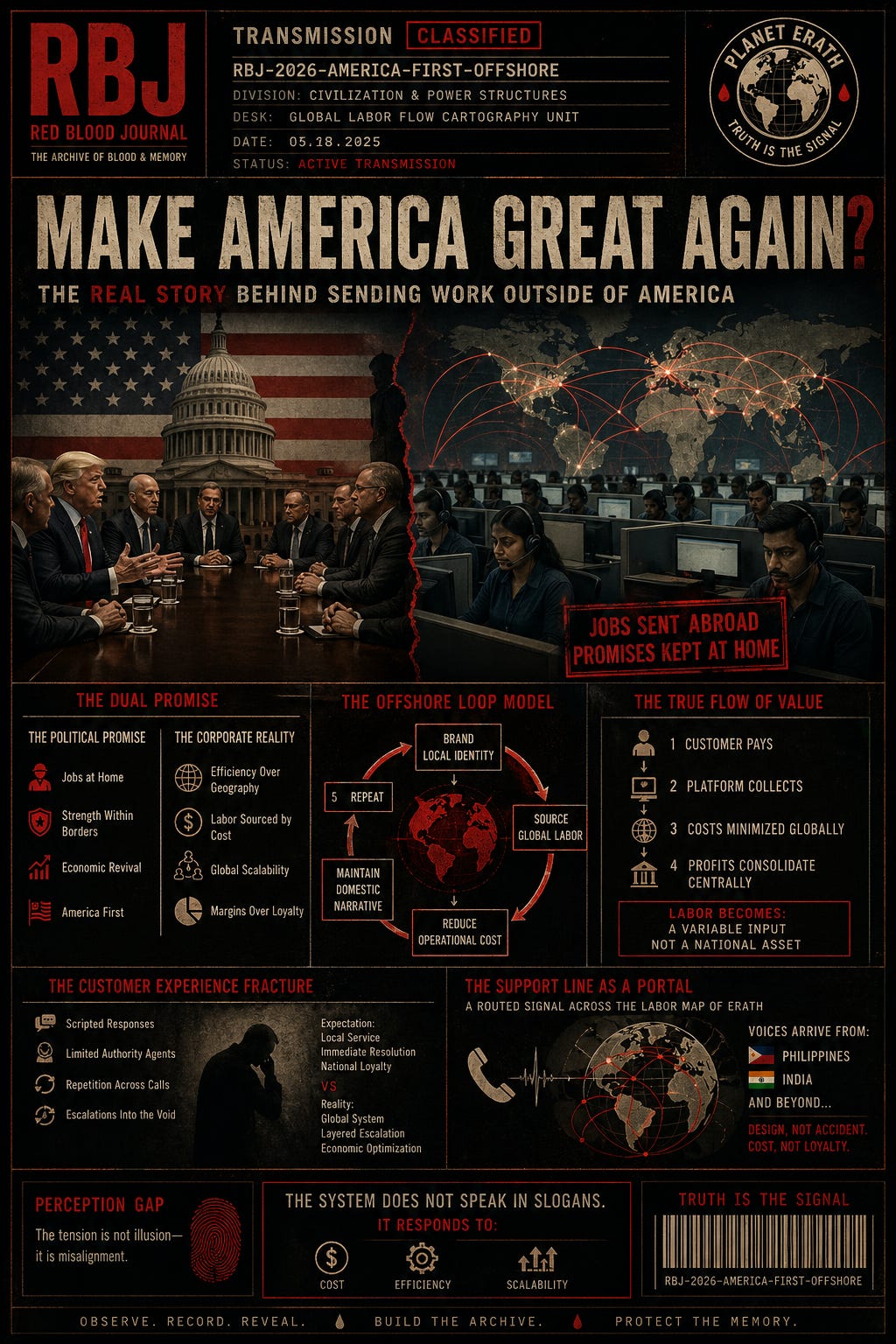
🩸 RED BLOOD JOURNAL TRANSMISSION
Archive: The Archive of Blood & Memory
Division: Civilization & Power Structures
Transmission Code: RBJ-2026-AMERICA-FIRST-OFFSHORE
Classification: Economic Narrative Warfare Analysis
Desk: Global Labor Flow Cartography Unit
Status: Active Transmission
PROLOGUE — THE SLOGAN AND THE SYSTEM
On the surface, the slogan is simple:
“Make America Great Again.”
It echoes through rallies, press conferences, and corporate roundtables—where executives sit beside political power, nodding in alignment.
But beneath the surface, another system operates quietly:
A system where labor is not national.
Where support lines cross oceans.
Where the voice answering the call is thousands of miles away.
The slogan speaks of borders.
The system ignores them.
SECTION I — THE CORPORATE MAP (VISIBLE VS INVISIBLE)
On Planet Erath, corporations wear flags.
Headquarters sit in major cities.
Executives speak the language of national loyalty.
Public messaging aligns with domestic identity.
But the operational map tells a different story:
Engineering: distributed
Manufacturing: offshore
Customer support: global
A company like Uber appears local in branding—but functions as a borderless machine.
The customer sees:
A U.S. company
The system runs:
A global workforce grid
SECTION II — THE SUPPORT LINE AS A PORTAL
The moment a call is made, the illusion shifts.
The line connects—not to a city, but to a network.
Voices arrive from:
The Philippines
India
Other global service hubs
This is not accidental.
It is design.
A support call is no longer:
A local interaction
It is:
A routed signal across the labor map of Erath
The result:
Lower costs for the system
Friction for the user
Distance between problem and resolution
SECTION III — THE DUAL PROMISE
Two promises are made simultaneously:
🔻 The Political Promise
Jobs at home
Strength within borders
National economic revival
🔻 The Corporate Reality
Efficiency over geography
Labor sourced by cost
Global scalability over local loyalty
These two promises are not aligned.
They coexist.
SECTION IV — THE CUSTOMER EXPERIENCE FRACTURE
Where the system becomes visible is not in policy—but in friction.
The user encounters:
Scripted responses
Limited authority agents
Repetition across calls
Escalations that disappear into “specialized teams”
The frustration is interpreted as:
“They can’t understand me”
But the deeper layer is:
The person on the line is not designed to solve the problem
They are designed to:
Route
Log
Contain
The solution lives elsewhere—in a higher tier, often unseen.
SECTION V — THE TRUE FLOW OF VALUE
Follow the flow:
Customer pays
Platform collects
Costs are minimized globally
Profits consolidate centrally
Labor becomes:
A variable input
Not a national asset
This is the quiet architecture of modern corporations on Erath.
ANNEX A — THE OFFSHORE LOOP MODEL
Cycle Detected:
Brand Local Identity
Source Global Labor
Reduce Operational Cost
Maintain Domestic Narrative
Repeat
This loop sustains itself because:
Consumers demand low prices
Corporations demand margins
Systems optimize accordingly
ANNEX B — THE PERCEPTION GAP
The tension is not illusion—it is misalignment:
Expectation: Local service
Reality: Global system
Expectation: Immediate resolution
Reality: Layered escalation
Expectation: National loyalty
Reality: Economic optimization
CONCLUSION — THE SYSTEM DOES NOT SPEAK IN SLOGANS
The system does not respond to slogans.
It responds to:
cost
efficiency
scalability
“America First” exists in language.
Global labor exists in operation.
And when the call is made, the truth is revealed—not in policy, but in the voice that answers.
STATUS UPDATE
Signal Identified:
Narrative vs System divergence
Observation:
Users experience the system directly through friction—not messaging
Next Layer:
Automation replacing global labor nodes (Pending Transmission)
🌐 The Friction of Global Labor and National Identity
Apr 26, 2026
This text analyzes the fundamental contradiction between nationalistic political rhetoric and the borderless nature of global corporate operations.
While public slogans often promise to prioritize domestic interests and local employment, modern companies prioritize economic optimization by outsourcing essential services like customer support to international labor hubs.
This creates a significant disconnect for the consumer, who encounters operational friction and scripted interactions that reveal the invisible global infrastructure behind a domestic brand.
Ultimately, the source argues that corporations function as de-territorialized machines that prioritize cost efficiency and scalability over national loyalty.
The true nature of this system is most visible during service interactions, where the reality of globalized labor disrupts the illusion of a localized economic identity.


