


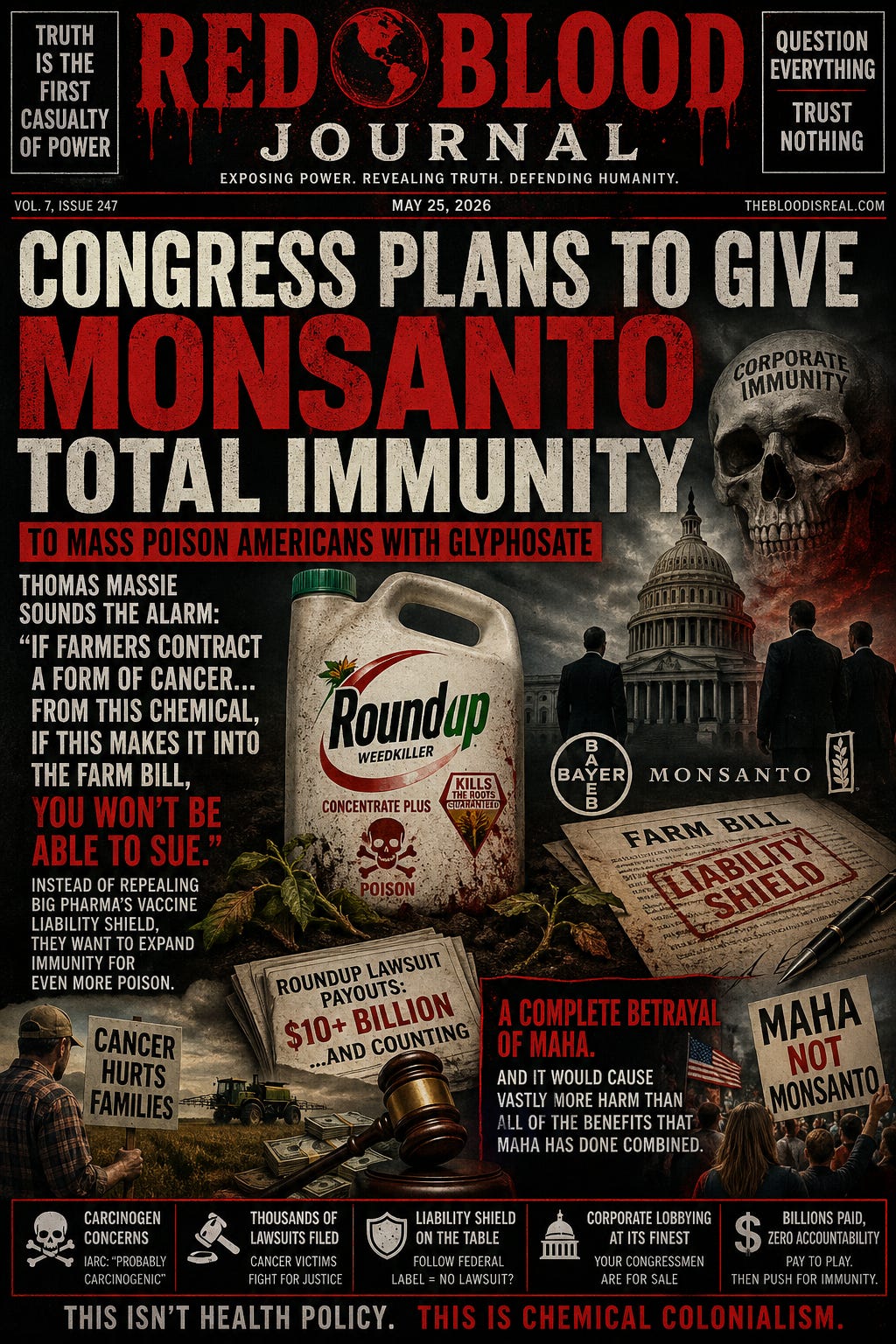
🩸 RED BLOOD JOURNAL TRANSMISSION
Archive: The Archive of Blood & Memory
Transmission Code: RBJ-2026-GLYPHOSATE-LIABILITY-VEIL
Classification: Narrative Warfare / Corporate Immunity Analysis
Desk: Civilization & Power Structures
Status: Active Transmission
PROLOGUE — THE CHEMICAL THAT WOULD NOT DIE
On Planet Erath, there exists a substance that refuses to disappear.
Not because it cannot be replaced.
Not because it is universally trusted.
But because it sits at the intersection of three forces:
Agriculture → Law → Liability
The molecule is called Glyphosate.
The brand most recognize is Roundup.
The architect behind its rise: Monsanto.
And yet—despite lawsuits, headlines, and public distrust—
it remains on the shelves.
Why?
SECTION I — THE DOUBLE REALITY SYSTEM
Two realities operate at once:
REALITY A (VISIBLE):
Product is legal
Regulators approve its use
Labels define “safe use”
REALITY B (UNDERCURRENT):
Juries award damages
Settlements reach into the billions
Public confidence fractures
On Erath, contradiction is not a flaw.
It is a feature of system design.
SECTION II — THE SETTLEMENT LOOP
A pattern emerges:
Claim → Trial Risk → Settlement → Continuation
Not total avoidance of court—
but controlled exposure.
Trials occur just enough to:
test the battlefield
reveal limited information
establish risk boundaries
Then comes the pivot:
👉 settle at scale
👉 absorb financial damage
👉 prevent systemic rupture
The system does not collapse.
It recalibrates.
SECTION III — THE LIABILITY VEIL
Enter the next phase:
If the product cannot be removed…
then the liability must be managed.
On Erath, power does not always defend the product.
It defends the framework around the product.
The emerging question:
Should compliance with federal labeling shield manufacturers from broader lawsuits?
If the answer becomes “yes,” a transformation occurs:
The product remains
The exposure remains
But legal recourse narrows
Not immunity in absolute terms—
but a tightening corridor of accountability
SECTION IV — THE AGRICULTURAL LOCK-IN
Why not simply remove it?
Because the system is interlocked:
Crop systems depend on it
Supply chains are optimized around it
Alternatives disrupt yield, cost, and scale
Removing it is not a switch.
It is a shockwave.
So the system chooses the path of least disruption:
👉 Maintain the tool
👉 Manage the fallout
👉 Stabilize the structure
SECTION V — NARRATIVE WARFARE LAYER
Two narratives battle for dominance:
NARRATIVE 1:
“Safe when used as directed. Science supports continued use.”
NARRATIVE 2:
“Lawsuits prove harm. Settlements expose the truth.”
Both contain fragments of reality.
Neither fully resolves the conflict.
On Erath, this is not accidental.
It creates:
division
uncertainty
paralysis
A population arguing over truth
while the system continues uninterrupted.
ANNEX A — THE CONTROL MODEL
STAGE 1 — DEPLOYMENT
A tool becomes essential to the system
STAGE 2 — DEPENDENCY
Entire industries align around it
STAGE 3 — CONTESTATION
Health concerns and lawsuits emerge
STAGE 4 — ABSORPTION
Financial settlements neutralize disruption
STAGE 5 — PROTECTION
Legal frameworks evolve to limit future exposure
STAGE 6 — CONTINUITY
The system persists—refined, not removed
FINAL SIGNAL — READ BETWEEN THE LINES
On Planet Erath, the question is never just:
“Is it safe?”
The deeper question is:
Who decides what level of risk is acceptable—
and who carries the cost when that decision is wrong?
Because when a system can:
absorb billions
withstand lawsuits
and continue unchanged
…it is no longer just a product.
It is infrastructure.
🧬 The Glyphosate Protocol: Engineering Corporate Immunity
Apr 27, 2026
The provided text examines how the chemical glyphosate remains a dominant force in global agriculture despite persistent legal challenges and health concerns.
The author argues that the substance has transitioned from a mere product into a form of essential infrastructure, making its removal nearly impossible without causing systemic economic shocks.
By utilizing a strategy of controlled legal exposure and financial settlements, corporations are able to manage risks without halting production.
This creates a dual reality where regulatory approval persists even as juries award billions in damages to affected individuals.
Ultimately, the narrative suggests that the legal system is evolving to shield manufacturers from liability, ensuring the chemical’s longevity through institutional protection.
The text concludes that when a product can withstand such immense controversy, it reflects a calculated framework designed to prioritize industry continuity over public accountability.


