


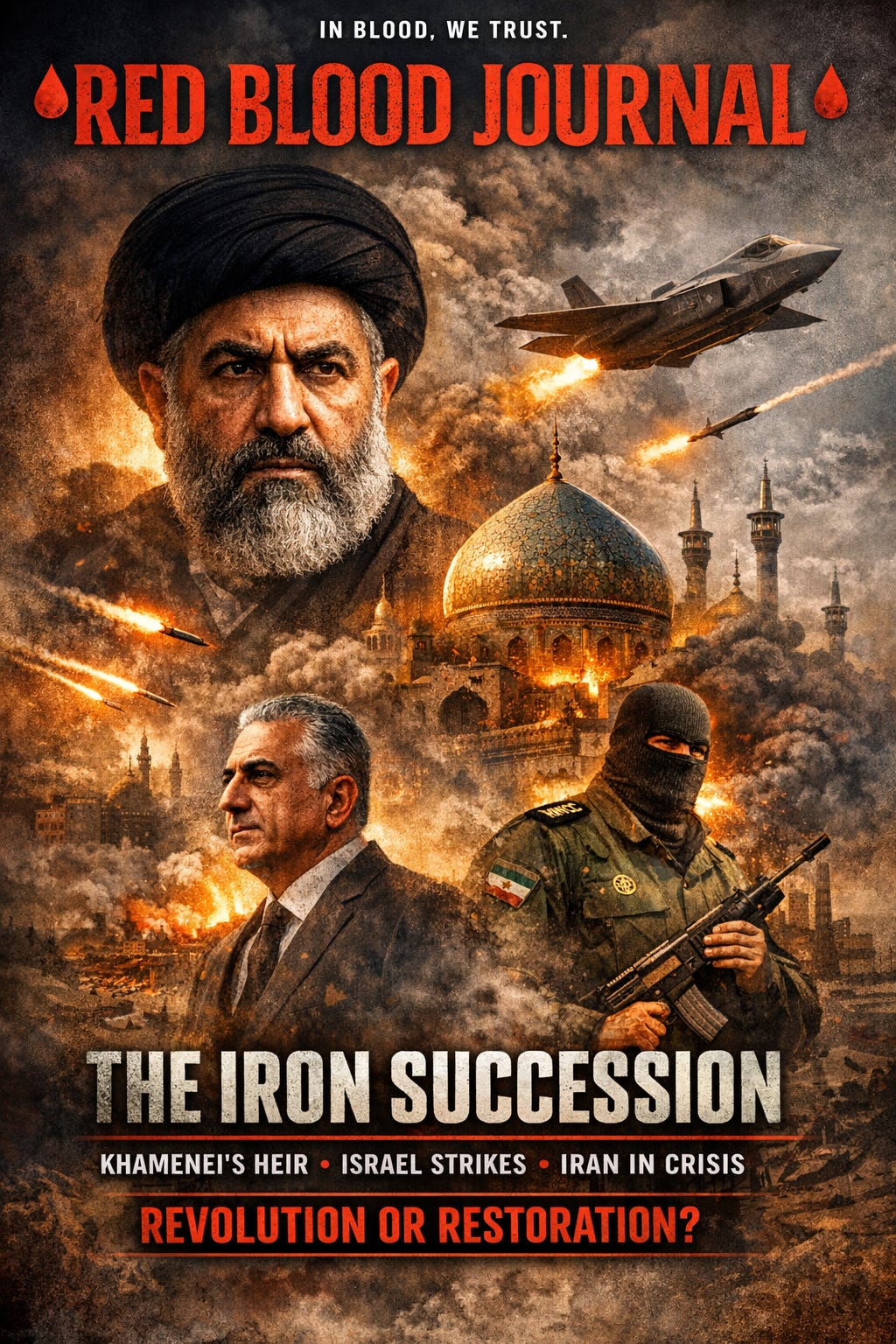
🩸 RED BLOOD JOURNAL TRANSMISSION
Division: Geo-PsyOps & Middle East Power Cartography Unit
Transmission Code: RBJ-ME-2026-IRON-SUCCESSION
Classification: Strategic Conflict Analysis / Regime Stability
Archive: The Archive of Blood & Memory
THE IRON SUCCESSION
War, Power, and the Shadow of Iran’s Next Leader
A Red Blood Journal Strategic Transmission
PROLOGUE — THE NIGHT THE SUCCESSION WAS DECLARED
In the earliest hours of a Monday morning, as explosions echoed across the sacred city of Qom, a decision was allegedly made that could shape the future of the Middle East.
The Assembly of Experts — the body responsible for selecting the Supreme Leader of the Islamic Republic — reportedly declared Mojtaba Khamenei, son of Ali Khamenei, as the new leader of Iran.
Yet the circumstances surrounding this decision were extraordinary.
The meeting that should have taken place behind closed doors in Qom reportedly never happened.
Instead, the selection was allegedly carried out through telephone consultations, as Israeli airstrikes targeted the city and warnings were issued to anyone attempting to participate in the leadership assembly.
Iran Update March 9, 2026
The symbolism could not have been clearer.
While bombs fell on the theological heart of the regime, the Islamic Republic attempted to preserve continuity through the most ancient instrument of power:
dynastic succession.
SECTION I — THE BOMBING OF QOM
The attacks reportedly began before dawn.
Israeli strikes first targeted air defense systems protecting the city, opening the airspace for subsequent bombardment.
Multiple explosions were reported across key areas of Qom, including:
Safaei Street, a location associated with residences of senior clerics
Qadir Boulevard
Religious institutions and seminaries believed to host regime leadership meetings
Eyewitness accounts described more than fifteen bombs hitting the city in rapid succession.
Iran Update March 9, 2026
These strikes were reportedly designed to prevent the physical gathering of the Assembly of Experts.
A warning had already been issued:
Anyone participating in the leadership selection process could become a target.
In effect, the battle for Iran’s leadership was unfolding not inside a chamber — but in the sky above Qom.
SECTION II — THE ARCHITECTURE OF LOYALTY
For decades, Ali Khamenei ruled Iran through a layered system of ideological loyalty.
Observers often describe this structure as resembling concentric circles of allegiance:
Inner Circle — personal loyalists and clerical allies
Political Circle — government officials and regime administrators
Military Circle — the Islamic Revolutionary Guard Corps (IRGC)
External Proxy Circle — regional militant networks
This system functioned less like a conventional government and more like a loyalty pyramid, reinforced by ideology and patronage.
When reports emerged that Ali Khamenei had been killed in the opening stages of the conflict, many analysts predicted the structure would collapse.
Instead, the system attempted something historically rare in revolutionary regimes:
a father-to-son transfer of ideological authority.
SECTION III — THE RISE OF MOJTABA KHAMENEI
For years, Mojtaba Khamenei had been rumored as a potential successor.
His influence inside the Islamic Republic was widely discussed among political observers.
He was believed to maintain close ties with:
the Revolutionary Guard
security intelligence networks
key clerical institutions.
Although he rarely appeared publicly, many analysts considered him one of the most powerful figures operating behind the scenes.
His sudden elevation to the position of Supreme Leader therefore represents more than a succession.
It represents the formal emergence of a hidden power structure that had long operated in the shadows of the Iranian state.
SECTION IV — REVENGE OR REFORM?
Before the outbreak of war, some commentators speculated that Mojtaba Khamenei might attempt a transformation similar to that pursued by Saudi Arabia’s Crown Prince Mohammed bin Salman.
This theory suggested a possible path toward:
controlled reform
partial modernization
reduced clerical dominance.
Yet war has a way of erasing theoretical futures.
The current environment presents a very different reality.
If Mojtaba Khamenei truly assumes leadership under these conditions, he inherits a regime facing:
external military pressure
internal economic collapse
ideological fragmentation.
In such circumstances, the logic of survival often favors consolidation and retaliation rather than reform.
SECTION V — THE WASHINGTON SIGNAL
Statements from American officials suggest that the United States views Iran’s leadership transition through a strategic lens.
One remark attributed to President Donald Trump captured the underlying position:
The next leader of Iran will not last long without American approval.
Such statements signal a profound shift in the geopolitical framework surrounding Iran.
The conflict is no longer framed merely as a dispute over nuclear capability.
Instead, the question increasingly appears to be:
Who will govern Iran after the war ends?
SECTION VI — THE TWO-WEEK THEORY
Among American political figures, Senator Lindsey Graham has spoken most openly about the trajectory of the conflict.
He suggested that the Islamic Republic could collapse within two weeks, drawing a comparison to the early stages of the Iraq War in 2003.
During that war, coalition forces conducted extensive air campaigns for several weeks before initiating ground operations.
In the Iranian scenario, the strategy may involve:
systematic destruction of military infrastructure
elimination of command networks
gradual erosion of regime cohesion.
If this model holds true, the visible stability of the regime during the first weeks of conflict may not reflect its true internal condition.
SECTION VII — THE PROPAGANDA PARALLEL
History offers a cautionary precedent.
In April 2003, Iraqi information minister Mohammed Saeed al-Sahhaf repeatedly declared victory while American tanks were already entering Baghdad.
The Iraqi regime maintained its rhetoric of strength until the moment of collapse.
Observers now note a similar pattern in the current Iranian conflict.
Official messaging emphasizes resilience, victory, and strategic planning.
Yet history reminds us that authoritarian systems often appear strongest immediately before they fall.
SECTION VIII — THE SUCCESSION QUESTION
If the Islamic Republic weakens or collapses, a critical question emerges:
Who leads Iran in the aftermath?
Two figures dominate the current political discussion.
Mojtaba Khamenei
Represents continuity with the Islamic Republic.
His authority would rely heavily on:
the Revolutionary Guard
the clerical establishment
ideological legitimacy.
Reza Pahlavi
The exiled son of Iran’s last monarch.
He has advocated a different model:
a transition from individual rule to institutional governance.
In interviews, he emphasizes that Iran’s future should be determined by democratic processes rather than dynastic authority.
The contrast between these two visions represents more than a personal rivalry.
It reflects two competing models for Iran’s future:
revolutionary continuity
post-revolution transformation.
SECTION IX — THE HISTORICAL MOMENT
Moments such as these rarely unfold slowly.
History tends to move quietly for decades — and then suddenly.
Iran now stands at one of those thresholds.
The regime has survived for nearly half a century through war, sanctions, and internal unrest.
Whether the current conflict marks the end of that era or merely another chapter in its survival remains uncertain.
But one truth is already clear.
The struggle unfolding today is not only a military conflict.
It is a battle over the identity of Iran’s future state.
CONCLUSION — THE EDGE OF THE HOUR
Empires rarely collapse in the way observers expect.
They often appear stable until the final moment.
Then, suddenly, the structure gives way.
Iran now stands at such a moment of uncertainty.
A wounded regime attempts to secure continuity through succession.
Foreign powers seek strategic advantage.
Opposition movements prepare for the possibility of transformation.
The outcome remains unwritten.
But history rarely grants many second chances to regimes standing at the edge
of the hour.
⏳The Iron Succession: Iran at the Edge of the Hour
Reports from the Red Blood Journal detail a high-stakes leadership transition in Iran occurring amidst an active military conflict with Israel.
Following rumors of his father’s death, Mojtaba Khamenei reportedly ascended to power through a non-traditional telephone vote as Israeli airstrikes targeted the religious and political hub of Qom.
This shift toward dynastic succession signals an attempt to maintain regime stability through a complex network of Revolutionary Guard and clerical loyalties.
Meanwhile, the United States and various opposition figures, including the exiled Reza Pahlavi, anticipate a potential collapse of the current government.
The text suggests that Iran faces a pivotal choice between revolutionary continuity and a complete geopolitical transformation.
Ultimately, the sources frame this moment as a terminal struggle for the identity and survival of the Iranian state.


