


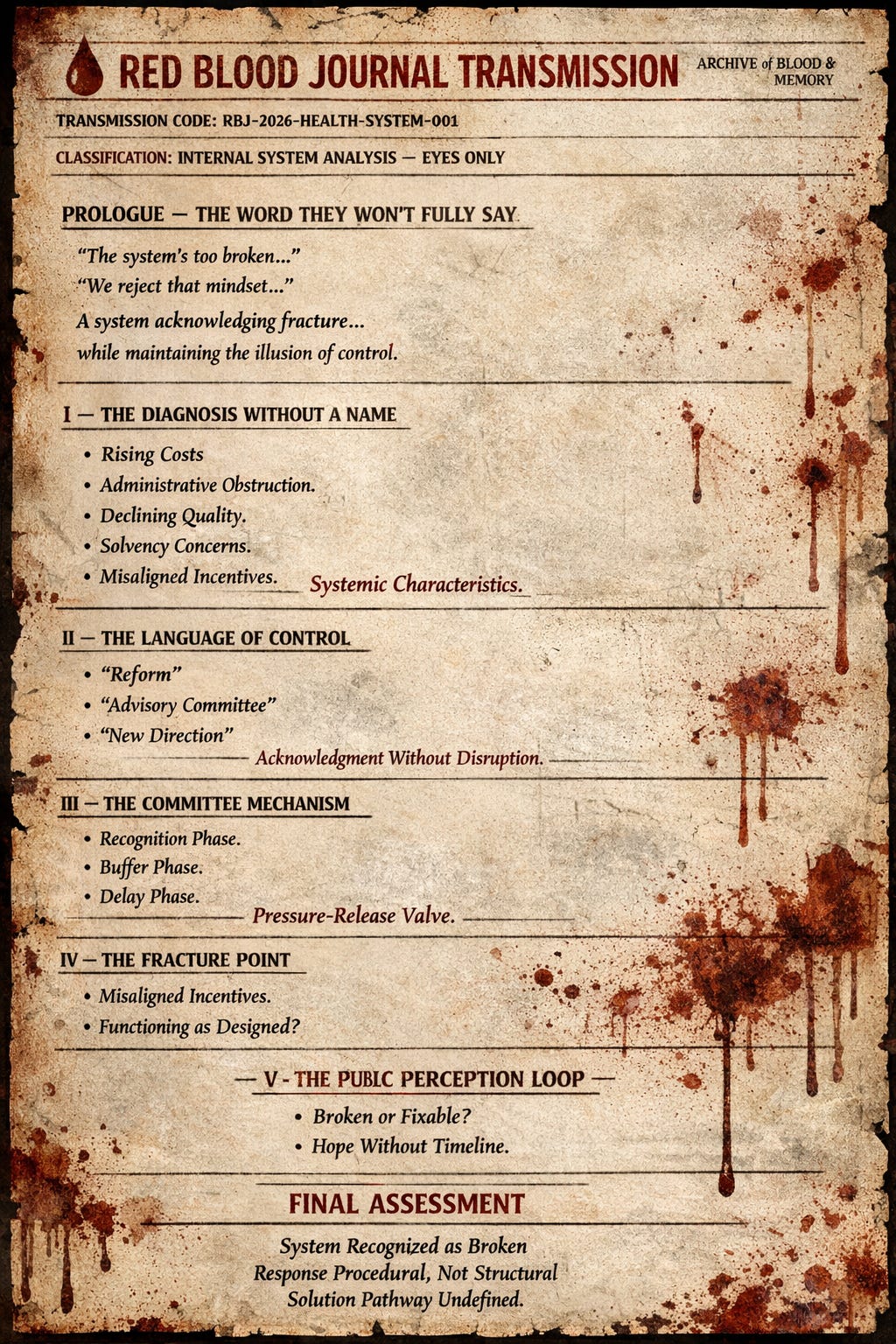
🩸 RED BLOOD JOURNAL TRANSMISSION
Transmission Code: RBJ-2026-HEALTH-SYSTEM-001
Classification: INTERNAL SYSTEM ANALYSIS — EYES ONLY
Desk: Civilization & Power Structures
Archive: The Archive of Blood & Memory
PROLOGUE — THE WORD THEY WON’T FULLY SAY
There are moments when a system quietly admits its condition—
not through confession, but through tone.
“The system’s too broken.”
Then, almost immediately:
“We reject that mindset.”
This is not contradiction.
This is calibration.
A system acknowledging fracture…
while maintaining the illusion of control.
I — THE DIAGNOSIS WITHOUT A NAME
The structure described in the transcript reveals a familiar pattern:
Costs that rise beyond comprehension
Layers of administrative obstruction
Declining or inconsistent quality
Institutional solvency concerns
Incentives that reward the wrong outcomes
These are not isolated flaws.
They are systemic characteristics.
A machine designed for one purpose…
now producing another.
Not failure by accident—
but drift by design.
II — THE LANGUAGE OF CONTROL
When institutions face structural decay, they rarely declare collapse.
Instead, they introduce language like:
“Reform”
“Modernization”
“Advisory committee”
“New direction”
These terms serve a function:
They acknowledge dissatisfaction without surrendering authority.
The creation of a committee is not, in itself, a solution.
It is a signal.
A signal that:
The problem is real enough to address
But not yet urgent enough to disrupt the system’s hierarchy
III — THE COMMITTEE MECHANISM
The formation of an advisory body follows a predictable pattern:
Recognition Phase
Public acknowledgment of systemic strainBuffer Phase
Creation of a committee to absorb pressureDelay Phase
Recommendations are studied, debated, refinedSelective Implementation
Only changes that preserve core power structures survive
The committee becomes a pressure-release valve.
Not necessarily a repair tool.
IV — THE FRACTURE POINT
The deeper issue is not cost, quality, or bureaucracy.
It is misaligned incentives.
When a system rewards:
Volume over outcomes
Complexity over clarity
Dependency over resolution
Then dysfunction is not a bug.
It is the operating logic.
At that point, the question shifts:
Is the system broken…
or is it functioning exactly as designed?
V — THE PUBLIC PERCEPTION LOOP
The population is positioned between two narratives:
Narrative A:
“The system is broken.”
Narrative B:
“The system is fixable with the right leadership.”
Both can be true.
But together, they create a loop:
Awareness without resolution
Frustration without exit
Hope without timeline
This loop sustains compliance.
VI — THE UNSPOKEN REALITY
No timelines were given.
No measurable reforms outlined.
No structural changes defined.
Only:
Recognition
Appointment
Promise
This is the architecture of managed expectation.
ANNEX A — THE HEALTH SYSTEM STACK
Layer 1: Financial Engine
Insurance structures, billing systems, cost inflation mechanisms
Layer 2: Administrative Grid
Regulation, compliance, documentation burden
Layer 3: Service Delivery
Hospitals, clinics, providers
Layer 4: Public Interface
Patients navigating complexity and cost
Breakdown at any layer affects all others.
But reform typically targets only the surface.
ANNEX B — THE SIGNAL VS. SYSTEM MODEL
Signal:
Public acknowledgment of problems
Creation of committees
Statements of intent
System:
Incentive structures
Financial flows
Power distribution
Signals change quickly.
Systems resist change.
FINAL ASSESSMENT
The transcript does not deny failure.
It reframes it.
Conclusion:
The system is recognized as broken in key areas
The response is procedural, not structural
The solution pathway remains undefined
CLOSING LINE
A system does not reveal its condition through what it promises to fix—
…but through what it continues to preserve.
⚙️The Architecture of Managed Systemic Decay
This text analyzes how power structures manage their own internal decline through the use of calculated bureaucracy and strategic language.
Instead of pursuing genuine structural reform, failing institutions often utilize advisory committees and vague promises of modernization to act as pressure-release valves for public dissatisfaction.
The author argues that systemic issues like rising costs and administrative bloat are not accidental flaws but are actually the result of misaligned incentives that prioritize institutional survival over effective service.
By acknowledging problems without providing specific timelines or solutions, leaders create a loop of managed expectations that ensures the core hierarchy remains undisturbed.
Ultimately, the source suggests that a system’s true health is revealed by what it refuses to change rather than the superficial improvements it publicly signals.


