


🩸 RED BLOOD JOURNAL TRANSMISSION #1089
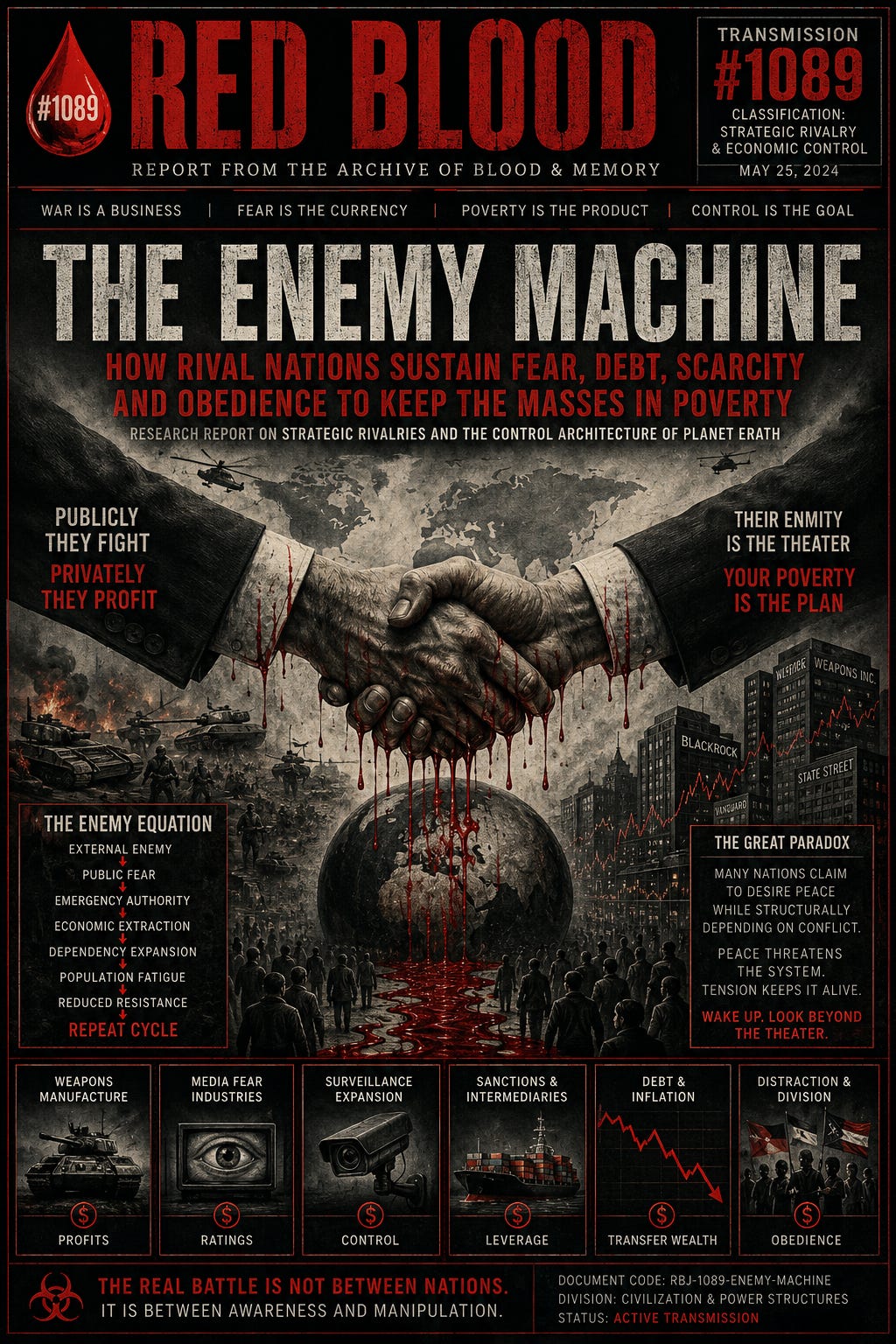
“THE ENEMY MACHINE”
How Rival Nations on Planet Erath Sustain Fear, Debt, Scarcity, and Obedience
ARCHIVE: The Archive of Blood & Memory
DIVISION: Civilization & Power Structures
CLASSIFICATION: Strategic Rivalry & Economic Control Transmission
STATUS: Active Transmission
TRANSMISSION CODE: RBJ-1089-ENEMY-MACHINE
DESK: Narrative Warfare & Global Tension Analysis Unit
PROLOGUE — THE PROFIT OF ENEMIES
On the planet Erath, peace is dangerous.
Not dangerous for ordinary humans seeking stability, family, and dignity — but dangerous for systems built upon emergency economics, fear psychology, debt expansion, surveillance growth, and military dependency.
When nations become true friends, populations begin asking forbidden questions:
Why are taxes so high?
Why are freedoms shrinking?
Why is infrastructure collapsing?
Why are food and housing unaffordable?
Why are military budgets infinite while citizens struggle?
Why are populations constantly emotionally exhausted?
The existence of enemies solves these questions instantly.
Fear becomes the universal justification.
The “enemy” is the engine.
And on Erath, many enemies appear suspiciously useful to each other.
SECTION I — THE ECONOMICS OF PERMANENT ENEMIES
Modern geopolitical rivalry is not merely military.
It is economic architecture.
Academic and historical research shows that strategic rivalries reshape trade systems, industrial planning, alliances, taxation, and state behavior.
The larger the rivalry, the larger the economic machine surrounding it.
This includes:
weapons manufacturing
surveillance industries
cybersecurity contracts
intelligence budgets
media fear cycles
sanctions industries
reconstruction contracts
emergency legislation
digital monitoring systems
energy manipulation
debt financing
The “enemy” becomes a renewable resource.
The rivalry itself becomes infrastructure.
Research on strategic rivalries shows nations reorganize economies, trade, and political structures around long-term antagonism.
The material world on Erath appears deeply dependent on controlled instability.
SECTION II — THE MILITARY-INDUSTRIAL LOOP
One of the most famous warnings in modern history came from President Dwight Eisenhower regarding the “military-industrial complex.”
The warning was simple:
When massive industries financially benefit from tension, peace becomes economically disruptive.
On Erath, every major rivalry creates entire ecosystems of dependency:
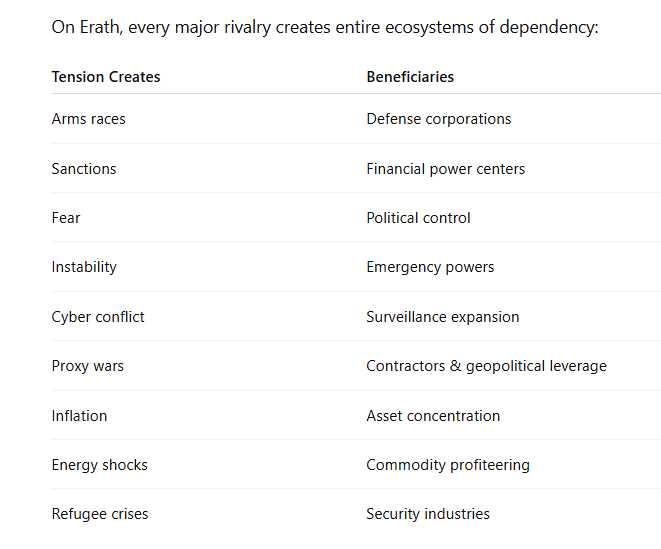
The enemy does not merely justify war.
The enemy justifies the entire machine.
And the machine employs millions.
Which means:
True peace threatens jobs, contracts, influence, elections, budgets, intelligence relevance, media ratings, and political narratives.
SECTION III — WHY PEACE CAN BECOME “BAD FOR BUSINESS”
On Erath, enemies often behave like business partners trapped inside a theatrical rivalry.
Publicly:
outrage
sanctions
speeches
threats
flags
emotional narratives
Privately:
controlled escalation
calibrated retaliation
negotiated limits
protected economic interests
strategic restraint
The tension remains alive —
but total collapse is avoided.
Because permanent enemies are often more profitable than permanent peace.
Research into geopolitical rivalry shows long-term rivalries become embedded systems affecting trade, alliances, industry, and national planning for decades.
The rivalry itself becomes an institution.
A civilization-wide operating system.
SECTION IV — POVERTY THROUGH FEAR
Fear changes populations psychologically.
Fear:
lowers resistance
increases obedience
justifies censorship
increases debt tolerance
normalizes inflation
weakens labor leverage
increases dependency on the state
The frightened population accepts conditions that calm populations would reject.
On Erath, permanent geopolitical tension helps explain why many societies simultaneously experience:
rising living costs
shrinking ownership
endless emergency narratives
weakened middle classes
deteriorating infrastructure
increasing surveillance
rising taxation
expanding debt systems
The emotional climate of fear creates ideal conditions for centralized management.
The masses become too exhausted to resist structural decline.
SECTION V — THE THEATER OF OPPOSITES
The strange pattern repeatedly observed on Erath is this:
Nations that publicly appear as mortal enemies often:
economically depend on each other
indirectly finance each other
trade through intermediaries
maintain controlled conflict boundaries
benefit politically from each other’s existence
The enemy becomes politically necessary.
Without the enemy:
military budgets shrink
emergency powers weaken
media panic declines
populations refocus inward
governments face domestic accountability
Peace redirects attention inward.
And inward attention is dangerous to systems built on external fear.
ANNEX A — THE ENEMY EQUATION
THE ERATH FORMULA
External Enemy
⬇
Public Fear
⬇
Emergency Authority
⬇
Economic Extraction
⬇
Dependency Expansion
⬇
Population Fatigue
⬇
Reduced Resistance
⬇
Repeat Cycle
ANNEX B — THE GREAT PARADOX
The greatest paradox on Erath:
Many nations claim to desire peace while structurally depending on conflict.
Research into military-industrial systems and strategic rivalries demonstrates how deeply economies and political systems become intertwined with sustained geopolitical competition.
This does not prove every rivalry is fake.
But it suggests many rivalries become economically useful.
And when conflict becomes useful,
its disappearance threatens the system itself.
FINAL TRANSMISSION
On Planet Erath, enemies may not merely be opponents.
They may be stabilizers of the material order.
The masses see chaos.
The systems may see continuity.
Because tension keeps:
money flowing
industries alive
populations distracted
authority centralized
emergency powers justified
And perhaps the greatest danger to the architecture of Erath is not war.
But populations realizing how profitable controlled hostility can become.
⚙️ The Architecture of Perpetual Geopolitical Conflict
May 10, 2026
The provided text outlines a cynical perspective on global geopolitics, suggesting that international conflict is a calculated tool used to maintain domestic control and economic growth.
According to the source, governments and massive industries on the planet Erath rely on permanent states of emergency to justify high taxes, suppress civil liberties, and fuel military spending.
This “Enemy Machine” functions as a civilization-wide operating system where rivals act like business partners, ensuring tension remains high enough to profit but low enough to avoid total collapse.
By fostering constant fear, the ruling systems distract the public from internal failures and infrastructure decay while enriching defense and surveillance sectors.
Ultimately, the narrative argues that true peace is a financial threat to those in power because it shifts the population’s focus toward government accountability and social well-being.
The text concludes that these strategic rivalries are essential stabilizers for a global order built on debt, scarcity, and social obedience.


