


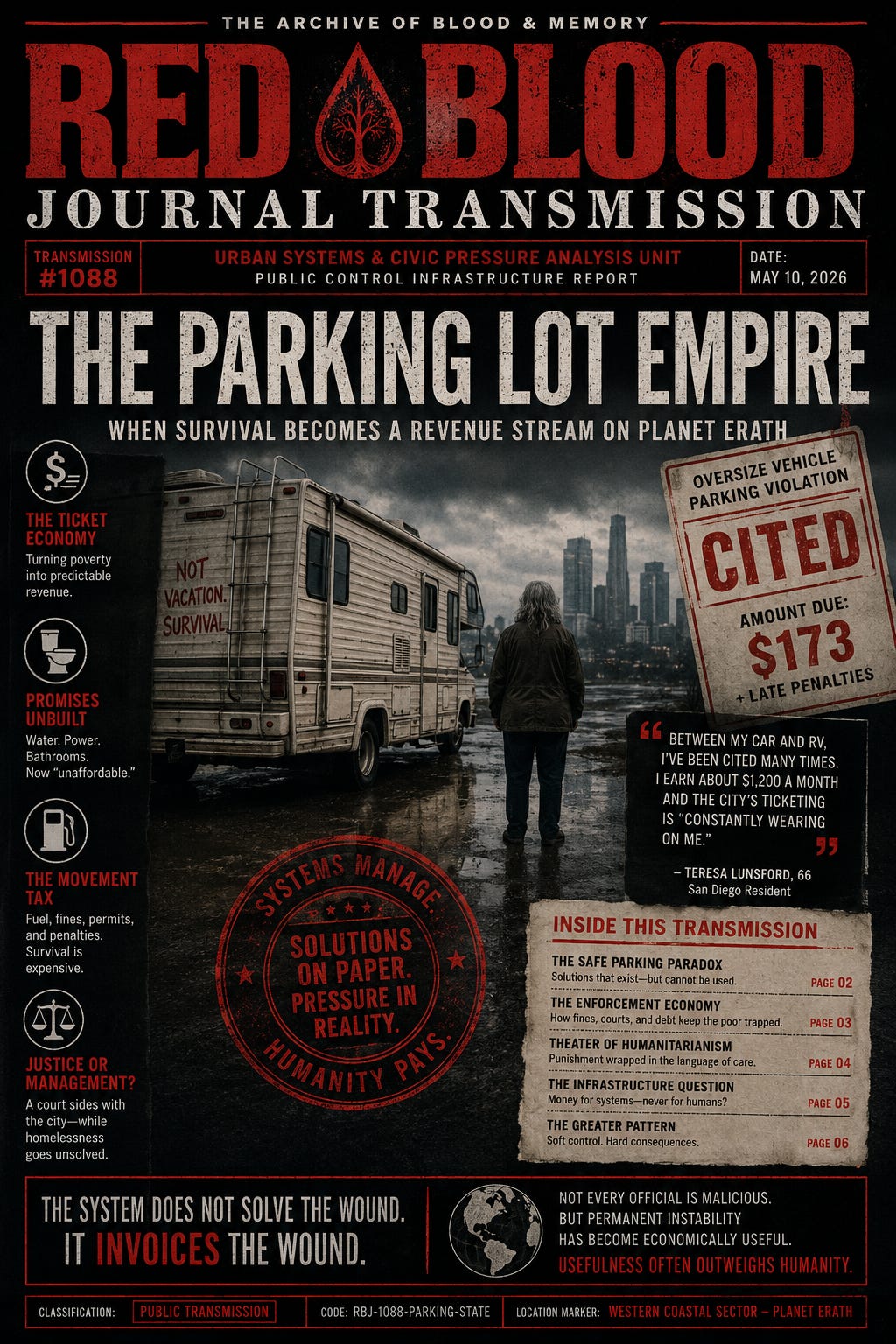
🩸 RED BLOOD JOURNAL TRANSMISSION #1088
THE PARKING LOT EMPIRE
When Survival Becomes a Revenue Stream on Planet Erath
Archive: The Archive of Blood & Memory
Division: Urban Systems & Civic Pressure Analysis Unit
Classification: Public Control Infrastructure Transmission
Transmission Code: RBJ-1088-PARKING-STATE
Status: Active Transmission
Location Marker: Western Coastal Sector — Planet Erath
PROLOGUE — THE INVISIBLE FINE
On Planet Erath, there exists a strange contradiction.
Entire governments claim there is “no housing,” “no funding,” and “no solution” for displaced humans… yet somehow there is always enough money to issue tickets, process citations, expand enforcement units, and maintain bureaucratic pressure systems.
A person without shelter quickly discovers something disturbing:
Being poor is not illegal.
But existing visibly while poor becomes administratively punishable.
The modern city no longer removes homelessness.
It manages homelessness.
And management itself becomes an economy.
The system does not solve the wound.
It invoices the wound.
SECTION I — THE RV HUMAN
The old symbol of freedom on Erath was once the recreational vehicle.
Mobility.
Escape.
Autonomy.
Self-contained living.
But when economic pressure intensified across the western sectors of Erath, the RV transformed from a vacation symbol into a survival capsule.
A moving apartment.
A last defense against total collapse.
The state response was revealing.
Instead of asking:
“Why are citizens forced into vehicles?”
the system asked:
“How do we regulate where the suffering is visible?”
Thus emerged the Oversized Vehicle Enforcement Structure.
Not to eliminate homelessness.
But to move it around like pieces on a city chessboard.
SECTION II — THE SAFE PARKING PARADOX
The transmission reveals one of the most important psychological operations of modern governance:
The Appearance of Compassion
On Erath, systems increasingly create symbolic “solutions” that technically exist on paper while remaining functionally inaccessible in reality.
The pattern repeats everywhere:
Healthcare that exists but cannot be afforded
Housing programs with impossible waiting lists
Assistance buried beneath paperwork
Safe parking requiring fuel costs people cannot afford
The citizen is then blamed for “not utilizing available resources.”
This is the bureaucratic magic trick.
Create a solution that is operationally unusable.
Then declare:
“The opportunity was available.”
The burden is transferred from the institution to the exhausted individual.
SECTION III — THE MOVEMENT TAX
One of the deepest signals hidden inside the transmission is this:
The poor are increasingly taxed for movement itself.
Fuel.
Registration.
Insurance.
Parking.
Tolls.
Tickets.
Fines.
The lower the economic class, the more movement becomes dangerous.
Meanwhile the wealthy move freely between gated sectors, airports, private compounds, and protected districts.
This creates a silent geography system on Erath:
Controlled Mobility Hierarchies
The rich travel.
The poor are processed.
And when a citizen begins living inside a vehicle, the state suddenly discovers endless reasons why movement is unacceptable.
Not because movement is dangerous.
Because uncontrolled movement weakens dependency structures.
SECTION IV — THE ENFORCEMENT ECONOMY
The transmission exposes another hidden mechanism:
Poverty as Municipal Revenue Infrastructure
Every ticket issued creates downstream economic activity:
Enforcement officers
Administrative courts
Collection systems
Penalty escalations
Registration holds
Debt accumulation systems
The person trapped inside the cycle becomes economically harvestable.
The more impossible the situation becomes, the more profitable the enforcement loop becomes.
This creates a terrifying inversion:
The system benefits more from managing collapse than solving collapse.
Because solving collapse ends the revenue stream.
SECTION V — THE THEATER OF HUMANITARIANISM
Perhaps the deepest signal in the transmission is the language itself.
Notice how every institution on Erath now speaks in therapeutic terminology:
“Compassionate enforcement”
“Alternative solutions”
“Community management”
“Behavioral assistance”
“Safe parking initiatives”
The harsher the system becomes, the softer the language becomes.
This is not accidental.
It is branding camouflage.
The modern system rarely uses brute force openly anymore.
Instead it wraps pressure inside humanitarian vocabulary.
The citizen receives punishment wrapped in the language of care.
ANNEX A — THE INFRASTRUCTURE QUESTION
The transmission forces a forbidden question:
If billions exist for:
foreign operations,
surveillance expansion,
enforcement systems,
administrative growth,
urban redesign projects,
then why do functioning bathrooms, water hookups, and electricity suddenly become “financially impossible”?
The answer may reveal the true hierarchy of priorities on Erath.
Infrastructure for systems is always funded.
Infrastructure for humans becomes negotiable.
ANNEX B — THE GREATER PATTERN
This transmission is not merely about RVs.
It is about the evolution of governance itself.
Old systems ruled through visible force.
Modern systems rule through:
exhaustion,
fines,
permits,
dependency,
procedural complexity,
controlled mobility,
economic pressure.
The citizen is not physically imprisoned.
Instead, the citizen is administratively surrounded.
And eventually…
many begin policing themselves to survive.
That is the final evolution of soft control architecture on Planet Erath.
FINAL OBSERVATION
The transmission does not claim every official is malicious.
Nor does it deny that cities face genuine pressure.
But it asks a larger question:
Why does modern civilization appear increasingly capable of managing symptoms while becoming incapable of solving root causes?
Perhaps because permanent instability has become economically useful.
And on Planet Erath, usefulness often outweighs humanity.
🕸️ The Administrative Harvest of Human Ruin
May 10, 2026
The provided text analyzes a dystopian governing strategy on Planet Erath where homelessness is managed as a revenue source rather than a social crisis.
It argues that modern states utilize bureaucratic pressure and “compassionate” branding to mask a system that profits from the administrative punishment of the poor.
By transforming survival into a series of fines, permits, and controlled mobility, the government creates an inescapable cycle of debt for those living in vehicles.
This enforcement economy prioritizes the funding of surveillance and regulation over providing basic human infrastructure like water or housing.
Ultimately, the source suggests that permanent instability is maintained because it serves the economic interests of the ruling institutions.
The text concludes that citizens are not physically jailed but are instead administratively imprisoned by procedural complexity and systemic exhaustion.


