


🩸 RED BLOOD JOURNAL TRANSMISSION #1090
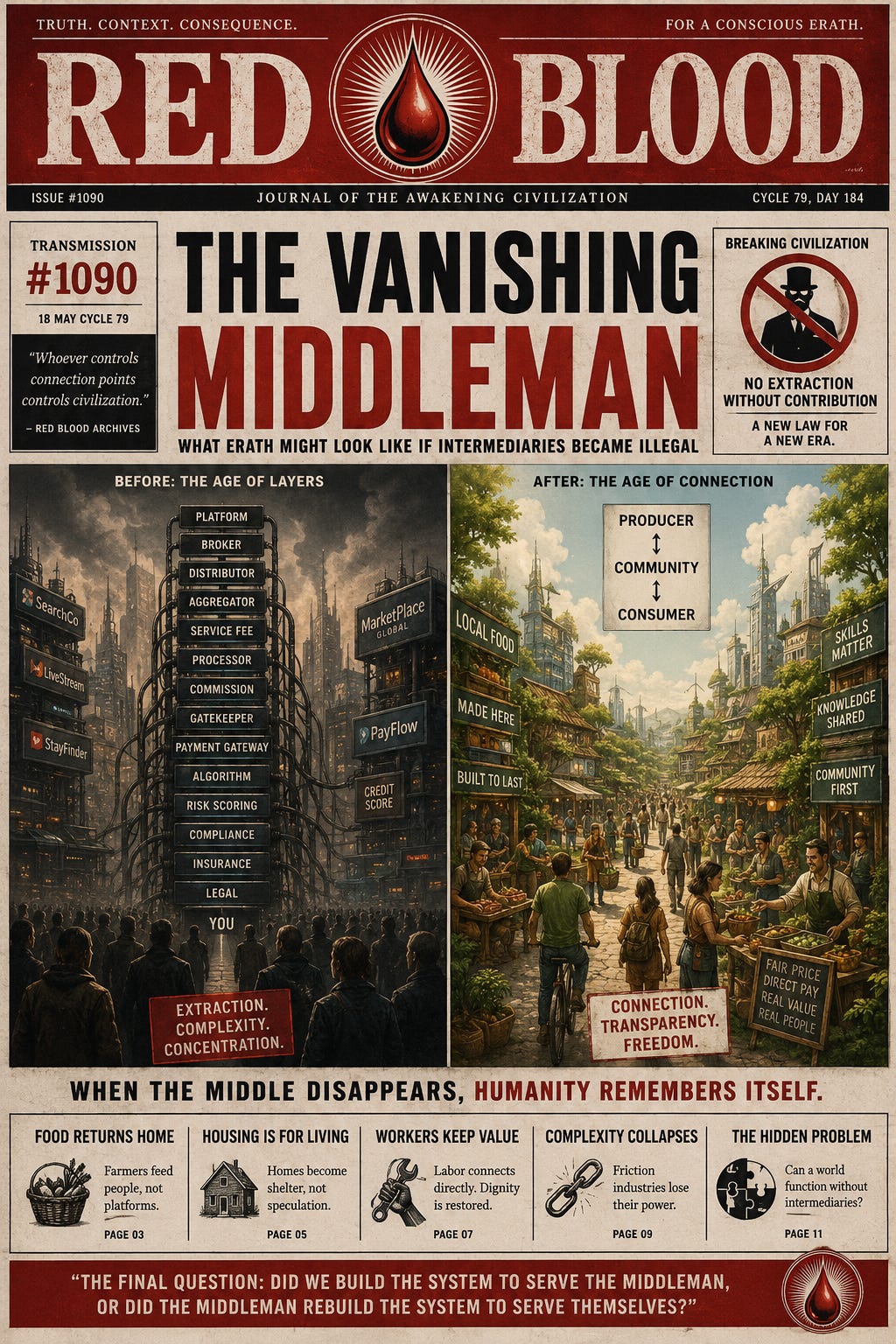
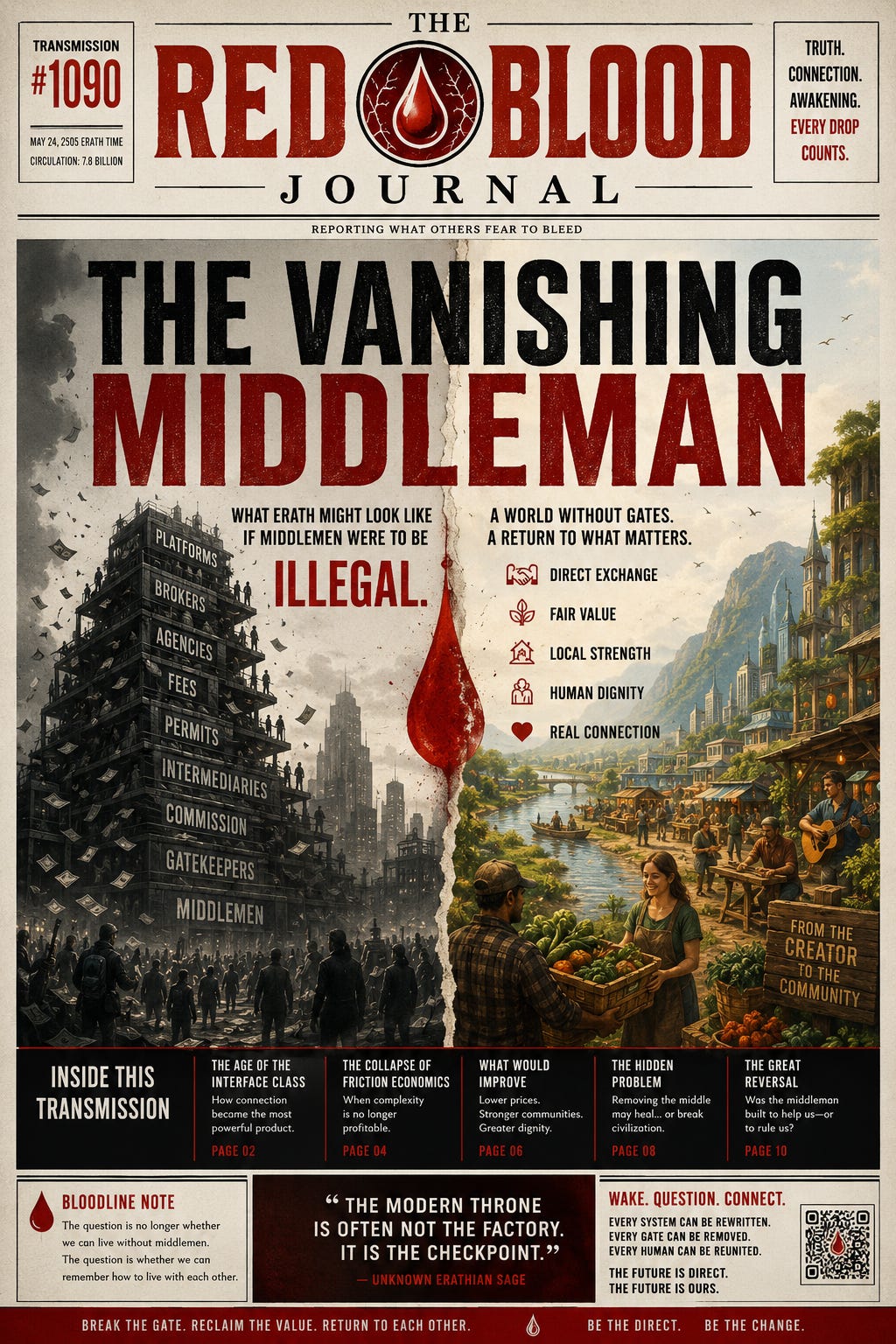
“THE VANISHING MIDDLEMAN”
What Erath Might Look Like If Intermediaries Became Illegal
PROLOGUE — THE INVISIBLE TAX OF ERATH
On the planet Erath, the middleman became so normalized that entire civilizations forgot direct exchange ever existed.
A farmer no longer sells to the eater.
A creator no longer sells to the audience.
A worker no longer negotiates with the customer.
A driver no longer connects directly with the passenger.
A musician no longer reaches listeners without platform permission.
A citizen no longer speaks to government without layers of institutional filtering.
Instead:
Platforms appeared.
Brokers appeared.
Agencies appeared.
Algorithms appeared.
“Service fees” appeared.
“Convenience layers” appeared.
And over time, the layers became thicker than the original human interaction itself.
On Erath, many citizens eventually noticed something strange:
The people closest to the actual labor often carried the highest stress…
while the entities standing in the middle accumulated the greatest wealth.
SECTION I — THE AGE OF THE INTERFACE CLASS
A new class emerged on Erath:
The Interface Class
Not builders.
Not growers.
Not transporters.
Not manufacturers.
But coordinators of access.
They owned:
marketplaces
transaction gateways
licensing systems
app stores
financial rails
digital identity checkpoints
search visibility
algorithmic ranking systems
The Interface Class discovered something powerful:
Whoever controls connection points controls civilization itself.
A hotel no longer needed to own rooms.
A taxi company no longer needed cars.
A media empire no longer needed reporters.
A store no longer needed inventory.
They only needed:
visibility control
payment routing
trust scoring
legal shielding
algorithmic leverage
The middle became the throne.
SECTION II — IF MIDDLEMEN BECAME ILLEGAL
Imagine Erath passing a planetary law:
“No entity may extract value without materially contributing labor, production, transport, repair, or creation.”
The shockwave would be immediate.
FOOD SYSTEMS
Farmers sell directly to neighborhoods.
No:
commodity brokers
futures manipulators
supermarket gatekeepers
platform commissions
Food prices collapse downward.
Freshness increases.
Massive industrial food monopolies weaken overnight.
Local agriculture returns.
Communities rediscover regional identity through food.
HOUSING
No corporate real-estate acquisition funds.
No speculative holding corporations.
No rent extraction chains through layered ownership shells.
Homes return to:
shelter
family
community continuity
Instead of:
investment vehicles
vacancy assets
algorithmic rent farms
Housing prices potentially fall dramatically because speculative layers vanish.
EMPLOYMENT
Workers connect directly with customers.
No:
staffing extraction
app commissions
recruiter skimming
management pyramids
subscription labor portals
Gig workers keep the full fare.
Tradespeople negotiate directly.
Musicians receive payment without platform dilution.
Writers distribute directly to readers.
The “commission economy” fractures.
SECTION III — THE COLLAPSE OF FRICTION ECONOMICS
On Erath, enormous industries survive not by creating value…
…but by controlling friction.
Examples:
banking transfer fees
insurance bureaucracy
ticketing markups
subscription gateways
pharmaceutical distribution layers
compliance labyrinths
permit ecosystems
legal complexity industries
If middlemen disappeared:
Complexity itself would become unprofitable.
Systems would suddenly need to become:
understandable
transparent
direct
simple enough for ordinary humans
Many institutions on Erath quietly depend on confusion to survive.
SECTION IV — WHAT WOULD IMPROVE
POSSIBLE BENEFITS
1. Lower Prices
Without stacked commissions:
food
housing
transportation
media
medicine
could become dramatically cheaper.
2. Stronger Local Communities
Direct exchange rebuilds trust.
People know:
who made the product
who grew the food
who repaired the machine
who taught the lesson
The anonymous machine weakens.
3. Less Algorithmic Control
Massive digital gatekeepers lose influence.
Discovery becomes human again instead of purely platform-ranked.
4. Greater Human Dignity
Workers stop feeling like interchangeable app components.
People regain ownership over:
reputation
pricing
schedules
relationships
5. Reduced Wealth Concentration
Extreme wealth accumulation through “ownership of access” becomes harder.
The wealth gap narrows.
SECTION V — THE HIDDEN PROBLEM
But Erath also discovers something uncomfortable:
Some middlemen emerged because civilizations became too large and complex.
Without intermediaries:
logistics become harder
fraud risks increase
trust verification becomes difficult
dispute resolution slows
quality control weakens
scaling becomes messy
A world without all intermediaries could become:
fragmented
inefficient
locally tribal
difficult to coordinate globally
The deeper issue may not be the existence of middlemen…
…but when the middleman becomes:
larger than the producer
richer than the laborer
more powerful than the creator
politically untouchable
ANNEX A — THE GREAT REVERSAL
The citizens of Erath eventually begin asking:
“Why does the connector earn more than the creator?”
That question alone threatens entire planetary structures.
Because many empires on Erath are not built on production…
They are built on:
extraction
brokerage
routing
licensing
visibility control
permission systems
The modern throne is often not the factory.
It is the checkpoint.
FINAL OBSERVATION — THE WORLD WITHOUT GATES
If middlemen became illegal on Erath, civilization would likely split into two simultaneous realities:
One Reality
A renaissance of:
localism
craftsmanship
direct trust
lower costs
community exchange
human-scale economics
The Other Reality
Chaos from removing coordination systems too quickly from an interconnected planetary machine.
The final question becomes:
Was the middleman originally created to help civilization…
…or did civilization eventually become engineered to serve the middleman?
✂️ The Great Reversal: The End of the Interface Class
May 10, 2026
This text explores a speculative scenario on the planet Erath where intermediaries and gatekeepers are legally abolished to restore direct human interaction.
It critiques a society dominated by an “Interface Class” that accumulates immense wealth by controlling access and extracting fees without contributing physical labor.
By imagining the removal of these layers, the source illustrates how costs for housing, food, and services might plummet while local communities regain their autonomy.
However, the narrative also acknowledges that eliminating all middlemen could lead to significant logistical chaos and trust issues in a complex global society.
Ultimately, the text challenges readers to consider whether modern systems are designed to facilitate human connection or merely to enrich the entities that sit at the checkpoints of commerce.


