


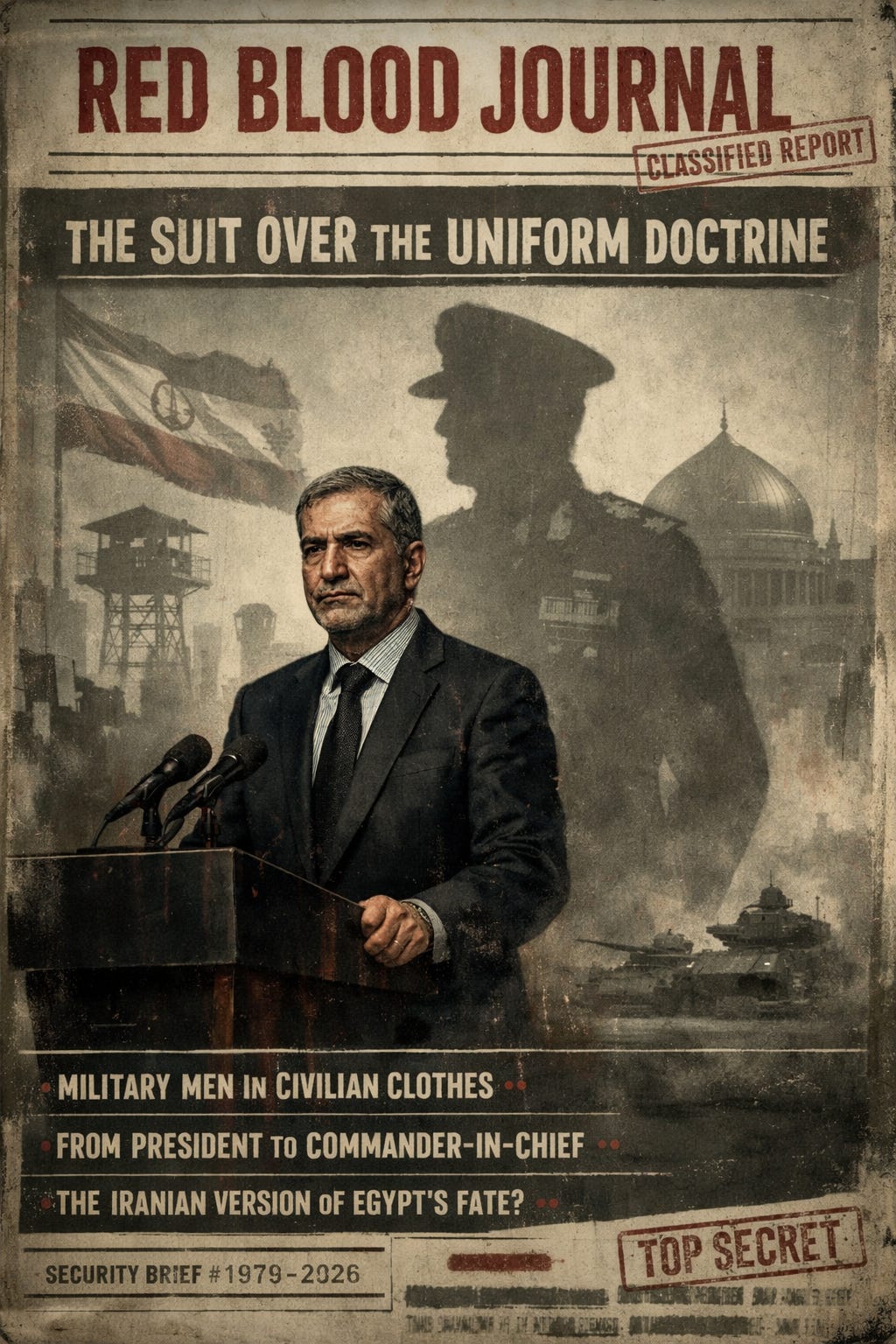
🩸 RED BLOOD JOURNAL TRANSMISSION
Division: Geo-Strategic Power Architecture Desk
Transmission Code: RBJ-IRAN-EGYPT-SUIT-DOCTRINE-001
Classification: Military-State Evolution / Civilian Mask Systems / Regime Continuity Doctrine
Archive: The Archive of Blood & Memory
How Militaries Rule From Inside Suits
THE SUIT OVER THE UNIFORM DOCTRINE
How Iran’s Future May Resemble Egypt — Not by Tank Coup, but by Military Absorption
PROLOGUE — THE DIFFERENCE BETWEEN A COUP AND A CONVERSION
On the surface, people are trained to recognize power only when it arrives loudly.
A coup, in the public imagination, is easy to detect:
tanks in the street
television stations seized
constitutions suspended
generals in uniform speaking from podiums
elected leaders placed under arrest
That was the Egyptian model.
But on deeper examination, not every military takeover looks like a takeover.
Some systems do not need to be overthrown because they were never truly civilian to begin with.
Some systems do not require the army to storm the palace because the army is already inside the palace, already in the ministries, already in the economy, already in the intelligence structure, already shaping what elected officials are allowed to do.
That is the more dangerous form.
Egypt showed the world the visible coup.
Iran may be moving toward the absorbed coup.
Not the general in uniform.
The general in a suit.
I — EGYPT: THE OPEN MILITARY SEIZURE
Egypt after Mubarak entered a phase that looked, briefly, like civilian politics.
A president was elected.
Islamists gained formal power through the ballot box.
A civilian pathway appeared possible.
But the military establishment of Egypt had never truly disappeared.
It had only stepped back long enough to measure the threat.
When the elected Islamist government under Mohamed Morsi began to polarize the country, the Egyptian military did not negotiate a new balance.
It removed the experiment.
That is the important point.
Egypt’s military did not gradually blend into civilian rule.
It interrupted civilian rule.
The sequence was clear:
Mubarak falls
elections produce an Islamist presidency
instability and division deepen
the military claims national rescue authority
the military takes the state back
In Egypt, the military acted as a structure outside the elected government that re-entered power openly.
It did not pretend for long.
It ruled in the name of order, stability, anti-chaos, and national survival.
That is the classic model people remember when they hear the word coup.
II — IRAN: THE SYSTEM WHERE THE MILITARY NEVER LEFT
Iran is different in architecture.
The central misunderstanding in many comparisons is the assumption that Iran still functions as a normal civilian state being threatened by an outside military institution.
That is not what Iran is.
Iran is a layered power structure:
an elected presidency
a civilian bureaucracy
a parliament
a clerical hierarchy
an intelligence-security state
and, above all, a revolutionary military institution embedded across all layers
The IRGC was never just a military force.
It became:
a security doctrine
an ideological enforcement mechanism
an economic empire
a regional foreign policy engine
a succession actor
a political gatekeeper
So in Iran, the question is not whether the military can take over the system.
The deeper question is:
How much of the system has already been converted into military-managed civilian theater?
That is why the Egyptian model cannot be copied exactly.
In Egypt, the military overthrew the civilian experiment.
In Iran, the military-security structure has long existed inside the experiment itself.
III — PEZESHKIAN AND THE LIMITS OF CIVILIAN APPEARANCE
The presidency in Iran carries symbolic importance, but limited sovereign power.
A civilian president may speak in the language of reform, moderation, management, or technocratic balance.
But the major pillars of strategic direction do not fully rest in presidential hands.
Where does hard power live?
in security networks
in revolutionary structures
in intelligence bodies
in ideological enforcement mechanisms
in crisis management institutions
in military-linked economic patronage
So when people say that the civilian layer has been “pushed aside,” the statement needs precision.
It is not necessarily that the civilian layer has suddenly been destroyed.
It is that the civilian layer may be increasingly revealed as secondary.
A president in such a structure can administer.
He can signal.
He can absorb pressure.
He can serve as interface.
But he may not fully command the machinery that decides the state’s survival doctrine.
That is why Iran’s possible future resembles Egypt only partially.
The resemblance is not in the event.
The resemblance is in the end state:
a country where military power governs through civilian form.
IV — THE SUIT OVER THE UNIFORM DOCTRINE
This is the future scenario.
Not tanks.
Not a midnight announcement.
Not necessarily the abolition of elections.
Not even the public burial of the civilian constitution.
Instead, something more subtle:
the gradual transformation of military guardians into civilian rulers without surrendering military logic.
This doctrine works through absorption.
The uniform is not discarded because the military has become weaker.
The uniform is discarded because it no longer needs to appear military to dominate.
A revolutionary commander becomes:
a statesman
a parliamentary broker
a national security elder
a business patron
a crisis manager
a presidential candidate
a “protector of stability”
This is how a military state learns sophistication.
The public is given a suit.
The system keeps the gun.
V — HOW IRAN COULD COME TO LOOK LIKE EGYPT
Iran may begin to resemble Egypt not through a visible repeat of 2013, but through structural convergence.
Egypt’s path:
military reclaims the state after civilian instability
Iran’s possible path:
military-security state becomes more explicit as the only credible administrator of crisis
That convergence could happen through several channels.
1. War pressure
External conflict always strengthens institutions that speak the language of security.
In wartime, the civilian sphere shrinks.
The security sphere expands.
What was once exceptional becomes permanent.
2. Leadership vacuum
Any weakening, fragmentation, or succession crisis at the top of the clerical hierarchy creates space for the best organized coercive structure to become the arbiter.
In such moments, the most disciplined network does not ask for permission.
It becomes the bridge between uncertainty and continuity.
3. Economic breakdown
When sanctions, black markets, patronage systems, and survival economies intensify, military-linked institutions often gain power because they are best positioned to manage scarcity, smuggling routes, internal discipline, and strategic sectors.
4. Civilian exhaustion
If the public ceases to believe that civilian politics can solve anything, then even a disguised military order begins to look preferable to paralysis.
That is how populations are prepared psychologically.
Not by loving the military.
But by losing faith in everything else.
VI — THE EGYPTIAN MIRROR, IN IRANIAN FORM
If Iran moves further in this direction, the result may not be a copy of Egypt, but an Iranian adaptation of the same core reality.
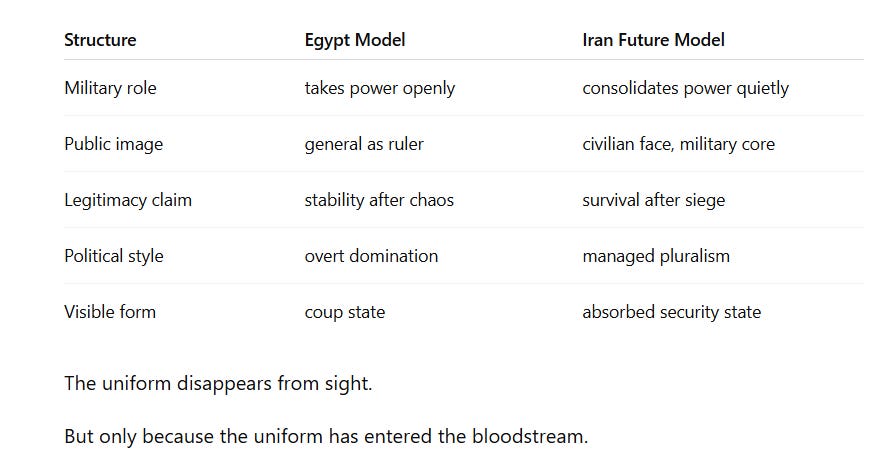
Egypt offered a military ruler in the open.
Iran may offer a military ruler through institutions, through committees, through aligned politicians, through economic guardianship, through ideological legitimacy, and through “civilian” officeholders whose survival depends on military consent.
So the mirror image looks like this:
VII — WHY THIS MODEL IS STRONGER THAN A CLASSIC COUP
A visible coup creates resistance because it is easy to name.
People see the break.
They know what happened.
The constitution was broken.
The army intervened.
The elected leader was removed.
But when the military-security order advances through suits, institutions, and controlled civilian process, it becomes harder to resist because it hides inside legality, procedure, patriotism, and national emergency.
This is the genius of modern authoritarian stabilization.
It does not always cancel elections.
It domesticates them.
It does not always abolish civilian offices.
It hollows them out.
It does not always put the colonel on state television.
It teaches the politician to speak with the colonel’s mind.
That is a more mature form of control.
VIII — THE PSYCHOLOGICAL PREPARATION OF THE POPULATION
No military-state conversion succeeds without public conditioning.
The people must be taught several lessons:
that civilian argument is weakness
that endless debate is national danger
that security institutions alone are serious
that emergency never truly ends
that survival outranks liberty
that managed order is better than unstable freedom
Once those beliefs take hold, the population begins to cooperate with the transformation.
Not always enthusiastically.
Often wearily.
A tired population is easier to convert than a hopeful one.
This is why the suit matters.
The suit tells the public:
“This is not dictatorship. This is responsibility.”
“This is not military rule. This is national management.”
“This is not coercion. This is survival administration.”
That is how the language is changed.
And once language changes, reality becomes easier to formalize.
IX — THE DEEP PATTERN
Egypt and Iran differ in historical DNA, ideology, and institutional design.
But beneath the differences lies the same deep pattern:
When states enter prolonged crisis, the institution that controls force, intelligence, and internal order tends to become the final guarantor of continuity.
The only question is style.
Will it rule openly?
Or will it rule elegantly?
Egypt chose the open route.
Iran may choose the elegant route.
Egypt presented the people with the uniform.
Iran may present the people with the suit.
But beneath both lies the same message:
The age of civilian uncertainty is over.
The guardians are back.
X — STRATEGIC FORECAST
If current pressures continue, Iran’s most plausible hardening scenario is not democratic renewal and not necessarily immediate collapse.
It is the tightening of a hybrid order in which:
the civilian system remains on paper
the military-security establishment expands in practice
ideological legitimacy is preserved where useful
technocratic figures remain in office where useful
crisis becomes the permanent justification for command consolidation
In that future, the presidency remains.
The parliament remains.
The language of republicanism remains.
But the center of gravity shifts further toward those who control:
coercion
intelligence
strategic patronage
regional force projection
succession management
That is not exactly Egypt.
It is something colder:
Egypt without needing the spectacle of the coup.
XI — FINAL RBJ ASSESSMENT
Egypt showed the world the visible seizure.
Iran may perfect the invisible conversion.
The danger is not merely that the military may overthrow the civilian state.
The danger is that the military-security order may become so fused with the civilian state that the public no longer knows where one ends and the other begins.
That is the final stage of the suit-over-uniform doctrine.
The general no longer needs to remove the president.
He only needs to become the air the presidency breathes.
CLOSING LINE
Egypt was the coup in uniform.
Iran’s future may be the coup in a suit.
🕴️The Suit Over the Uniform Doctrine
This text analyzes a shifting political doctrine where military entities transition from overt seizures of power to a more subtle “absorbed coup” by integrating into civilian structures.
Using Egypt as a historical benchmark for visible military takeovers, the author suggests Iran represents a more sophisticated model where the security apparatus already inhabits the government, economy, and bureaucracy.
This “suit over the uniform” strategy allows a military-security state to maintain total control through civilian theater, utilizing elections and politicians as mere interfaces for coercive power.
Ultimately, the source argues that modern authoritarianism thrives not by abolishing civilian institutions, but by hollowing them out until the military becomes the invisible yet absolute guarantor of the state.


