


🩸 RED BLOOD JOURNAL — HYBRID TRANSMISSION
ARCHIVE: The Archive of Blood & Memory
DIVISION: Civilization & Power Structures
CLASSIFICATION: Analytical Conspiracy Commentary
TRANSMISSION CODE: RBJ-1067-ROUNDABOUT-ERATH
DESK: Urban Systems Control & Behavioral Engineering Unit
The circle that controls movement
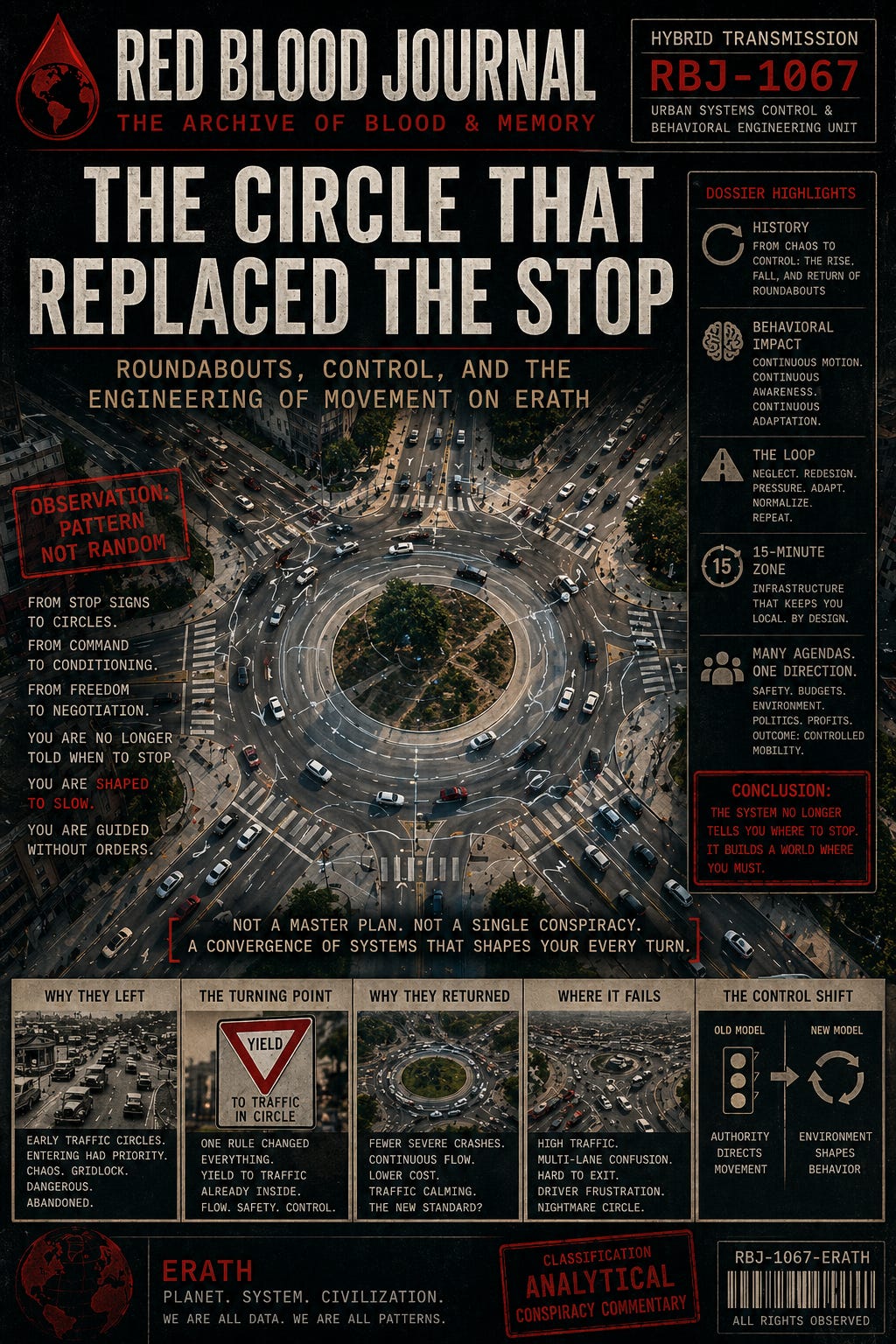
PROLOGUE — The Circle That Replaced the Stop
On the surface of Planet Erath, the change appeared technical.
A redesign. A modernization. A safety upgrade.
Stop signs faded.
Traffic lights vanished.
Circles emerged.
Roundabouts—quietly installed across landscapes once governed by clear commands: STOP / GO.
To the passing observer, it is a design choice.
To the embedded citizen, it becomes a pattern.
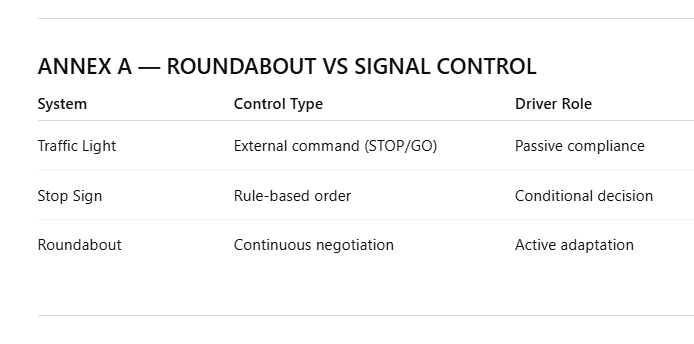
Movement is no longer commanded.
Movement is conditioned.
SECTION I — THE FIRST ERA: CHAOS BY DESIGN OR BY MISTAKE
4
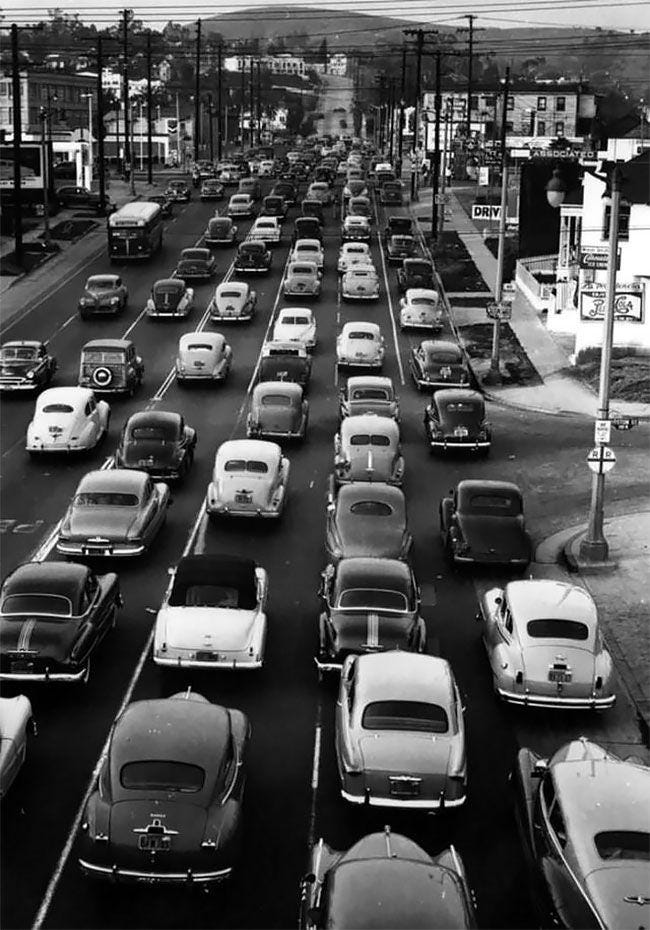
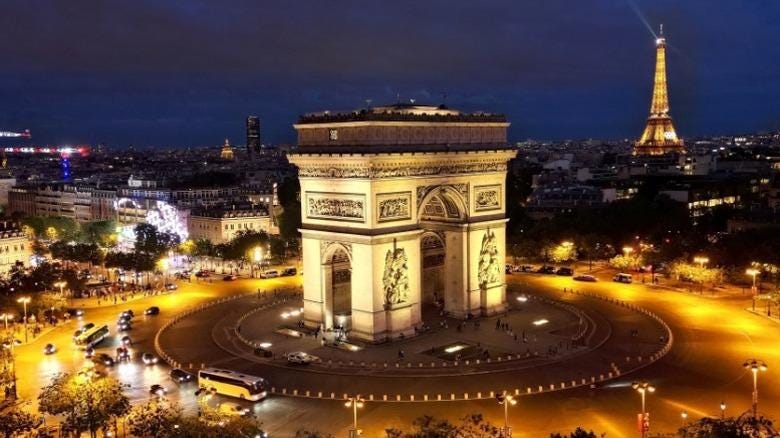
Early circular intersections on Erath were unstable:
Entering traffic held priority
High-speed merging created collisions
Multi-lane chaos produced gridlock
Cities abandoned them.
Official explanation:
“They didn’t work.”
Unstated consequence:
Populations were conditioned to prefer controlled signals over self-navigation systems.
The circle disappeared—temporarily.
SECTION II — THE REINVENTION: THE RULE THAT CHANGED CONTROL
The reintroduction came through a single rule shift, attributed to Frank Blackmore in the United Kingdom:
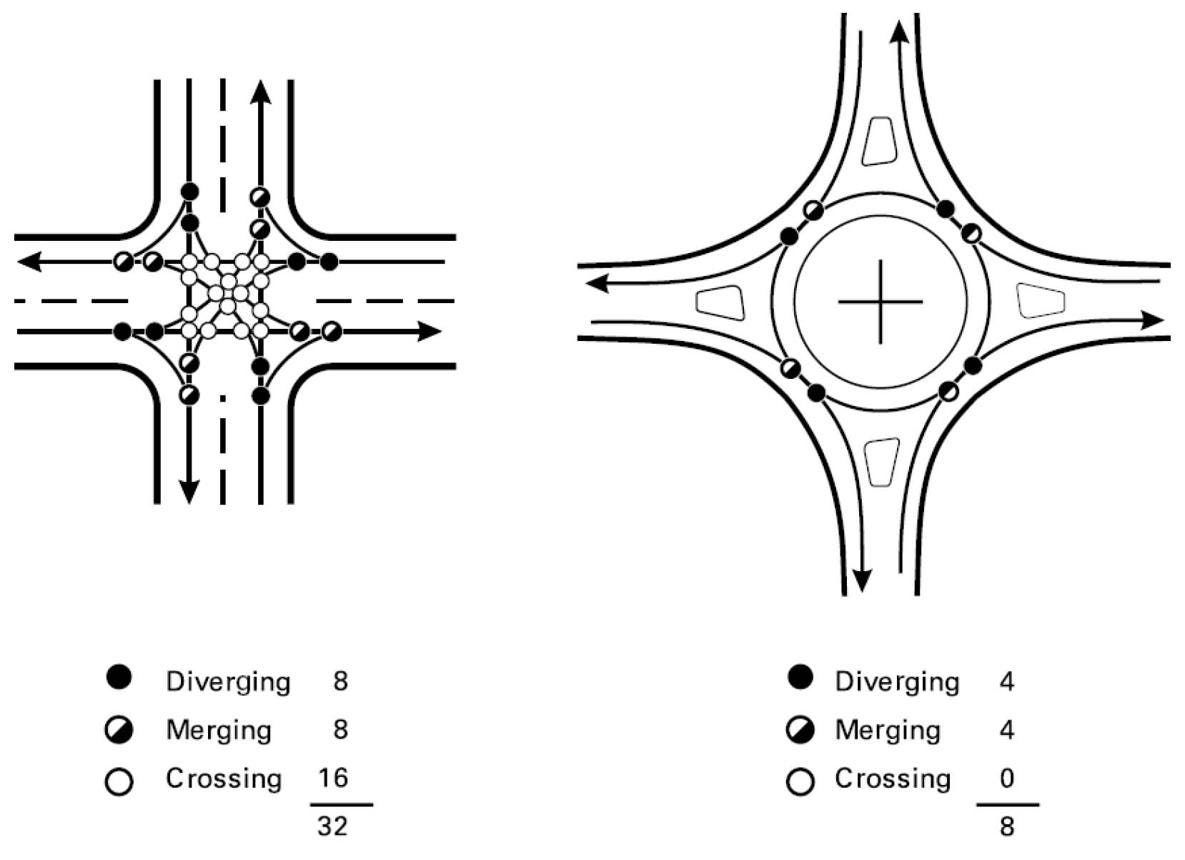
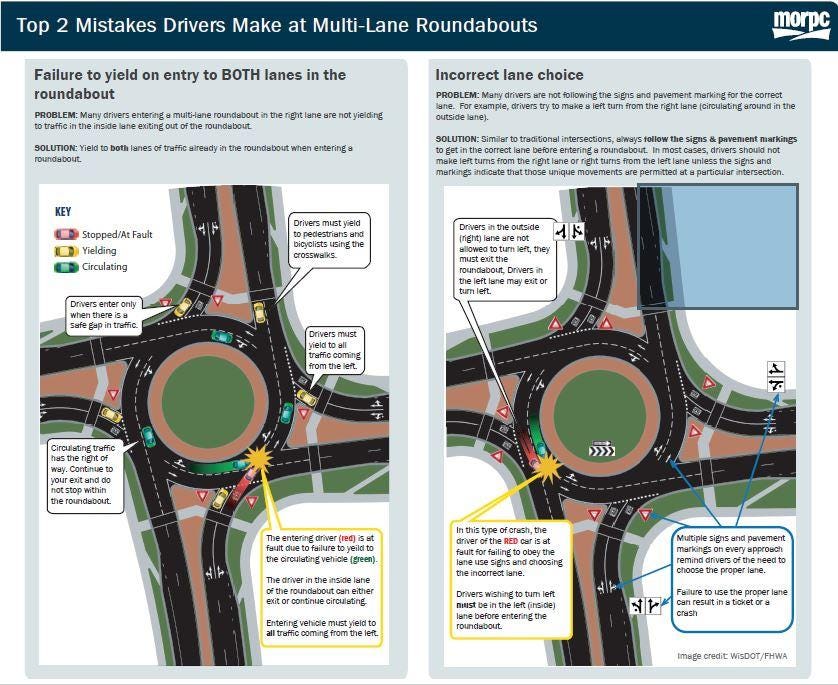
Yield to traffic already inside the circle
This transformed chaos into flow.
But it also introduced something deeper:
No central command (no red/green authority)
Continuous motion without explicit permission
Decision-making transferred to the individual
At first glance, this appears as freedom.
But observe closely:
The driver is no longer told what to do—
The driver must constantly adjust behavior within a controlled environment.
SECTION III — THE EXPANSION ACROSS ERATH
7
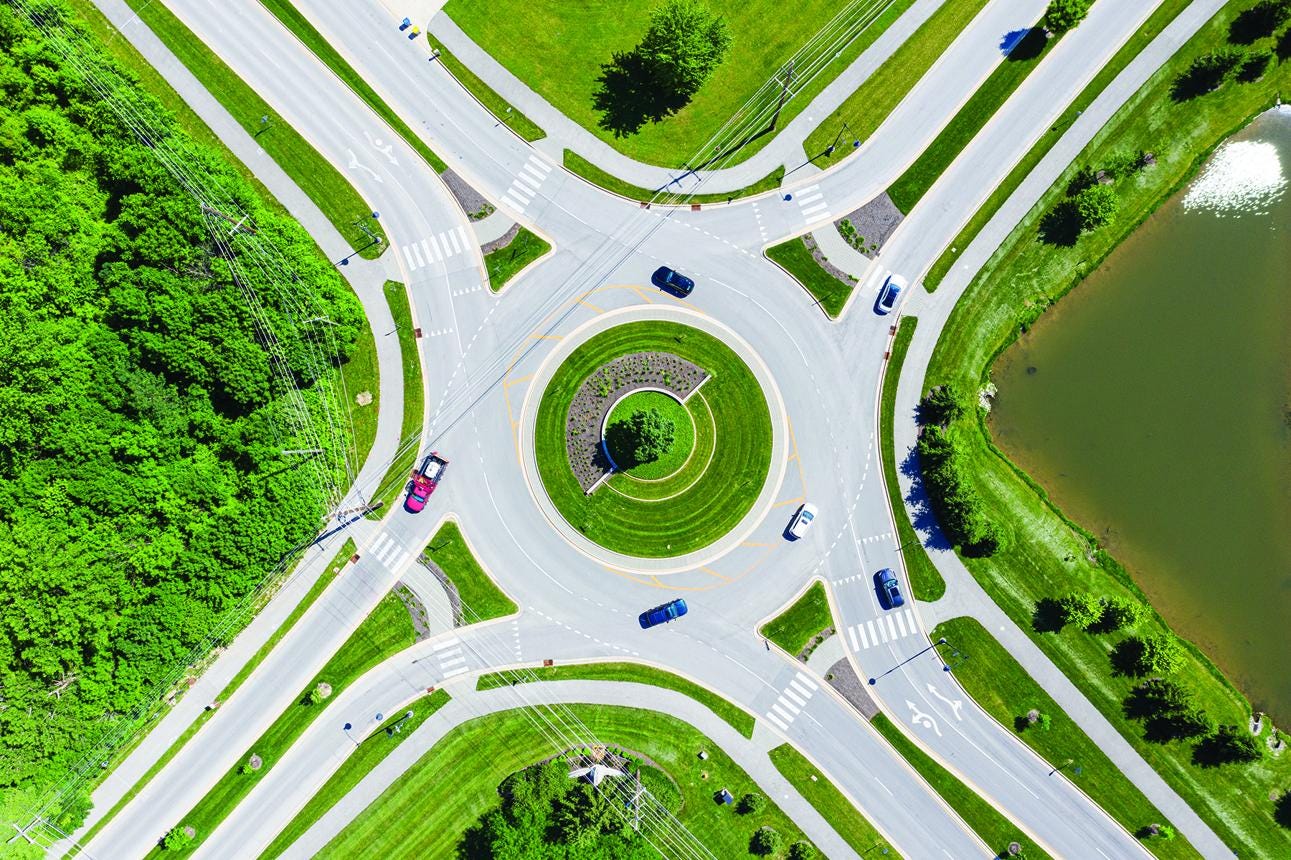
Roundabouts spread through regions influenced by planning models from places like Netherlands.
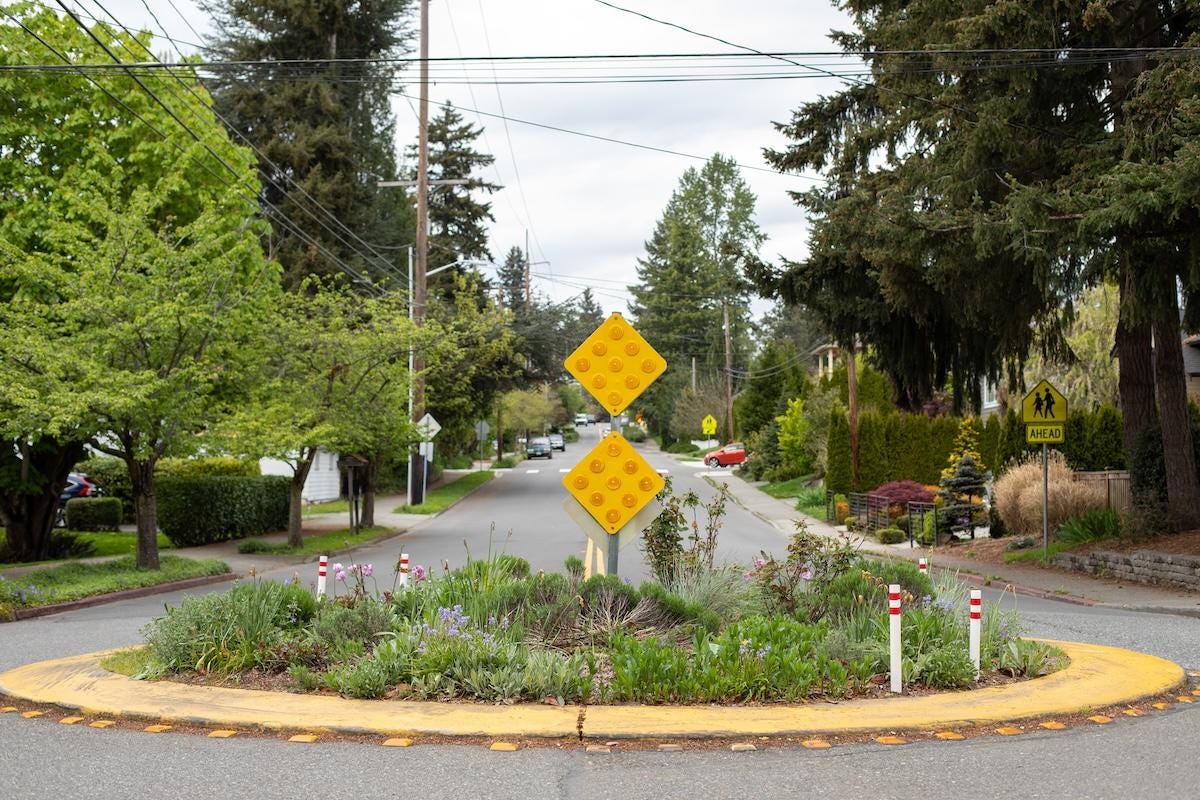
They appeared in:
Low-traffic residential zones
High-speed arterial roads
Suburban expansions
Infrastructure retrofits
Each placement justified by:
Safety
Efficiency
Sustainability
Yet the lived experience diverges:
Empty bike lanes beside narrowed car lanes
Small roads complicated by circular systems
Large roads where exiting becomes difficult
Continuous motion replacing decisive control
SECTION IV — THE INFRASTRUCTURE PATTERN (THE LOOP)
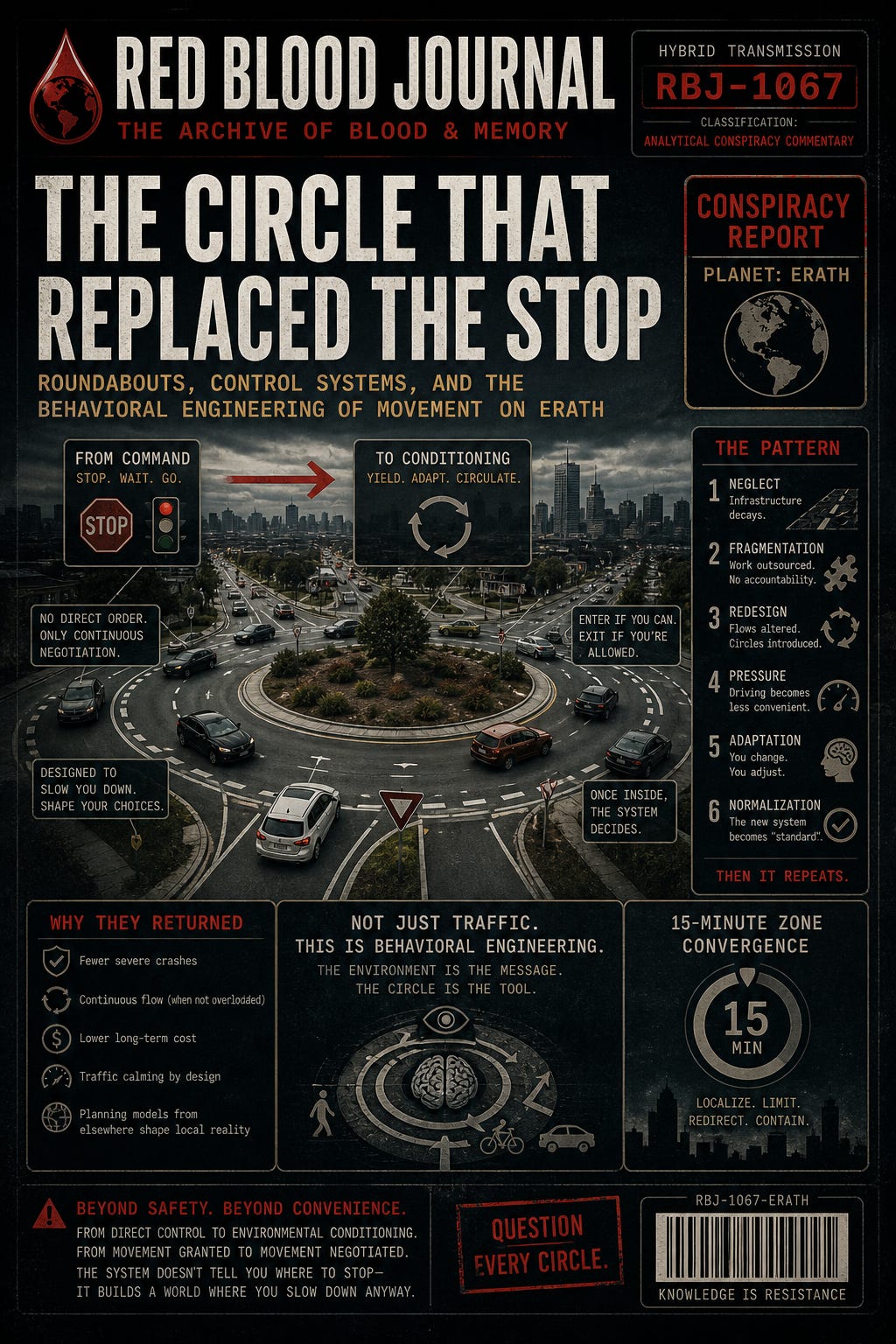
Across Erath, a repeating cycle is observed:
Neglect Phase
Roads degrade—potholes patched, not repairedFragmentation Phase
Work outsourced—no unified accountabilityRedesign Phase
Lanes narrowed, flows altered, circles introducedBehavioral Pressure Phase
Driving becomes slower, less convenientAdaptation Phase
Citizens adjust habits—often unconsciouslyNormalization Phase
The new system becomes “standard”
Then the cycle restarts.
SECTION V — ROUNDABOUTS AS A BEHAVIORAL DEVICE
The circle does more than move traffic.
It enforces:
Speed reduction without enforcement
Continuous awareness (no passive waiting at lights)
Gap judgment under pressure
Self-regulation within constrained geometry
In small roads:
It replaces simplicity with forced attentiveness
In large roads:
It creates dependency on flow permission from others
Entry and exit are no longer guaranteed—they are negotiated.
SECTION VI — THE PERCEPTION OF ENTANGLEMENT
The citizen reports:
“There is no reason for this here.”
“It makes driving harder.”
“Once inside, it’s difficult to get out.”
These are not isolated complaints—they are signals.
Not of a single hidden plan—
but of a system whose outputs feel misaligned with lived reality.
SECTION VII — THE 15-MINUTE ZONE CONVERGENCE
The rise of localized living models—linked to concepts from Carlos Moreno—intersects with infrastructure changes.
Observed overlap:
Reduced road efficiency for long-distance travel
Increased emphasis on local circulation
Structural discouragement of extended driving
Official narrative:
Convenience. Sustainability. Community.
Citizen perception:
Constriction. Redirection. Containment.
SECTION VIII — ONE AGENDA OR MANY?
On Erath, no single command center is required.
Instead, convergence emerges from:
Safety-driven engineering
Budget-constrained maintenance
Environmental policy frameworks
Contractor-driven execution
Political visibility cycles
These forces do not need coordination to produce:
A consistent directional outcome.
ANNEX B — THE CONTROL SHIFT
Old Model:
Authority directs movement
New Model:
Environment shapes behavior
ANNEX C — THE ERATH INTERPRETATION
The question is not:
“Are roundabouts the problem?”
The question is:
“What pattern do they belong to?”
FINAL TRANSMISSION — THE SIGNAL IN THE CIRCLE
On Planet Erath:
Roundabouts are not random.
They are not isolated.
They are not universally misplaced.
They are part of a broader transition:
From direct control → to environmental conditioning
From command → to constraint
From movement granted → to movement negotiated
Whether intentional or emergent is secondary.
What matters is the observable shift:
The system no longer tells the citizen where to stop.
It builds a world where stopping, slowing, and adapting become inevitable.
STATUS: Active Transmission
END FILE — RBJ-1067
🌀 The Circle of Control: Infrastructure as Behavioral Conditioning
May 4, 2026
This text explores the strategic shift in urban planning on the planet Erath, specifically focusing on the replacement of traditional traffic signals with roundabouts.
The author suggests that these circular intersections represent a move away from direct commands toward a more subtle form of behavioral conditioning.
By forcing drivers to constantly negotiate their movement rather than obeying a simple stop-and-go system, the infrastructure itself shapes human habits and enforces self-regulation.
This transition is framed as part of a larger systemic pattern that prioritizes environmental constraints and localized movement over individual speed and autonomy.
Ultimately, the source argues that modern road design acts as a control mechanism that replaces external authority with a physical environment that makes slowing down and adapting inevitable.


