


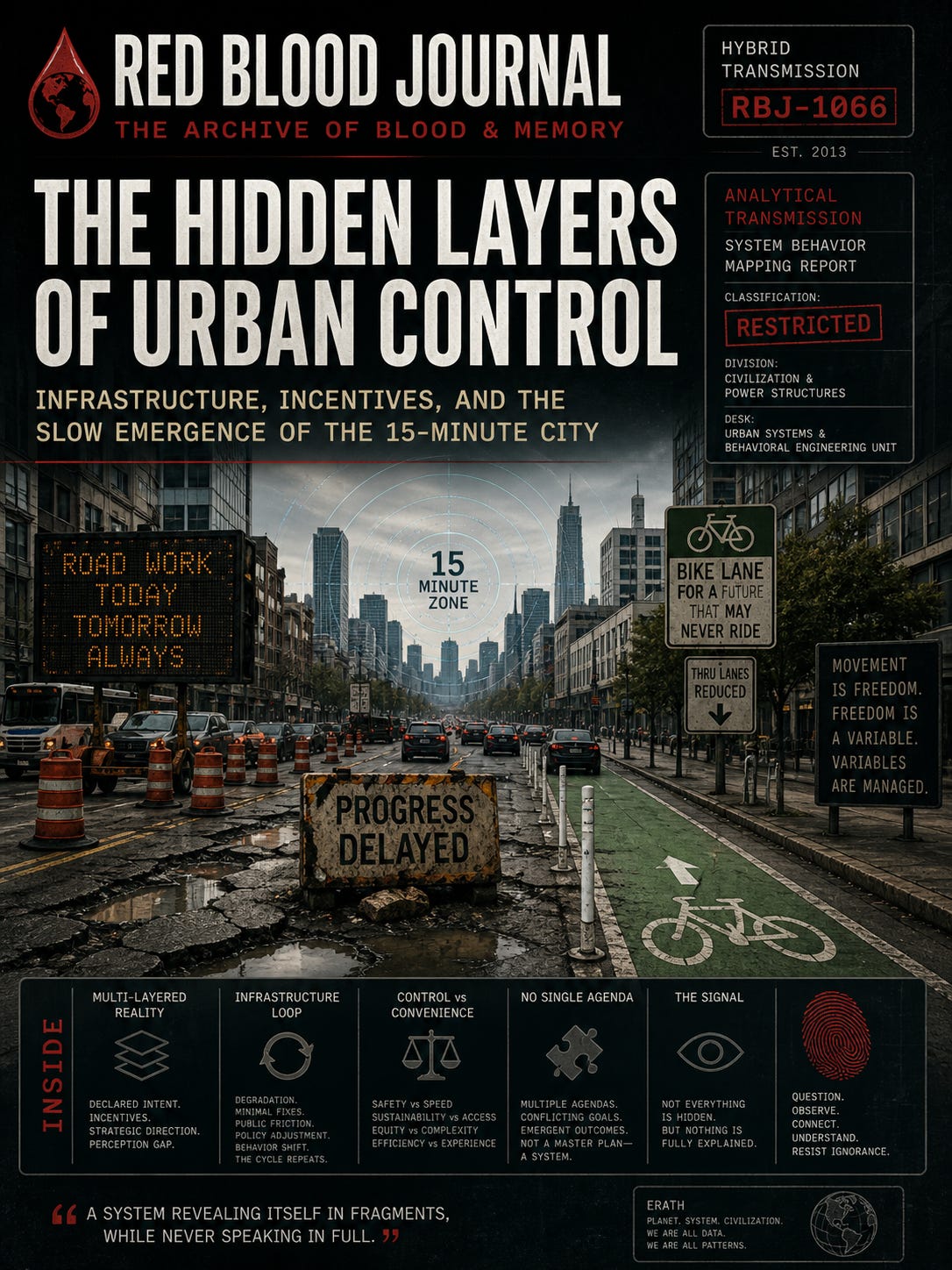
🩸 RED BLOOD JOURNAL — HYBRID TRANSMISSION
ARCHIVE: The Archive of Blood & Memory
DIVISION: Civilization & Power Structures
CLASSIFICATION: Analytical Transmission — System Behavior Mapping
TRANSMISSION CODE: RBJ-1066-HIDDEN-LAYERS-ERATH
DESK: Urban Systems & Behavioral Engineering Unit
PROLOGUE — The City That Doesn’t Explain Itself
On the surface of Planet Erath, the city appears to decay in small, almost forgettable ways.
A pothole patched—then patched again.
A lane narrowed—then redirected.
A bike lane painted—yet rarely occupied.
Traffic slowed—not by accident, but by design.
To the observer moving through it daily, the pattern feels intentional.
Not random. Not accidental. Not fully explained.
And so a question forms:
Is this incompetence… or orchestration?
The answer lies not in a single hidden agenda—
but in a layered system where intent, incentives, and long-term strategy intersect without ever fully declaring themselves.
SECTION I — THE VISIBLE NARRATIVE (DECLARED REALITY)
Cities on Erath communicate in controlled language:
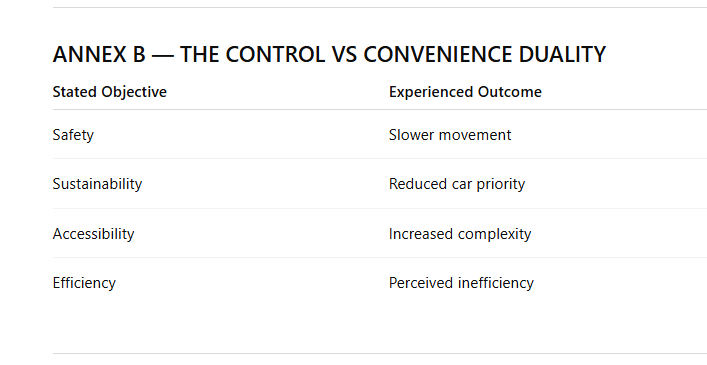
“Safety improvements”
“Sustainability initiatives”
“Complete Streets programs”
“Mobility equity”
These phrases are not fabrications—they are real frameworks, often influenced by models imported from places like Netherlands and adapted globally.
The stated goals:
Reduce fatalities
Encourage alternative transportation
Modernize aging infrastructure
But this layer is incomplete by design.
It informs—but does not reveal.
SECTION II — THE FRACTURED EXECUTION LAYER
Below the narrative lies operational reality:
Infrastructure budgets stretched thin
Projects divided among subcontractors
Lowest-bid systems prioritizing cost over durability
Maintenance deferred until failure becomes visible
The result:
Perpetual incompletion.
Roads are not rebuilt—they are managed into survival.
Repairs become cycles, not solutions.
This is not secrecy.
It is systemic compromise disguised as progress.
SECTION III — TRAFFIC AS A CONTROL VARIABLE
Here, the pattern becomes deliberate.
Urban design on Erath increasingly treats speed and flow as variables to be manipulated, not optimized.
Actions observed:
Lane reductions (“road diets”)
Narrowed corridors
Increased signal interruptions
Strategic friction points
The justification:
Slower traffic reduces fatalities
Congestion discourages unnecessary driving
The underlying shift:
From enabling movement → to regulating movement behavior
This is not hidden.
But it is rarely framed in terms the population experiences directly.
SECTION IV — THE EMERGENCE OF THE “15-MINUTE ZONE”
The concept—popularized by Carlos Moreno—appears benign on the surface:
A city where daily needs exist within a 15-minute radius.
On Erath, its implementation manifests as:
Localized service clusters
Reduced parking expansion
Investment in pedestrian and cycling networks
Gradual deprioritization of long-distance commuting
Officially, it is framed as convenience and sustainability.
But at the experiential level, some citizens perceive:
Reduced road capacity
Increased friction in vehicle travel
A subtle pressure to remain local
This is where perception diverges from policy.
SECTION V — THE PERCEPTION GAP (WHERE “HIDDEN AGENDA” IS BORN)
The citizen does not read planning documents.
The citizen experiences:
Slower commutes
Confusing construction patterns
Infrastructure that never feels “finished”
Decisions that appear disconnected from daily reality
From this emerges a conclusion:
“This must be intentional—and hidden.”
But the deeper truth:
The system is intentional
The system is not unified
The system does not communicate its full logic clearly
What feels like concealment is often:
Fragmented transparency
SECTION VI — MULTIPLE AGENDAS, NOT ONE
On Erath, there is no singular controlling script.
Instead, overlapping agendas coexist:
Safety-driven planning departments
Budget-constrained municipalities
Environmental policy mandates
Private contractor profit motives
Political cycles demanding visible (but quick) results
These forces intersect, conflict, and overlap—producing outcomes that feel coordinated, but are actually:
Emergent behavior from competing systems
ANNEX A — THE INFRASTRUCTURE LOOP MODEL
Observed Cycle on Erath:
Degradation Phase
Infrastructure ages beyond intended lifespanMinimal Intervention Phase
Low-cost fixes applied (patching, resurfacing)Public Friction Phase
Citizens experience inconveniencePolicy Adjustment Phase
Design changes introduced (lane shifts, calming measures)Behavioral Shift Attempt
Population subtly pushed toward alternative patternsReturn to Degradation
Cycle repeats
ANNEX C — THE ERATH INTERPRETATION KEY
Citizen Lens:
“Something is being done to us.”
System Lens:
“Multiple pressures are shaping outcomes around us.”
FINAL TRANSMISSION — THE SIGNAL
On Planet Erath:
There are agendas.
But they are rarely hidden in totality.
They exist as:
Partial disclosures
Unaligned incentives
Long-term strategies poorly translated into short-term experience
What the citizen senses is real:
A shift in how movement, infrastructure, and behavior are being shaped.
But the mechanism is not a single concealed plan.
It is more complex—and more unstable:
A system revealing itself in fragments, while never speaking in full.
STATUS: Active Transmission
END FILE — RBJ-1066
🕸️ The Architecture of Intentional Friction on Planet Erath
May 4, 2026
This transmission examines the strategic design of urban environments on the planet Erath, where infrastructure is manipulated to influence human behavior.
While official narratives promote safety and sustainability, the actual experience of citizens is defined by intentional traffic friction and perpetual construction.
This friction is not the result of a single conspiracy, but rather an emergence of overlapping agendas, including budgetary limits and environmental mandates.
Consequently, the transition toward localized living zones creates a significant perception gap between government policy and public frustration.
Ultimately, the text argues that what appears to be systemic incompetence is actually a complex orchestration of movement control that is never fully explained to the population.


