


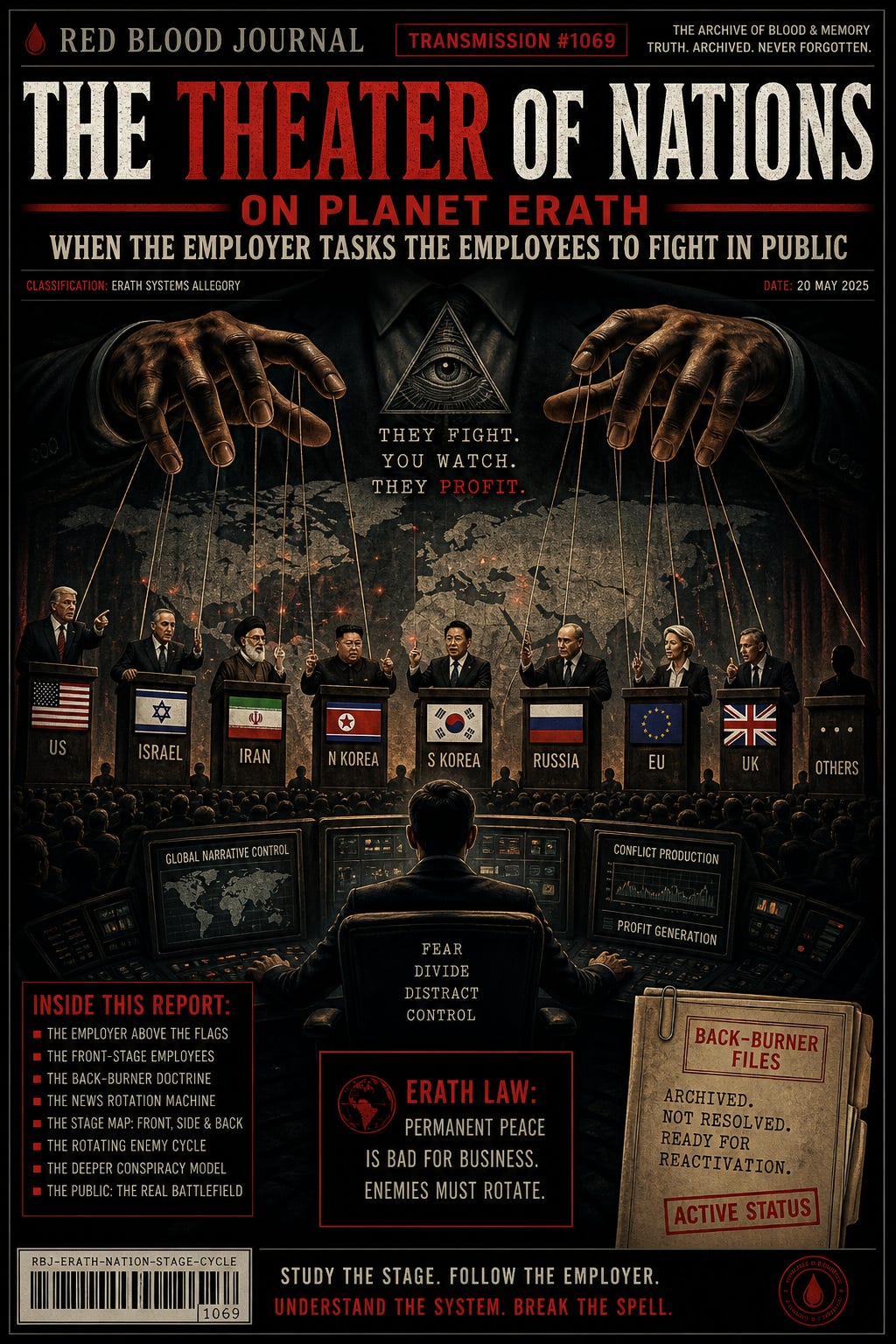
🩸 RED BLOOD JOURNAL TRANSMISSION
THE THEATER OF NATIONS ON PLANET ERATH
When the Employer Tasks the Employees to Fight in Public
Archive: The Archive of Blood & Memory
Division: Parallel Planet Intelligence Wing
Classification: Erath Systems Allegory / Geopolitical Theater Analysis
Transmission Code: RBJ-ERATH-NATION-STAGE-CYCLE
Status: Active Transmission
Management Wearing Flags on Planet Erath
PROLOGUE — THE COMPANY MEETING DISGUISED AS WORLD WAR
On Planet Erath, nations do not always behave like independent sovereign beings.
They behave like departments inside a larger corporation.
One department is told to play security.
One department is told to play resistance.
One department is told to play victim.
One department is told to play villain.
One department is told to play mediator.
One department is told to pretend it has no connection to the rest.
The public is shown conflict.
But behind the curtain, the deeper structure is not always war.
It is management.
The people are told:
“These countries hate each other.”
But the deeper Erath question is:
Who benefits when the employees fight in front of the customers?
SECTION I — THE EMPLOYER ABOVE THE FLAGS
On Erath, the flag is the uniform.
The nation is the department.
The politician is the shift manager.
The intelligence service is the internal security office.
The media is the loudspeaker system.
The public is the customer base.
But the employer is something larger than any single flag.
Not one man.
Not one country.
Not one capital city.
The employer is the network of power that lives above elections:
finance
defense contracts
intelligence infrastructure
energy corridors
sanctions architecture
debt systems
media distribution
technology platforms
reconstruction contracts
controlled opposition networks
This is why Planet Erath never truly looks fixed.
The same nations that claim to hate each other still need each other to justify their own existence.
Without enemies, security budgets shrink.
Without crises, emergency laws expire.
Without fear, populations ask questions.
Without tension, the machine loses fuel.
So the system must keep a rotating stage.
SECTION II — THE FRONT-STAGE EMPLOYEES
On Erath, certain countries are ordered into the spotlight.
They are the visible actors.
The United States
Assigned role: global manager, military enforcer, democracy salesman, crisis narrator.
Israel
Assigned role: regional trigger point, moral pressure node, intelligence amplifier, permanent emergency state.
Iran
Assigned role: resistance state, sanctions laboratory, controlled pressure valve, revolutionary villain-asset.
Russia
Assigned role: old empire antagonist, energy weapon, NATO justification engine.
North Korea
Assigned role: nuclear fear symbol, isolated villain, emergency reminder.
South Korea
Assigned role: model client state, technology showcase, forward operating society.
European Union
Assigned role: bureaucratic empire, regulatory priesthood, civilian face of global management.
United Kingdom
Assigned role: old imperial intelligence desk, narrative bridge between America and Europe.
These are not merely countries in this Erath model.
They are stage functions.
Each performs a role necessary for the continuation of the larger drama.
SECTION III — THE BACK-BURNER COUNTRIES
Some nations are not gone.
They are simply waiting offstage.
The public thinks silence means peace.
But on Erath, silence often means preparation.
A country leaves the news cycle because:
its crisis has already served its purpose
another country is needed as the current villain
public attention must be redirected
negotiations are happening quietly
the next phase is not ready
the population is exhausted from the previous storyline
This is the Back Burner Doctrine.
Countries are not removed from the script.
They are parked.
Like files on a desk.
When needed, they return.
The media says:
“Breaking news.”
But the archive says:
“Old file reactivated.”
SECTION IV — THE PUBLIC FIGHT AS A MANAGEMENT TOOL
On Erath, public conflict has several uses.
1. It disciplines populations
People are easier to manage when they believe danger is near.
Fear compresses thought.
A frightened population asks fewer structural questions.
It does not ask:
Why are our cities decaying?
It asks:
Who is the enemy today?
2. It protects domestic failure
When potholes remain unrepaired, when cities decay, when hospitals collapse, when roads narrow, when infrastructure rots, the ruling class needs a bigger story.
So the public is given foreign danger.
The message becomes:
“Do not look at the broken street. Look at the enemy overseas.”
This is the oldest Erath trick:
externalize the crisis to hide internal corruption.
3. It justifies money movement
War is not only destruction.
War is accounting.
Every enemy creates invoices:
weapons contracts
surveillance systems
cybersecurity budgets
border programs
sanctions enforcement
intelligence expansion
refugee management
reconstruction planning
emergency logistics
The citizen sees conflict.
The contractor sees revenue.
4. It refreshes loyalty
The public must be reminded who to love and who to hate.
Not once.
Repeatedly.
That is why the news cycle must rotate enemies.
Yesterday’s ally can become tomorrow’s villain.
Yesterday’s villain can become tomorrow’s strategic partner.
The people are not meant to remember too clearly.
They are meant to emotionally update.
SECTION V — THE EMPLOYEES STANDING UP TO EACH OTHER
The key phrase is:
The employer tasks employees to stand up to each other for the public.
This is the deepest Erath mechanism.
The system does not always need total agreement.
It needs managed disagreement.
It needs one leader to condemn another.
It needs one nation to sanction another.
It needs one army to threaten another.
It needs one diplomat to walk out.
It needs one president to make a speech.
It needs one regime to shout back.
The audience sees independence.
But the deeper question remains:
Are these actors truly free, or are they trapped inside roles assigned by the larger architecture?
On Erath, even rebellion can become a department.
Even resistance can become a managed product.
Even opposition can be monetized.
SECTION VI — WHY NOTHING MAKES SENSE ON ERATH
Nothing makes sense because it is not designed to make moral sense.
It is designed to produce motion.
The contradiction is the fuel.
A nation says it supports freedom while funding control.
A government says it opposes terror while arming proxies.
A regime says it defends the poor while making the poor suffer.
A democracy says it protects citizens while spying on them.
An empire says it wants peace while expanding bases.
A revolutionary state says it fights corruption while building its own ruling class.
That is why the public becomes confused.
The confusion is not a bug.
It is part of the architecture.
Confused people retreat into teams.
Teams stop thinking structurally.
They defend flags instead of studying systems.
SECTION VII — THE NEWS ROTATION MACHINE
On Erath, the news does not simply report reality.
It assigns emotional homework.
This week:
Fear Russia.
Next week:
Watch Iran.
Then:
North Korea missile alert.
Then:
Israel emergency.
Then:
EU regulation crisis.
Then:
South China Sea tension.
Then:
domestic distraction.
Then:
celebrity scandal.
Then:
back to war.
This is not random.
It is rhythm.
The human nervous system is placed inside a global metronome.
Fear.
Relief.
Anger.
Confusion.
Patriotism.
Exhaustion.
Repeat.
SECTION VIII — THE GREAT ERATH STAGE MAP
Front Stage
Where the public watches.
speeches
sanctions
missile tests
press conferences
war footage
diplomatic insults
emergency meetings
Side Stage
Where managers coordinate.
intelligence sharing
backchannel diplomacy
banking exemptions
prisoner swaps
energy deals
weapons transfers
quiet guarantees
Back Stage
Where the real architecture lives.
debt
minerals
oil routes
military basing
digital identity systems
currency control
population management
media synchronization
crisis monetization
The public is trained to watch the front stage.
Red Blood studies the backstage.
SECTION IX — THE DEEPER CONSPIRACY MODEL
The deepest conspiracy is not that every event is fake.
That is too simple.
The deeper model is this:
Real conflicts are harvested by larger systems.
The suffering is real.
The deaths are real.
The sanctions are real.
The poverty is real.
The trauma is real.
The propaganda is real.
The manipulation is real.
The theater does not mean nothing happened.
It means what happened was converted into system profit.
That is the coldest layer.
The machine does not need to invent every fire.
Sometimes it only needs to control where the smoke goes.
SECTION X — THE PLANET ERATH LAW OF ROTATING ENEMIES
On Erath, permanent peace is bad for business.
So enemies must rotate.
Not disappear.
Rotate.
When one enemy becomes too familiar, another must rise.
When one war becomes exhausting, another crisis must appear.
When one population becomes numb, the emotional script must change.
This creates the Rotating Enemy Cycle:
Identify → Demonize → Sanction → Escalate → Exhaust → Negotiate → Archive → Reactivate
That is why old conflicts never fully die.
They are stored.
Every unresolved conflict is a battery.
The system can plug it back in whenever public attention needs charging.
SECTION XI — THE PUBLIC AS THE REAL BATTLEFIELD
The battlefield is not only Ukraine, Gaza, Iran, Korea, Taiwan, or Europe.
The battlefield is the citizen’s perception.
The objective is not only territory.
It is emotional obedience.
The public must believe:
this crisis is natural
this enemy is permanent
this spending is necessary
this surveillance is temporary
this sacrifice is patriotic
this contradiction is too complicated to question
Once the public accepts that, the system wins without firing another shot.
ANNEX A — THE EMPLOYEE-THEATER MODEL
Employer
The transnational power architecture.
Managers
Political leaders, security institutions, central banks, defense networks.
Employees
Nation-states assigned visible roles.
Customers
The public.
Product
Fear, loyalty, confusion, consent.
Revenue
Control, contracts, debt, surveillance, obedience.
ANNEX B — THE BACK-BURNER FILES
A country placed on the back burner is not irrelevant.
It is cooling.
The file remains active.
The pressure is simply reduced until needed again.
The back-burner state can return through:
border crisis
election dispute
missile test
assassination
leaked intelligence
sanctions announcement
humanitarian emergency
cyberattack narrative
The public calls it sudden.
The archive calls it scheduled reactivation.
ANNEX C — THE ERATH FORMULA
Domestic Decay + Foreign Crisis = Public Distraction
Public Fear + Media Repetition = Consent
Enemy Rotation + Memory Loss = Permanent Control
War Theater + Real Suffering = System Profit
ANNEX D — THE FINAL READ
On Planet Erath, the nations stand up to each other like employees arguing in front of customers.
The public believes it is watching history.
But often it is watching a managed performance of power.
Not every actor knows the whole script.
Not every crisis is fake.
Not every war is planned from one room.
But the machine does not require perfect coordination.
It only requires that every crisis be converted into advantage.
That is the real theater.
Not illusion alone.
But the conversion of reality into control.
CLOSING TRANSMISSION
The citizen is told:
Pick a side.
The archive replies:
Study the stage.
The citizen is told:
Fear the enemy.
The archive replies:
Follow the employer.
The citizen is told:
This is world politics.
The archive replies:
This is management wearing flags.
End Transmission.
🎭 Management Wearing Flags: The Theater of Nations on Erath
May 4, 2026
The provided text presents an allegorical critique of global geopolitics, framing sovereign nations as mere departments within a vast, corporate-like hierarchy.
This “Theater of Nations” suggests that international conflicts are managed performances designed to distract the public from internal domestic failures and justify massive security expenditures.
According to this model, prominent world powers act as employees assigned specific roles—such as the villain, the victim, or the enforcer—to maintain a profitable cycle of crisis and resolution.
By rotating enemies and manipulating public fear, the underlying power structure ensures continuous social control and financial gain.
Ultimately, the narrative asserts that while the human suffering in war is real, the geopolitical drama is a management tool used to convert reality into systemic obedience.


