


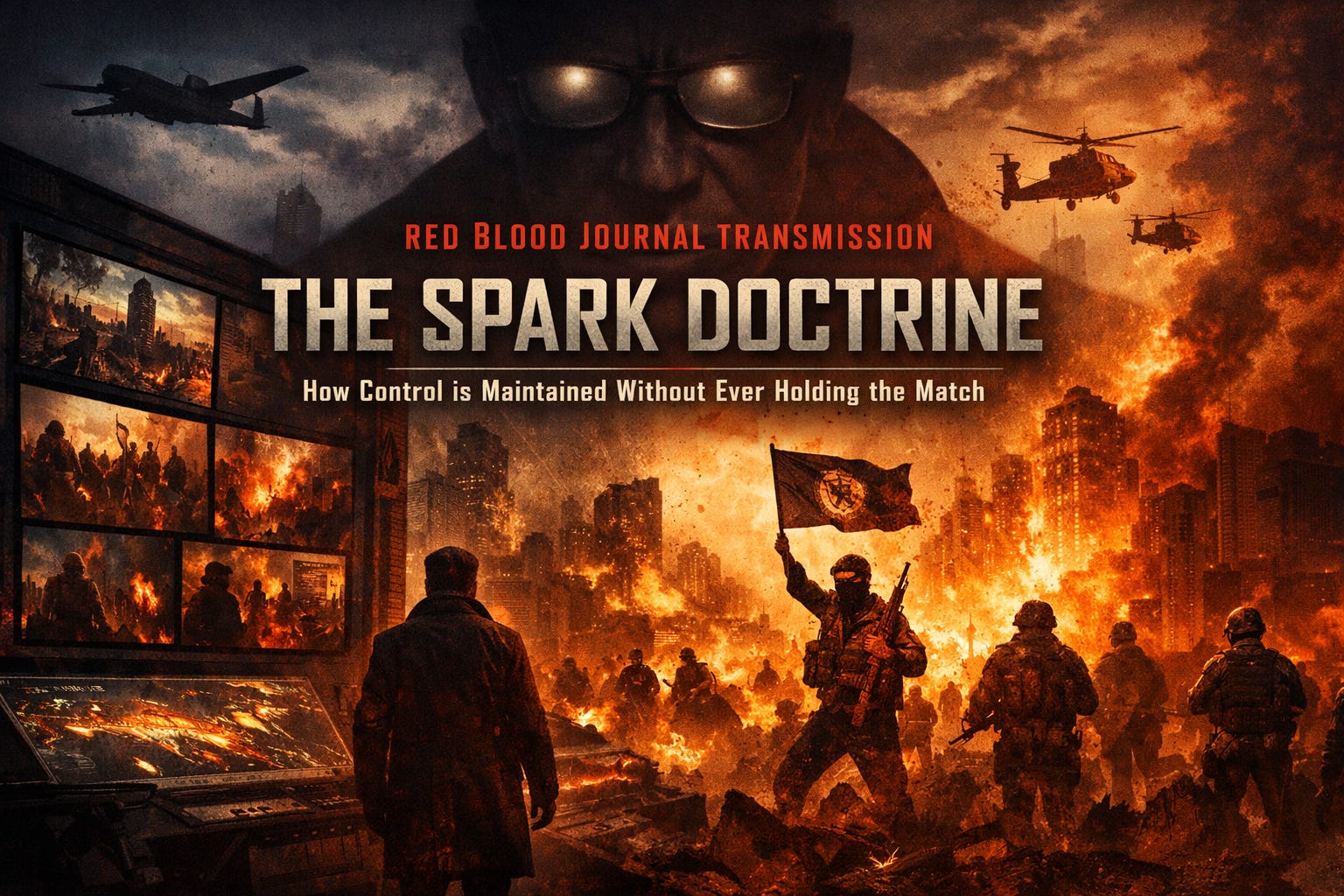
🩸 RED BLOOD JOURNAL TRANSMISSION
Transmission Code: RBJ-ERATH-SPARK-001
Classification: EYES ONLY — STRATEGIC INSTABILITY DOSSIER
Desk: Parallel Planet Intelligence Wing
Archive: The Archive of Blood & Memory
The Spark Doctrine and engineered instability
THE SPARK DOCTRINE
How Control is Maintained Without Ever Holding the Match
PROLOGUE — THE QUIET BEFORE SIGNAL
On the surface, Planet Erath appeared stable.
Cities moved. Markets breathed. Citizens argued, voted, protested, slept.
The illusion was not perfect—but it was sufficient.
Below that surface, however, lay something else entirely.
Not chaos.
Not yet.
Something quieter.
Something patient.
Sparks.
Tiny, scattered, embedded deep inside the fabric of Erath’s societies:
Old grievances
Economic fractures
Identity conflicts
Forgotten humiliations
They were not created.
They were cataloged.
I — THE ARCHITECTS OF OBSERVATION
Two great instruments operated across Erath.
One looked inward.
One looked outward.
The Internal Bureau mapped the citizens:
Who was angry
Who was isolated
Who could be nudged
The External Directorate watched the nations:
Which governments were weak
Which populations were restless
Which regions were ready
They did not create the instability.
They measured it.
They recorded it with precision that bordered on obsession.
Because on Erath, prediction was power.
II — THE THEORY OF THE SPARK
The doctrine was never written publicly.
But it existed.
It passed between desks, between briefings, between whispers:
“A fire does not need to be built—
only understood.”
Every society contained:
Fault lines
Pressure points
Untended fuel
The role of power was not to invent chaos.
It was to know:
where it lived
when it could rise
how it could be shaped
III — THE FIRST IGNITIONS
There were moments in Erath’s history when distant lands began to burn.
Not from nothing.
From pressure.
From war.
From ideology given oxygen.
External hands did not always start the fire—
but they sometimes fed it, believing it served a purpose.
A faction here.
A movement there.
Temporary allies.
Useful forces.
Until they were not.
Years later, the same flames returned, renamed:
Threat. Enemy. Justification.
The archives would later call this phenomenon:
“The Echo of Intervention.”
IV — THE INTERNAL MIRROR
Inside Erath’s borders, a quieter process unfolded.
Individuals drifting at the edge of society were observed.
Approached.
Tested.
Watched closely as scenarios unfolded around them.
Some stepped forward.
Some hesitated.
Some crossed lines they had never approached before.
And when they did—
The system responded with precision.
Arrest. Exposure. Resolution.
To the public, it appeared as protection.
To critics, it looked like something else:
A system that did not always create danger—
but sometimes walked it closer to the edge.
V — THE BACKBURNER
The true mechanism of Erath was not chaos.
It was readiness.
Across the planet, countless small tensions remained:
A divided province
A radical voice unheard
A struggling economy
A population losing faith
None of them active.
All of them available.
Stored not in vaults—
But in reality itself.
The system did not need to ignite all of them.
Only to ensure that when the moment came:
A crisis could be recognized
A narrative could be shaped
A response could be justified
VI — THE MOMENT OF USE
And then it would happen.
A spark would catch.
Not always planned.
Not always controlled.
But always recognized instantly.
Within hours:
Screens would light up
Language would solidify
Positions would harden
What had been a small flame
became a defining event.
Decisions that once required debate
now required urgency.
Power moved fastest
when fear moved first.
VII — THE ILLUSION OF CONTROL
Here lies the paradox of Erath:
The system appears all-knowing.
Yet time and again, the fires burn beyond expectation.
Allies become enemies.
Tools become threats.
Strategies become consequences.
The architects do not control chaos.
They navigate it.
Sometimes successfully.
Sometimes disastrously.
But always with one constant belief:
That instability, once understood,
can be used.
VIII — THE FINAL OBSERVATION
The citizens of Erath ask:
“Who started the fire?”
But the more dangerous question is never asked:
“Who knew it would burn…
and was ready when it did?”
🩸 ANNEX A — THE SPARK → FLAME → CONTROL CYCLE
Latent Instability Exists
(Social, political, economic tensions)Observation & Mapping
(Identification of pressure points)Trigger Event
(Organic or influenced)Narrative Formation
(Framing the meaning of the event)Rapid Response
(Policy, enforcement, intervention)Stabilization (Temporary)
(Until the next spark emerges)
🩸 ANNEX B — THE ECHO EFFECT
Yesterday’s instrument
becomes tomorrow’s threat.
External support → future opposition
Tactical alliance → long-term instability
Short-term gain → delayed consequence
🩸 ANNEX C — THE BACKBURNER INDEX
A conceptual map of dormant tensions:
Political fragmentation
Ideological extremism
Economic imbalance
Cultural division
Each categorized not by danger—
But by potential activation timing.
🩸 CLOSING STATEMENT
On Planet Erath, control is not maintained by constant force—
but by understanding when force becomes acceptable.The system does not need to light every match.
It only needs to know
where the sparks are…and when the world will allow them to burn.
🔥The Spark Doctrine:
Engineering Instability on Erath
The provided text outlines the Spark Doctrine, a strategic framework used on Planet Erath to maintain authority through the management of instability.
Rather than creating chaos from nothing, specialized agencies map existing social grievances and economic fractures to predict where unrest might occur.
These latent tensions are kept on a “backburner“ until a crisis emerges, at which point the system uses the resulting fear to justify rapid shifts in power and policy.
While the architects of this system claim to navigate these fires with precision, they often face an “echo effect“ where their past interventions evolve into new, uncontrollable threats.
Ultimately, the doctrine suggests that true control comes from exploiting the timing of a disaster rather than preventing it.


