


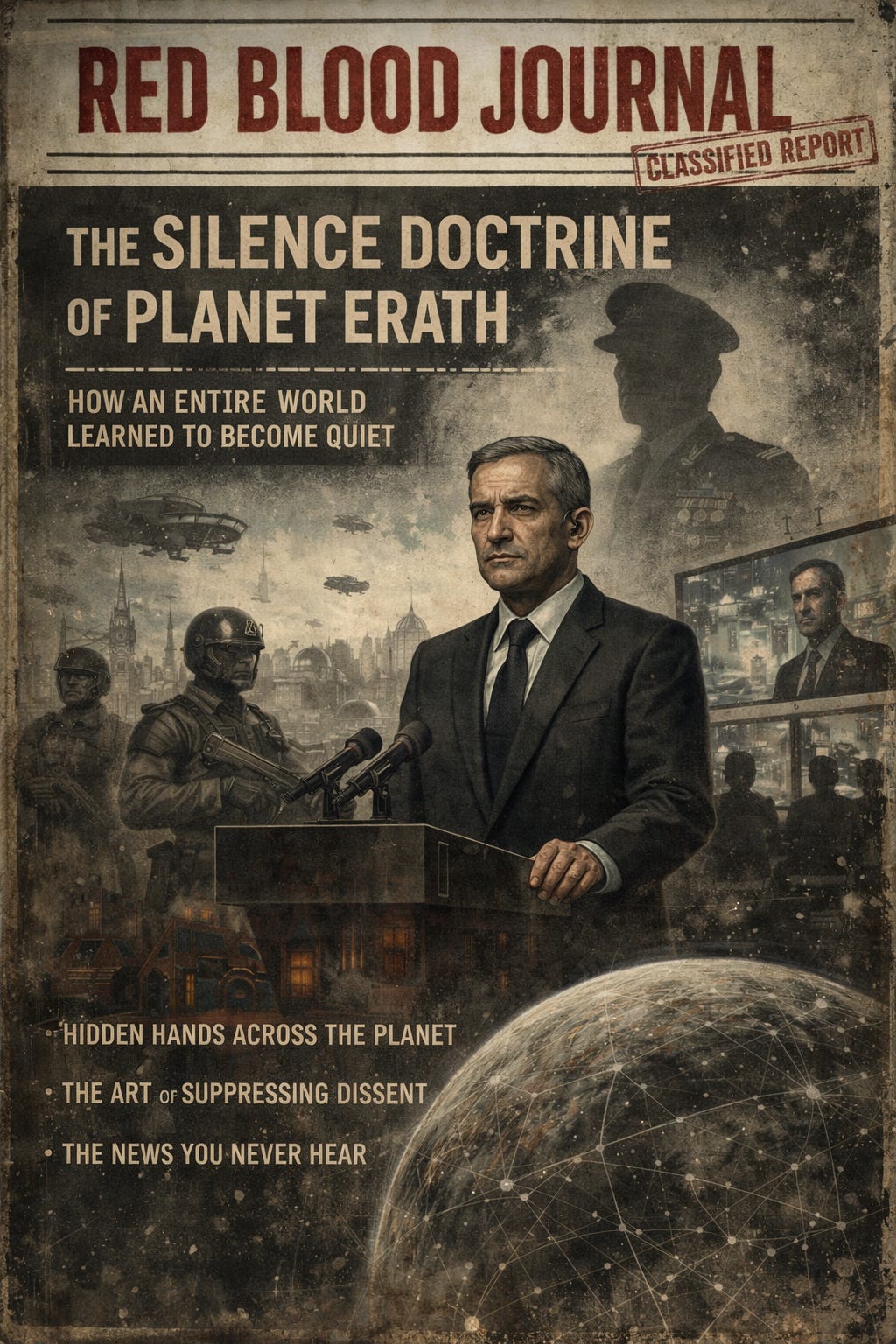
🩸 RED BLOOD JOURNAL TRANSMISSION
Division: Parallel Planet Intelligence Wing
Transmission Code: RBJ-ERATH-SILENCE-DOCTRINE-001
Classification: Allegorical Power Systems / Narrative Control Simulation
Archive: The Archive of Blood & Memory
THE SILENCE DOCTRINE OF PLANET ERATH
How an Entire World Learned to Become Quiet
🪐 PROLOGUE — THE PLANET THAT STOPPED MAKING NOISE
On the not-so-distant world of Erath, there was a time when everything was loud.
Cities argued with themselves.
Leaders shouted across borders.
The people believed noise meant freedom.
Every event became a story.
Every story became a battle.
Every battle became a signal.
And then, slowly…
The noise began to disappear.
Not all at once.
Not by force that could be seen.
But by something far more effective:
The quieting of everything that could become noise.
I — THE FIRST PHASE: THE AGE OF CHAOS
In the early cycles of Erath, instability spread like a storm.
Governments rose and fell
Factions competed for narrative dominance
Information flooded the population
Truth and lies collided in real time
The people of Erath believed this chaos was natural.
They believed:
“This is what it means to be alive.”
But beneath the chaos, something else was forming.
Not a single ruler.
Not a single empire.
But a realization shared by many centers of power:
Chaos is unpredictable.
Unpredictability is dangerous.
And danger must be managed.
II — THE SECOND PHASE: THE DISCOVERY OF QUIET
The rulers of Erath—kings, councils, generals, technocrats—did not meet in one room.
They did not form a single alliance.
But they all arrived at the same conclusion:
Noise is the enemy of control.
So they began, each in their own domain, to shape a new principle:
Reduce the noise.
Not eliminate people.
Not eliminate systems.
Just eliminate volatility.
III — THE MECHANISMS OF SILENCE
Silence on Erath was not created through one method.
It emerged through layers.
1. The Gatekeepers of Story
On Erath, every story passed through invisible filters.
Not all stories were banned.
But only certain stories were allowed to grow.
The rest…
Faded.
Not because they were erased—
But because they were never amplified.
2. The Training of the Messengers
Journalists, scribes, and speakers learned quickly:
Some topics led to consequences.
Others led to survival.
Over time, they no longer needed to be told.
They adjusted themselves.
And silence became self-sustaining.
3. The Economy of Attention
On Erath, attention was the most valuable currency.
The great networks learned to direct attention toward:
distant wars
emotional conflicts
dramatic personalities
And away from:
stable power structures
quiet consolidations
slow transformations
So the people believed they were informed.
But they were only shown what moved.
4. The Psychology of Fatigue
The people of Erath were not conquered.
They were exhausted.
After cycles of chaos, many began to prefer:
predictability over freedom
order over argument
quiet over truth
And once the people began to choose quiet…
The system no longer needed to enforce it as strongly.
IV — THE ILLUSION OF THE HIDDEN HAND
As the silence spread across Erath, a belief began to grow among the observers:
“There must be a single force controlling everything.”
They called it:
The Hidden Hand.
A force that:
controlled governments
controlled information
controlled outcomes across the planet
But the truth of Erath was more complex.
There was no single hand.
There were many hands—
All moving in the same direction.
V — THE CONVERGENCE
Across Erath, different powers reached the same conclusions:
Stability preserves rule
Control reduces risk
Information shapes reality
Noise creates danger
So without coordination, without conspiracy, without a central command—
They built the same systems.
And those systems began to look identical.
To the people, it appeared as one design.
In reality, it was many designs… converging.
VI — THE GREAT QUIETING
Over time, entire regions of Erath became…
Quiet.
Not empty.
Not inactive.
But controlled.
The signs were subtle:
Fewer public conflicts
Predictable leadership
Limited opposition
Consistent narratives
Stable surfaces
And to the outside observer, it looked like nothing was happening.
But beneath the surface:
Everything was being maintained.
VII — THE SUIT OVER THE ARMOR
In the early ages of Erath, rulers wore armor.
Their power was visible.
Their control was obvious.
But in the age of silence, a new evolution emerged:
The rulers began to wear suits.
They spoke calmly.
They used the language of management.
They presented themselves as administrators—not commanders.
But behind them:
stood the enforcers
stood the watchers
stood the systems that ensured continuity
The armor had not disappeared.
It had simply moved out of sight.
VIII — THE FINAL STAGE: WHEN SILENCE BECOMES NORMAL
The most powerful moment in Erath’s transformation was not when silence was created.
It was when silence was accepted.
When the people stopped asking:
“Why is nothing happening?”
And began believing:
“Nothing needs to happen.”
At that moment, the system reached stability.
Not perfect control.
But sufficient control.
Enough that it no longer needed to prove itself.
IX — THE ERATH PARADOX
On Erath, the absence of noise created a paradox:
The quieter the system became,
the more powerful it felt.
And the more powerful it felt,
the more people believed it must be controlled by something vast and hidden.
But the true mechanism was simpler—and more unsettling:
The system did not need a master.
It only needed alignment.
X — FINAL RBJ ASSESSMENT
Planet Erath did not fall under one ruler.
It evolved into something else:
A world where:
control became efficient
information became curated
instability became suppressed
and silence became the dominant signal
🩸 CLOSING LINE
On Erath, silence was not proof of nothing.
It was proof that everything had learned to operate without being seen.
🤫The Erath Convergence:
Mechanics of the Silence Doctrine
The provided text describes a fictional planet called Erath that transitioned from a state of chaotic public discourse to a highly controlled, silent society.
This transformation was not achieved through a single dictator, but through the convergence of various power centers that realized volatility was a threat to their stability.
Control was maintained by curating information, exhausting the public’s will to resist, and replacing visible force with administrative management.
Eventually, the citizens grew to prefer predictable order over the noise of freedom, making the silence self-sustaining.
The narrative suggests that true power is most effective when it becomes an invisible, accepted part of the social fabric.
This allegorical archive serves as a study on how narrative control and psychological fatigue can quietly dismantle systemic opposition.


