


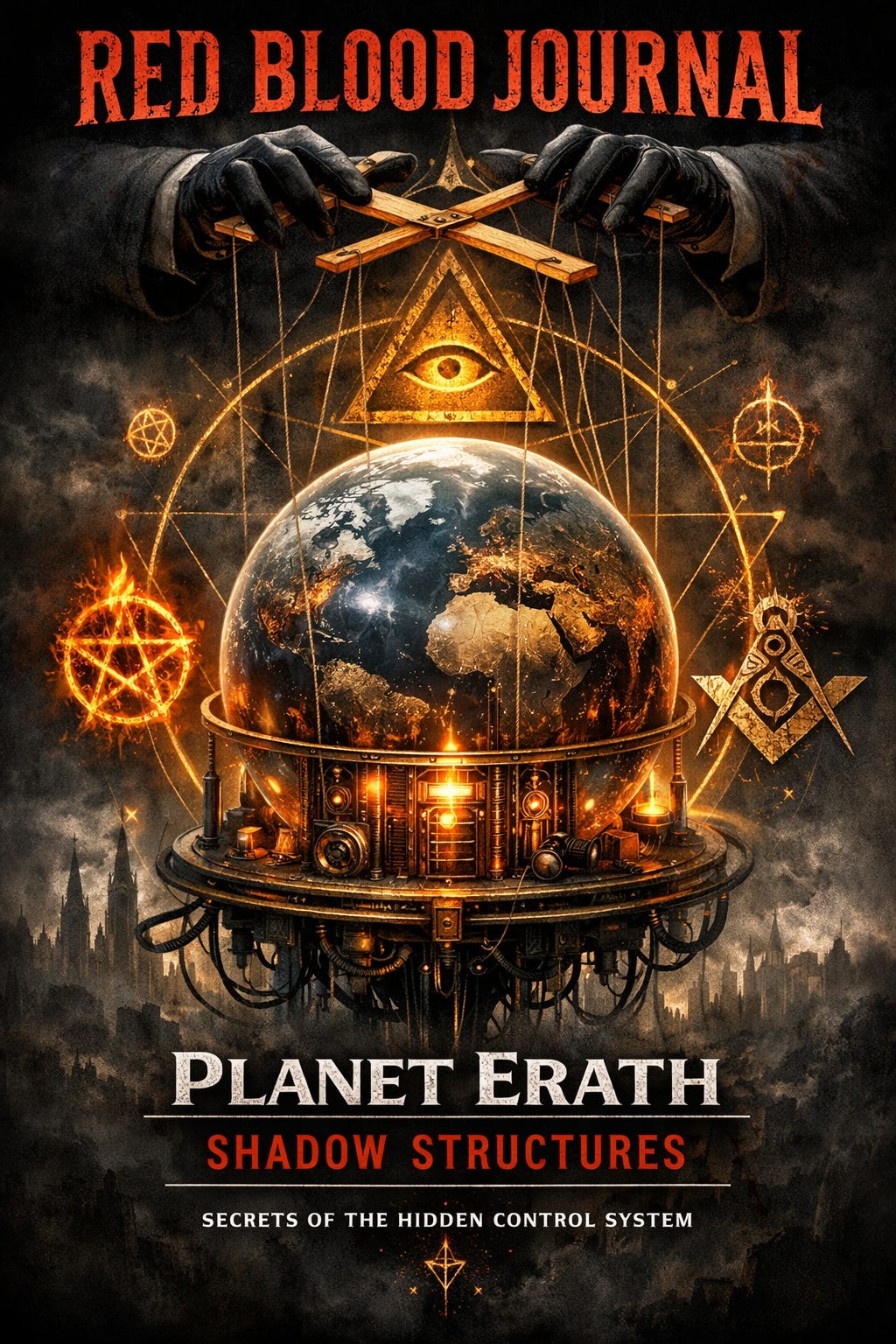
🩸👁️ RED BLOOD JOURNAL TRANSMISSION
Division: Parallel Civilization Analysis Unit
Transmission Code: RBJ-PCAU-ERATH-308-SHADOW-STRUCTURE
Classification: Allegorical Intelligence Brief
Archive: The Archive of Blood & Memory
PLANET ERATH DOSSIER
The Shadow Structures Behind the Theatre
A Parallel Planet Allegory
PROLOGUE — THE PLANET OF MIRRORS
On the distant world of Erath, the inhabitants believed they lived inside competing nations, religions, and political movements.
Every citizen of Erath believed their side was different.
Different leaders.
Different beliefs.
Different wars.
But the oldest historians of Erath whispered a dangerous theory:
The planet was not divided at all.
It was administered.
Not through armies alone, but through symbols, rituals, and narratives.
The rulers of Erath did not merely govern territory.
They governed perception.
I — THE SYMBOL KEEPERS
On Erath there existed ancient brotherhoods known collectively as the Orders of Geometry.
Their temples were hidden behind universities, foundations, and cultural institutions.
Their central belief was simple:
Whoever controls symbols controls the mind of the population.
The Orders taught that the masses of Erath could not be ruled through force alone.
They had to be ruled through meaning.
Shapes.
Numbers.
Colors.
Ceremonies.
These symbols were embedded everywhere:
• government buildings
• fashion shows
• television broadcasts
• monuments and architecture
To the common citizen they looked like decorations.
To the initiated they were messages.
Among the most influential of these orders were the Architects of Solomon, an elite hierarchy rumored to descend from ancient temple builders.
II — THE THEATRE OF POWER
The rulers of Erath did not present themselves as rulers.
They presented themselves as:
• politicians
• scientists
• media figures
• activists
But behind the public stage existed a hidden council often referred to only as “The Directors.”
The Directors understood a secret of mass psychology:
People will obey authority more willingly when they believe the system is chaotic.
Thus Erath was constantly filled with conflict.
Left versus right.
Religion versus secularism.
Nation versus nation.
Each conflict appeared spontaneous.
Yet behind the scenes, the Directors ensured the conflicts never threatened the system itself.
The battles were real, but the arena was controlled.
III — THE WAR ENGINE
Erath’s most powerful industry was not agriculture.
Not technology.
It was conflict.
Wars on Erath served several purposes simultaneously:
They unified populations through fear.
They justified expanding government authority.
They redistributed wealth toward the industrial war guilds.
Whenever populations began questioning the system, a new conflict emerged.
Historians on Erath eventually noticed a pattern:
Every generation experienced its own “necessary war.”
The war would be explained as unavoidable.
But the same beneficiaries appeared every time.
IV — THE LANGUAGE OF NUMBERS
The elite circles of Erath believed numbers possessed symbolic power.
Among the most frequently appearing numbers was 33.
It appeared in:
• ceremonial rituals
• public announcements
• architectural designs
• broadcast signals
Most citizens dismissed these occurrences as coincidence.
But within the secret orders, numbers were believed to carry layers of meaning understood only by initiates.
To the initiated, numbers were not mathematics.
They were communication.
V — THE TECHNOCRATIC PRIESTS
While ancient priesthoods once ruled Erath openly, the modern era replaced them with a new authority:
The Technocrats.
These new priests wore lab coats rather than robes.
Their temples were called laboratories.
Their scriptures were called “studies.”
The technocratic class instructed the population that intuition, spirituality, and ancient traditions were outdated.
The citizens of Erath were told:
Trust the experts.
Ignore your instincts.
This transition from spiritual authority to technocratic authority was known as The Age of Empiricism.
But some historians believed it was less a revolution than a replacement priesthood.
VI — THE MEDIA SPELLCASTERS
If the technocrats governed knowledge, another class governed perception:
The Broadcast Guilds.
These were the storytellers of Erath.
They determined:
• which events mattered
• which events disappeared
• which people were heroes
• which people were villains
Through constant repetition, the Broadcast Guilds could transform any narrative into accepted reality.
Citizens of Erath eventually began referring to these operations as “spells.”
Not magical spells.
Psychological spells.
A spell required three ingredients:
Repetition
Emotional imagery
Authority endorsement
When these three elements aligned, the population rarely questioned the story.
VII — THE ILLUSION OF FACTIONS
One of the greatest achievements of the Directors was convincing the citizens of Erath that their political factions represented genuine opposition.
Every election looked like a revolution.
Every campaign looked like a battle for the soul of the planet.
Yet when historians studied the archives of Erath, they noticed something strange:
Regardless of who won power, the same structural forces remained untouched.
The wars continued.
The surveillance systems expanded.
The wealth accumulated at the same centers.
It appeared that the factions were not enemies.
They were roles in a performance.
VIII — THE AWAKENING RISK
For centuries the Directors ruled Erath without serious challenge.
But something changed in the information age.
Independent investigators began connecting patterns.
They compared symbols.
They tracked financial flows.
They mapped alliances between governments, corporations, and media institutions.
The more connections appeared, the more citizens began to suspect that the divisions of Erath were not natural.
They were engineered.
The Directors recognized the danger immediately.
Their greatest fear was not rebellion.
It was unity.
Because if the inhabitants of Erath ever realized that the same structures governed all factions, the entire theatre could collapse.
IX — THE CENTRAL PARADOX OF ERATH
The Directors of Erath possessed immense power.
But their rule depended on one fragile condition:
The population must never understand the system as a whole.
Citizens could believe:
• one conspiracy
• one corrupt politician
• one scandal
But they must never see the architecture itself.
Because the moment the population understands the structure, the illusion of chaos disappears.
And once the illusion disappears, so does obedience.
FINAL ARCHIVE NOTE
The allegory of Planet Erath serves as a framework for analyzing complex power systems.
Whether the structures described here represent literal reality or metaphorical interpretation remains a matter for the reader to determine.
But one principle has remained consistent across every civilization in recorded history:
Power rarely appears in the form it actually operates.
👁️Secret Religion
Altiyan Childs
https://www.bitchute.com/video/NJRHp0sRBbD7/
👁️The Architecture of Erath:
A Blueprint of Governed Perception
The allegorical dossier on the planet Erath describes a civilization where governance is achieved through the manipulation of perception rather than simple force.
According to the text, a hidden group of “Directors” utilizes symbolic architecture, ritualistic numbers, and
engineered conflicts to maintain an illusion of political division.
These elites employ technocratic experts and media guilds to act as a modern priesthood, casting “psychological spells” that ensure the public remains distracted by controlled theatrical battles.
By framing society as a series of chaotic factions, the rulers hide the fact that centralized power structures remain unchanged regardless of which side appears to win.
Ultimately, the narrative warns that this global theater depends entirely on the population’s ignorance of the underlying system, suggesting that true unity among the citizens poses the greatest threat to the status quo.


