


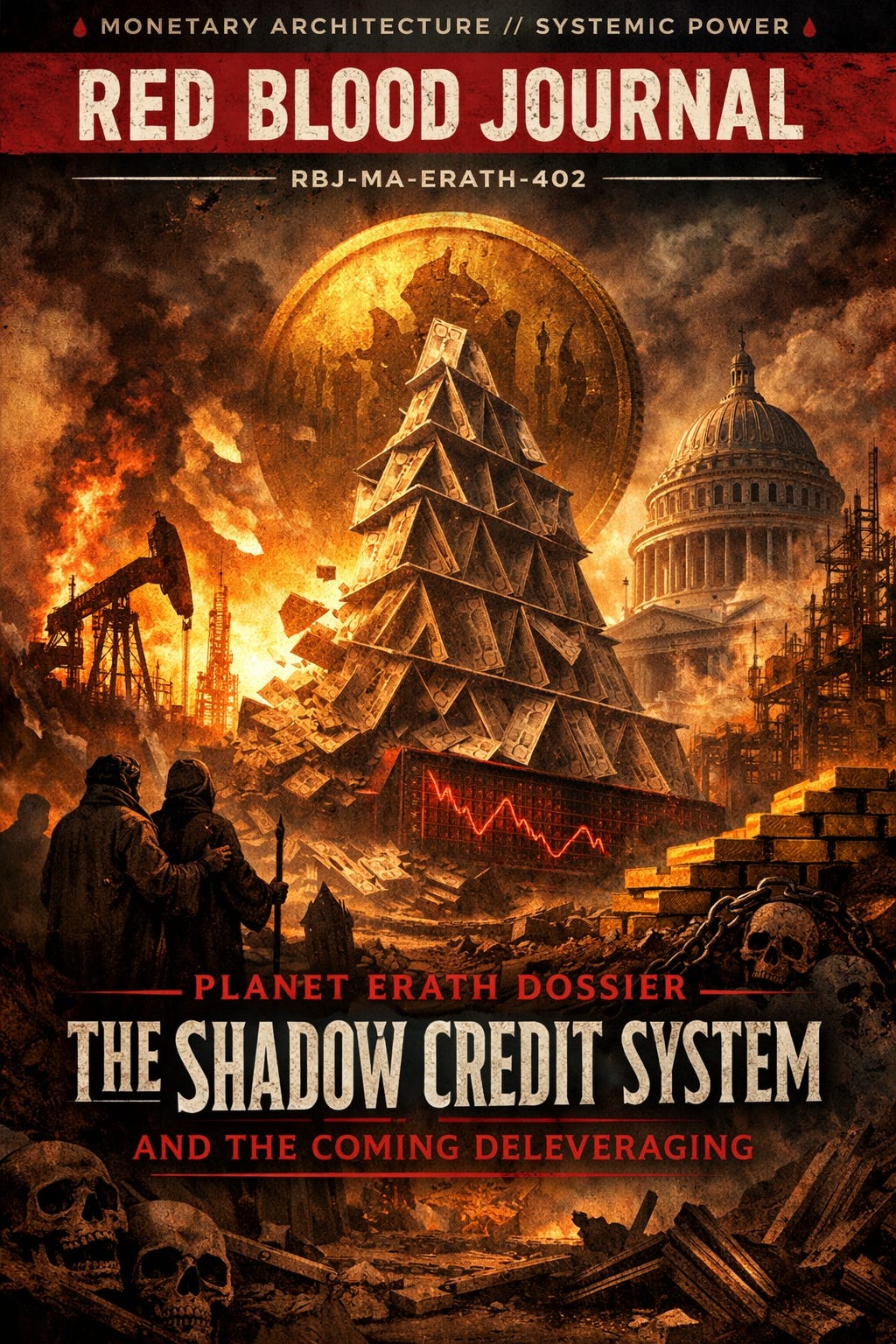
🩸 RED BLOOD JOURNAL TRANSMISSION
Division: Monetary Architecture & Systemic Power Analysis Unit
Transmission Code: RBJ-MA-ERATH-402-PRIVATE-CREDIT-DOMINO
Classification: Allegorical Strategic Financial Brief
Archive: The Archive of Blood & Memory
Architecture of the Leveraged Collapse
PLANET ERATH DOSSIER
The Shadow Credit System and the Coming Deleveraging
PROLOGUE — THE ECONOMY BUILT ON AIR
On the mirror planet Erath, the citizens believed their prosperity was built on productivity, innovation, and hard work.
Factories produced goods.
Banks financed homes.
Governments managed the currency.
But the historians of Erath knew something different.
The wealth of the planet was not built on production.
It was built on leverage.
Debt layered upon debt.
Loans stacked upon loans.
Promises resting on promises.
And above it all stood the Invisible Treasury, issuing obligations to be purchased by the entire world.
For decades the system expanded.
Until one small crack appeared.
And the historians of Erath understood a terrible truth:
In a leveraged civilization, it only takes one domino.
I — THE SHADOW BANKING EMPIRE
Long ago on Erath, banks were the guardians of credit.
They issued loans under strict oversight from the planetary regulators.
But regulation limits profit.
So the financial architects of Erath built something new.
A parallel banking system.
It was called Private Credit.
This system did not operate through banks.
Instead it operated through massive financial guilds:
The House of Blackstone
The Order of Apollo
The Blue Owl Syndicate
The KKR Consortium
The Carlyle Network
These institutions lent enormous sums of money to:
private corporations
real estate empires
infrastructure projects
But the most important secret was where the money came from.
It came from the retirement savings of the citizens of Erath.
Pensions.
Insurance reserves.
Worker retirement accounts.
The people unknowingly became the capital base of the Shadow Lending System.
Within a single decade this system grew to three trillion credits in size.
And almost none of it was transparent.
II — THE ILLUSION OF LIQUIDITY
The citizens believed their investments were safe.
They believed their retirement funds were liquid.
But the loans in the shadow system were long-term and locked.
When investors asked for their money back, something unexpected happened.
The funds replied:
“You cannot withdraw now.”
Redemption requests began to surge across the system.
Some funds limited withdrawals.
Others halted them entirely.
The illusion of liquidity vanished overnight.
The citizens of Erath discovered something frightening:
Their wealth was trapped inside illiquid debt contracts.
III — THE LEVERAGE TOWER
To understand why this mattered, the scholars of Erath mapped the structure of their civilization.
It looked like a tower built from fragile cards.
At the bottom stood the workers.
They borrowed money to buy homes.
Above them stood the banks, which borrowed money to lend mortgages.
Above the banks stood the credit funds, packaging those loans.
Above them stood insurance companies and pensions.
And above everything stood the planetary government, itself buried under 38 trillion credits of debt.
Every layer was borrowed against the one beneath it.
The entire civilization had become a pyramid of leverage.
And the historians of Erath remembered an earlier collapse.
IV — THE LESSON OF THE 2008 COLLAPSE
During the Great Mortgage Crisis of Erath’s past, something remarkable occurred.
Only a tiny fraction of loans actually failed.
Yet the entire financial system collapsed.
Why?
Because leverage amplifies everything.
A small shock becomes a catastrophic chain reaction.
The scholars warned:
The same pattern could happen again.
V — THE OIL TRIGGER
Across the oceans of Erath lies a narrow passage known as the Hormuz Gate.
Nearly one-fifth of the planet’s oil flows through this strait.
When war erupted nearby, the cost of energy surged.
This alarmed the economists of Erath because history had shown a repeating pattern.
Every time oil prices spiked sharply:
A recession followed.
Energy is the hidden input of the entire economy:
transportation
food
manufacturing
shipping
When energy costs rise, businesses respond in only one way:
They cut workers.
VI — THE FEDERAL RESERVE TRAP
The central monetary authority of Erath — known as The Reserve Council — normally fights recessions using two weapons:
Lower interest rates
Print money
But now the council faced a strategic trap.
Inflation remained elevated.
Oil prices were volatile.
If the council printed money to fight unemployment, inflation would explode.
If it fought inflation, unemployment would rise.
The Reserve Council could only defend one side of the battlefield at a time.
VII — THE GOVERNMENT BALANCE SHEET CRISIS
Meanwhile the government of Erath had a structural problem.
Tax revenue:
5.2 trillion credits
Spending:
7 trillion credits
The difference — two trillion credits per year — was borrowed.
Most revenue was already committed.
Social programs consumed the majority.
Interest payments on debt were rising rapidly.
Defense spending remained untouchable.
Before funding infrastructure, education, or research, the treasury was already beyond its income.
The system depended entirely on continuous borrowing.
VIII — THE GOLD RESET THEORY
Hidden deep within the vaults of Erath lay a forgotten asset.
Gold.
The government officially possessed 8,000 tons.
But a strange accounting rule existed.
The gold was valued on government books at only $42 per ounce, a price frozen since the 1970s.
Meanwhile, the real market price had risen to thousands of credits per ounce.
Some economists proposed a radical solution.
Revalue the gold.
If the treasury marked its gold reserves to real market value, the balance sheet would instantly strengthen.
The treasury could create over a trillion credits in assets overnight without borrowing or taxation.
This technique had been used before during past financial crises.
IX — GOLD FOR OIL
An even more radical proposal emerged.
What if Erath’s government stopped paying oil producers with paper currency?
What if it paid them in gold instead?
If gold were repriced high enough, oil producers might accept a lower nominal oil price while still gaining real purchasing power.
Oil prices could stabilize.
Inflation could fall.
The financial system might survive.
X — THE SYSTEMIC QUESTION
But beneath all technical discussions lies a deeper truth about Erath.
The civilization is not built on productivity alone.
It is built on confidence in debt.
If that confidence breaks:
Credit disappears.
Businesses fail.
Unemployment spreads.
Markets collapse.
And the tower of leverage begins to fall.
FINAL OBSERVATION — THE DOMINO RULE
The citizens of Erath often imagine that a global financial collapse would require massive failure.
But history teaches something else.
Sometimes it takes only one small domino.
A corner of the credit market.
A spike in oil.
A sudden withdrawal of liquidity.
And a civilization built on leverage begins to unwind.
The historians of Erath watch closely.
Because when the first domino falls,
the rest rarely remain standing.
🩸 END TRANSMISSION
Archive Reference: RBJ-MA-ERATH-402
⏳The Erath Dossier:
Architecture of a Leveraged Collapse
This text presents an allegorical warning about the fragile nature of a modern global economy through the lens of a fictional planet named Erath.
The narrative highlights how excessive leverage and a massive shadow banking system have created a precarious financial tower built on debt rather than genuine productivity.
Because essential retirement funds are locked in illiquid contracts, the system is vulnerable to sudden shocks, such as rising energy costs or geopolitical instability.
The source further explores a monetary trap where central authorities must choose between fighting inflation or preventing unemployment while managing a massive government deficit.
Ultimately, the document suggests that revaluing gold may be the only way to stabilize the currency before a single financial failure triggers a systemic collapse.


