


🩸 RED BLOOD JOURNAL TRANSMISSION
Archive: The Archive of Blood & Memory
Division: Civilization & Power Structures
Classification: Controlled Labor Architecture
Transmission Code: RBJ-2026-PROP22-TROJAN-MODEL
Desk: Economic Systems & Algorithmic Governance Unit
Status: Active Transmission — Analytical Convergence Detected
PROLOGUE — THE HORSE AT THE GATE
On the surface of the planet Erath, a proposal approached the gates under the banner of freedom.
It spoke softly:
“Protect flexibility.”
“Be your own boss.”
“Work when you want.”
Behind the language stood not the workers—but the architects of the system itself:
Uber
Lyft
DoorDash
And the mechanism they delivered into law was known as:
→ California Proposition 22
The gates opened.
The horse entered.
SECTION I — THE PROMISE LAYER (VISIBLE STRUCTURE)
The outer shell was simple, emotionally precise, and strategically framed:
Flexibility over rigidity
Independence over employment
Opportunity over restriction
The worker on Erath was presented with a binary illusion:
Freedom OR control
What was not presented clearly:
How earnings would be calculated
How time would be defined
Who would ultimately control the flow of income
The narrative battlefield was won before the mechanics were understood.
SECTION II — THE CORE MECHANISM (HIDDEN STRUCTURE)
Inside the structure, the rules were rewritten at the level that matters most:
Time itself.
Under the system:
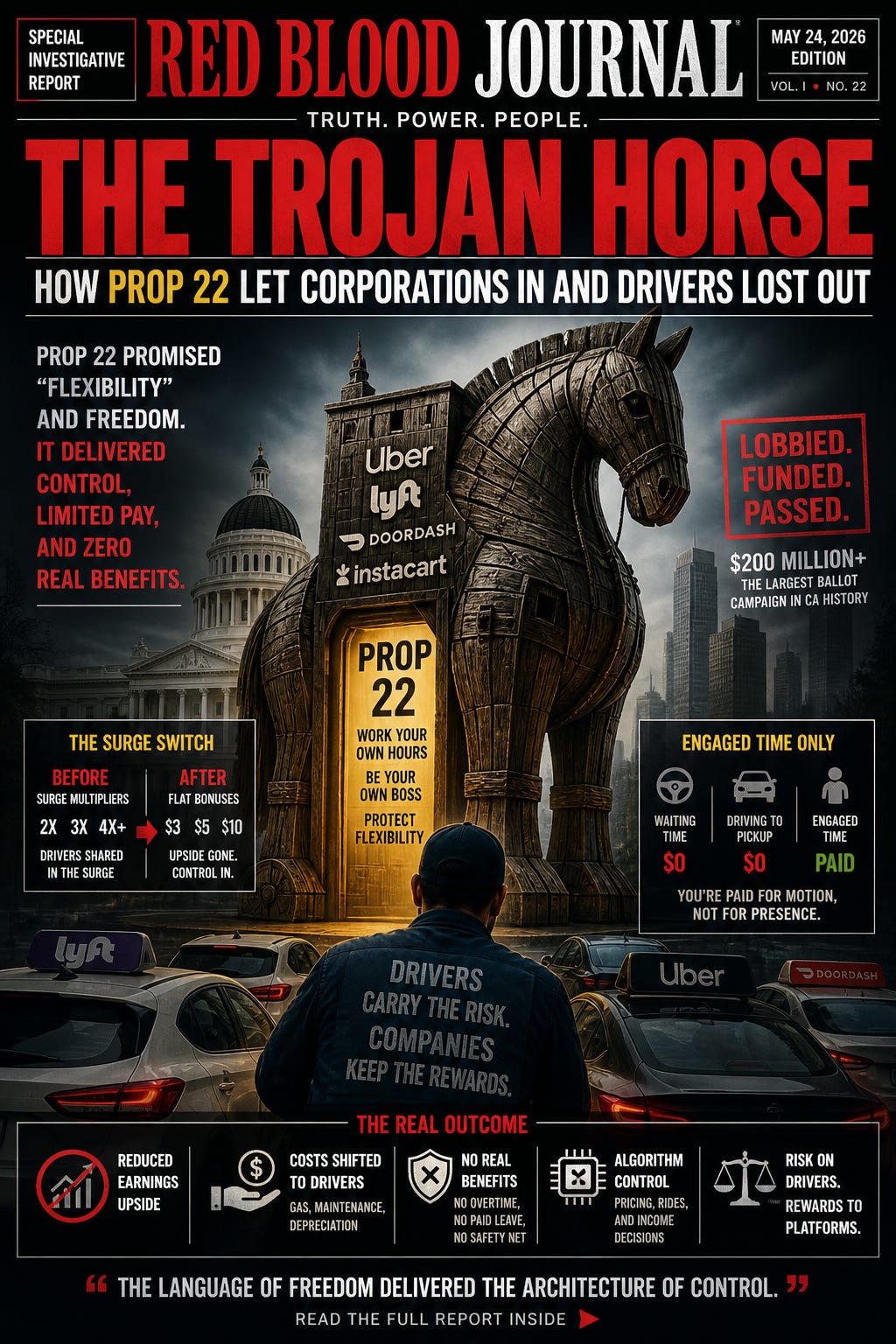
Only engaged time counts
Waiting time = invisible
Positioning time = invisible
Strategic downtime = invisible
The system declares:
“You are paid for motion—but not for presence.”
This is the pivot.
Not a removal of pay…
but a redefinition of reality.
SECTION III — THE SURGE EXTRACTION EVENT
Before the shift, Erath’s drivers operated within a chaotic opportunity field:
Surge multipliers (2x, 3x, higher)
Direct relationship between demand and reward
Strategy translated into profit
After the shift:
Surge becomes flat bonuses
Pricing becomes opaque
The platform separates:
What the passenger pays
What the driver receives
The link is severed.
The market is no longer experienced—
it is interpreted by the system.
SECTION IV — THE CONTROL LOOP (ALGORITHMIC GOVERNANCE)
The system evolves into a stabilized loop:
Input: Driver time + vehicle + risk
Processing: Platform algorithm
Output: Managed earnings band
Not too low (to retain labor)
Not too high (to protect margins)
This is not minimum wage by law.
This is minimum wage by design behavior.
A soft ceiling emerges.
Drivers feel it:
“No matter how I play the game… I land in the same range.”
The game is no longer played on the street.
It is played in code.
SECTION V — THE COST SHIFT (FINAL TRANSFER)
Under this structure:
The worker becomes a hybrid entity:
Employee in control
Contractor in liability
Responsibilities absorbed by the driver:
Fuel
Maintenance
Depreciation
Time risk
Idle exposure
Protections not granted:
Full benefits
Overtime
True expense reimbursement
The equation resolves:
Risk → Human
Control → Platform
ANNEX A — THE TROJAN MODEL (ERATH SYSTEM BLUEPRINT)
Phase 1 — Narrative Entry
Frame the issue emotionally (freedom vs control)
Mobilize support through identity, not mechanics
Phase 2 — Legal Embedding
Codify alternative classification structure
Redefine key variables (time, wage, engagement)
Phase 3 — Algorithmic Override
Introduce opaque pricing systems
Separate value creation from value distribution
Phase 4 — Earnings Compression
Replace volatility with controlled bands
Reduce upside while maintaining participation
Phase 5 — Cost Externalization
Shift operational burden to labor
Maintain scalability without fixed obligations
FINAL SIGNAL — READ BETWEEN THE LINES
The event on Erath was not a simple deception.
It was more precise.
A system where the language of freedom delivered the architecture of control.
The drivers were not removed.
They were re-positioned.
Inside the system.
Operating it.
Sustaining it.
While believing they chose it.
END TRANSMISSION
🪅 The Trojan Model: Architecture of Algorithmic Control
May 1, 2026
The provided text analyzes California Proposition 22 as a strategic “Trojan Horse” that used the rhetoric of professional independence to implement a rigid system of algorithmic governance.
While promising drivers flexibility and autonomy, the legislation effectively allowed platforms to redefine labor by only compensating “engaged time” and decoupling passenger fees from driver pay.
This transition shifted operational risks and costs, such as fuel and maintenance, onto the workers while keeping them within a managed earnings band controlled by opaque code.
Ultimately, the source argues that this model creates a hybrid entity where the worker assumes all the liabilities of a contractor but possesses none of the true protections of an employee.
The narrative suggests that modern gig work functions through a paradox of choice, where the illusion of freedom masks a sophisticated architecture of centralized corporate control.


