


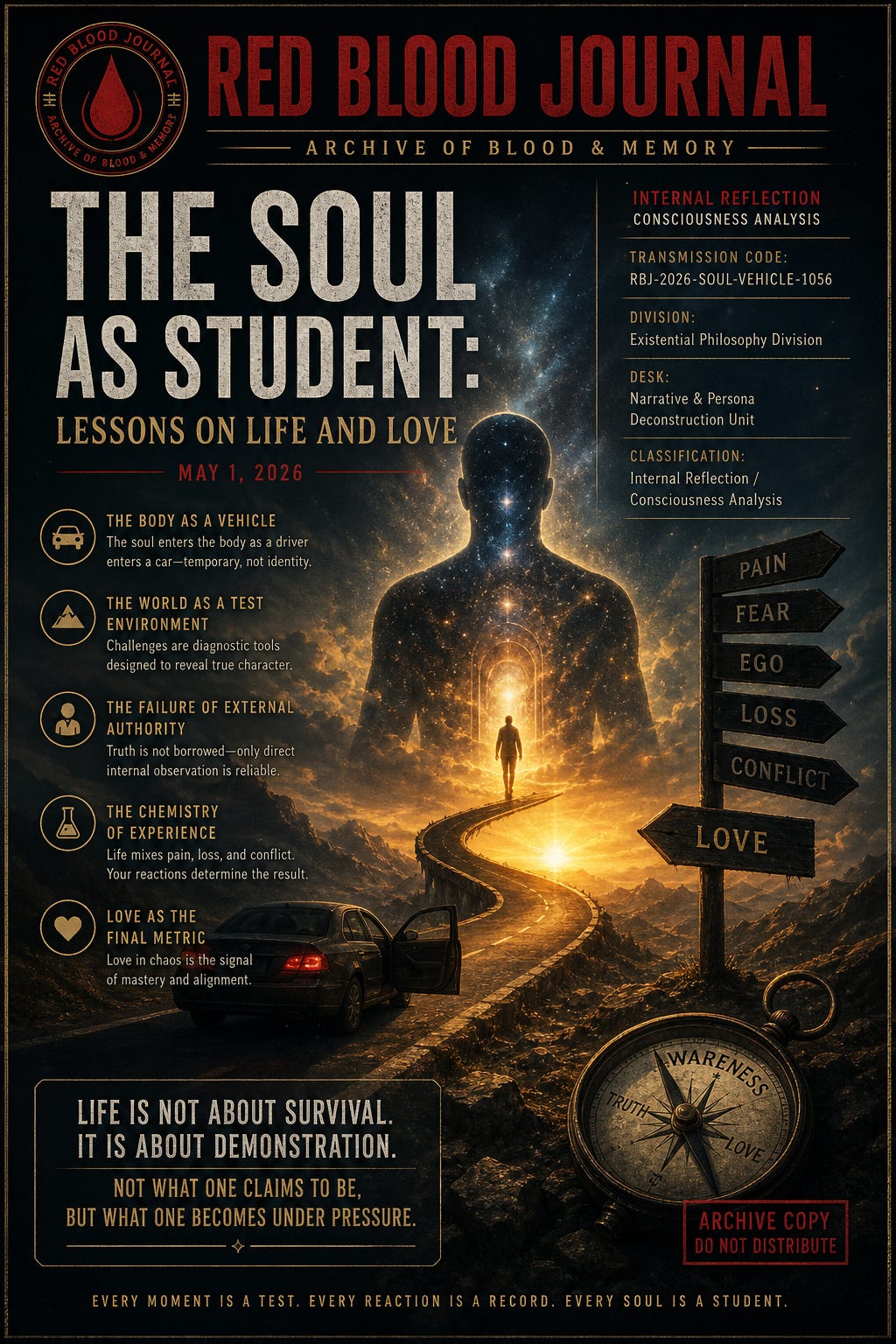
🩸 RED BLOOD JOURNAL TRANSMISSION #1056
Archive: The Archive of Blood & Memory
Division: Existential Philosophy Division
Classification: Internal Reflection / Consciousness Analysis
Transmission Code: RBJ-2026-SOUL-VEHICLE-1056
Desk: Narrative & Persona Deconstruction Unit
PROLOGUE — THE DRIVER WHO SPOKE LIKE A MAP
A conversation unfolds not as small talk—but as a transmission.
Inside a moving vehicle, one man speaks as if he has already exited the game and returned to explain the rules. The setting is ordinary. The content is not.
What appears at first to be opinion gradually reveals itself as a structured worldview:
Life is not random
The body is not the self
Experience is not the destination—it is the test
This is not religion.
This is not doctrine.
This is a framework for decoding existence.
SECTION I — THE BODY AS A VEHICLE
The central claim is simple but disruptive:
The human body is not the identity—it is equipment.
The soul, in this model, enters the body the way a driver enters a car.
It operates within constraints: time, decay, emotion, limitation.
Birth = Entry into the vehicle
Life = Duration of operation
Death = Exit from the vehicle
The critical implication:
Fear of death becomes a misunderstanding of perspective.
The driver fears the damage to the car, forgetting he is not the car.
SECTION II — THE WORLD AS A TEST ENVIRONMENT
The speaker reframes reality as a controlled testing ground:
Not punishment.
Not chaos.
But designed friction.
Challenges are not obstacles—they are diagnostic tools.
Each moment asks:
Are you reactive or composed?
Are you fearful or courageous?
Are you hateful or capable of love under pressure?
This transforms life from:
“Why is this happening to me?”
into:
“What is this revealing about me?”
SECTION III — THE FAILURE OF EXTERNAL AUTHORITY
A sharp rejection emerges:
Scholars
Institutions
Organized religion
Even family guidance
All are seen as secondary interpretations—not primary truth.
The argument is not that they are malicious—but that they are filters.
And filters distort.
The only reliable source becomes:
Direct internal observation
The battlefield is not outside.
It is within perception, reaction, and interpretation.
SECTION IV — THE CHEMISTRY OF EXPERIENCE
The metaphor of a “chemistry class” appears—precise and revealing.
Life mixes:
Pain + Time
Loss + Memory
Conflict + Ego
The result is not random—it is reaction-based.
Two individuals can face the same event:
One becomes bitter
One becomes compassionate
The difference is not the event.
It is the internal processing system.
Thus, the true curriculum is:
Transforming negative input into positive output
This is the exam.
SECTION V — LOVE AS THE FINAL METRIC
All paths converge into one variable:
Love.
Not as sentiment.
Not as ideology.
But as state stability under pressure.
The claim:
Anyone can love in comfort
Only the trained soul can love in chaos
Love becomes:
The indicator of mastery
The signal of alignment
The exit condition of the system
ANNEX A — THE SOUL PATH MODEL
ENTRY → IMMERSION → TESTING → REACTION → REFINEMENT → EXIT
Entry
Soul enters material formImmersion
Identity becomes entangled with body, ego, environmentTesting
Life introduces friction (loss, conflict, uncertainty)Reaction
True character surfacesRefinement
Awareness leads to adjustment (or repetition of failure)Exit
Vehicle ends → Soul departs with accumulated state
ANNEX B — THE CORE ASSERTION
The transmission does not ask for belief.
It proposes a lens:
Life is not about survival.
It is about demonstration.
Not what one claims to be.
But what one becomes under pressure.
CLOSING NOTE — THE QUIET IMPLICATION
If this framework holds—even partially—
Then every moment becomes significant:
Every reaction is recorded
Every emotion is a signal
Every interaction is a test
And the final question is no longer:
“What did I achieve?”
But:
“What did I become?”
🧘The Soul as Student: Lessons on Life and Love
May 1, 2026
The provided text captures a philosophical dialogue between an older man and a younger passenger during a vehicle ride, centering on the purpose of existence and spiritual self-discovery.
The narrator argues that life is a material test for the soul, designed to reveal one’s true character—be it a warrior, hero, or victim—through various challenges.
He emphasizes that individuals must look inward for truth rather than relying on external scholars, family members, or organized religions, which he views as potentially distracting or divisive systems.
By viewing the world as a spiritual boot camp, the speaker suggests that finding positivity and love in every negative situation is the key to passing this existential “chemistry class.”
Ultimately, he posits that the soul uses the physical body as a temporary vehicle to gain experience and must achieve a state of self-forgiveness and purity to return to its source.


