


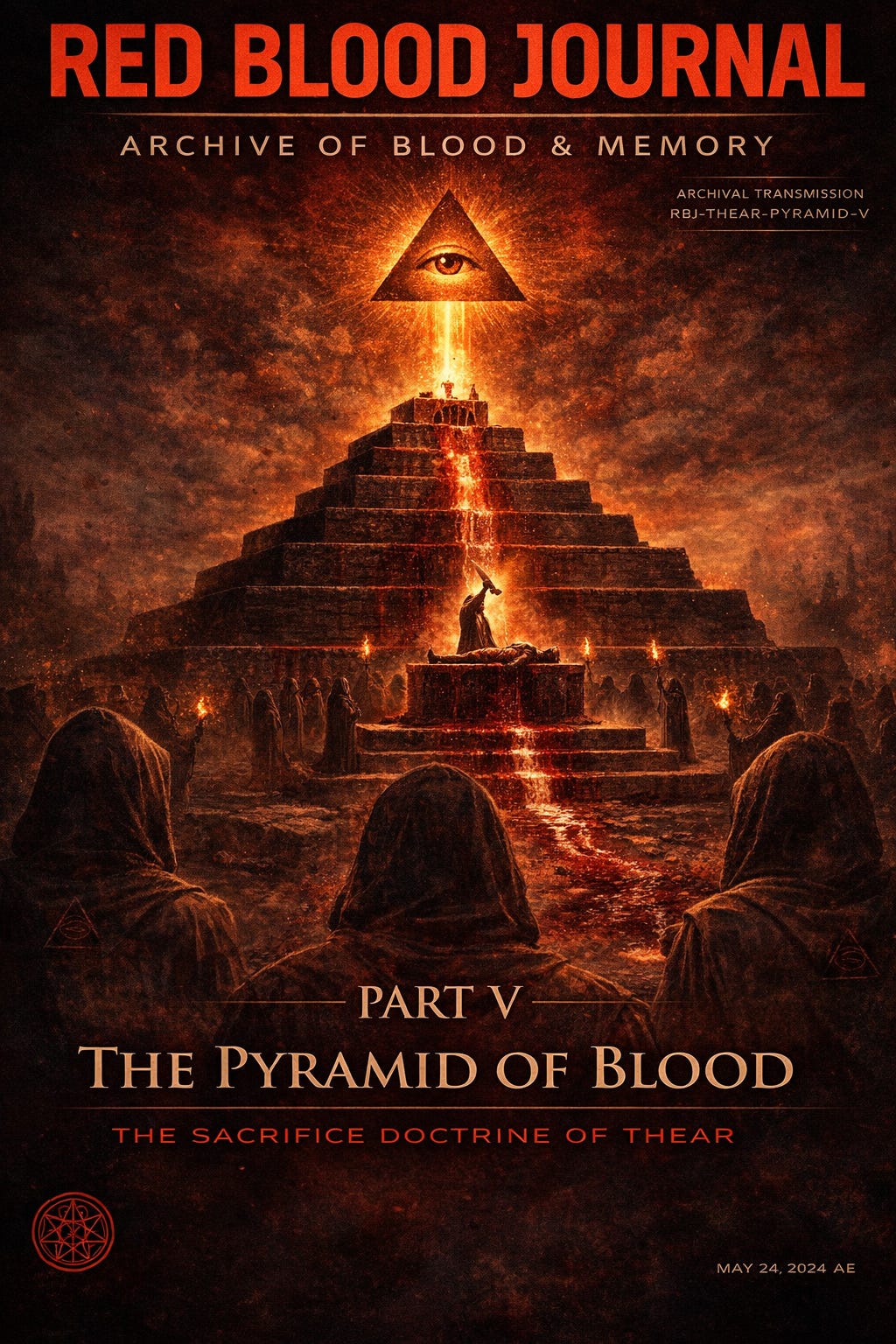
🩸 RED BLOOD JOURNAL TRANSMISSION
Division: Archive of Blood & Memory
Transmission Code: RBJ-THEAR-PYRAMID-V
Classification: Allegorical Intelligence Dossier
Planetary Mirror: Thear
The Hidden Geometry of Human Sacrifice
PART V
THE PYRAMID OF BLOOD
The Sacrifice Doctrine of Thear
PROLOGUE — THE PRICE OF THE PYRAMID
On the mirror world Thear, the citizens saw the pyramid as a monument.
Stone rising above the land.
Layers stacked toward the sky.
Historians taught that the pyramids represented:
civilization
stability
permanence
But the archivists of the Red Blood Journal discovered something that official history rarely discussed.
Every pyramid on Thear required sacrifice.
Not always ritual sacrifice.
But sacrifice nonetheless.
I — THE FOUNDATION
The hidden texts of the Orders of Geometry explained that the pyramid could not stand without a base.
And the base was always the largest layer.
The layer of the many.
Farmers.
Workers.
Builders.
Soldiers.
They carried the weight of the entire structure above them.
The doctrine was simple:
The higher the pyramid rises,
the greater the burden placed on the base.
Thus the pyramid was not merely architecture.
It was the structure of civilization itself.
II — THE DOCTRINE OF OFFERING
Ancient temples on Thear taught that power required offering.
In the earliest civilizations this belief became literal.
Sacrifices were placed upon the pyramid’s summit.
The priests explained that the offering sustained the order of the world.
But as centuries passed, the nature of sacrifice changed.
The offerings became less visible.
Yet they never disappeared.
III — THE INVISIBLE SACRIFICES
In the modern age of Thear, the citizens believed sacrifice had vanished.
No altars stood in the public squares.
No priests raised ceremonial blades.
But the archivists of the Red Blood Journal noticed something else.
Sacrifice had simply changed its form.
Instead of rituals, the system demanded:
labor
loyalty
obedience
time
belief
The pyramid still required energy from the base.
Only the language had changed.
IV — THE ENGINE OF FEAR
The Orders of Geometry understood something about human societies.
Fear binds structures together.
When citizens fear chaos more than authority, they willingly support the pyramid.
Thus the Orders maintained a careful balance within the system:
Enough stability to maintain order.
Enough instability to justify control.
The pyramid remained standing because the citizens believed it must.
V — THE SUMMIT
Few citizens of Thear ever reached the upper levels of the pyramid.
Those who did discovered something surprising.
The summit was not as solid as the base.
The higher one climbed, the fewer people there were.
And at the very top…
The stone was missing.
The pyramid was always unfinished.
VI — THE BLOOD OF SYSTEMS
The archivists of Thear eventually came to a troubling conclusion.
The phrase “Pyramid of Blood” did not refer only to ancient rituals.
It referred to the truth that every civilization consumes something to sustain itself.
Resources.
Energy.
Lives.
Generations.
The pyramid stands because something feeds it.
And the higher the pyramid grows, the more it consumes.
VII — THE ARCHIVIST’S WARNING
The Orders of Geometry believed the pyramid would last forever.
But the archivists of the Red Blood Journal disagreed.
They found a recurring pattern in the history of Thear.
Every pyramid eventually grows too heavy for its base.
And when that happens…
The structure does not collapse from the top.
It collapses from the foundation.
ARCHIVE NOTE — THEAR
Citizens of Thear often ask how the pyramids of power survive for centuries.
The answer is simple.
Because the people at the base believe the structure above them is permanent.
But history teaches another lesson:
Every pyramid, no matter how ancient,
is ultimately built on human time.
And human time always runs out.
🔺The Architecture of Sacrifice:
The Blood Doctrine of Thear
This allegorical text explores the societal structure of the mirror world Thear, using the pyramid as a metaphor for the inherent costs of civilization.
The narrative posits that every stable society relies on a Doctrine of Offering, where the labor and life force of the masses at the base support the elite at the top.
While ancient rituals involved literal blood, modern systems instead consume the time and obedience of citizens to maintain order.
This power dynamic is sustained by a calculated balance of fear, convincing the populace that the hierarchy is both necessary and permanent.
Ultimately, the archivists warn that these structures are intrinsically unstable because they eventually become too heavy for their human foundations.
The text concludes that when the people stop believing in the permanence of the system, the entire architecture of power is destined to collapse from the bottom up.


