


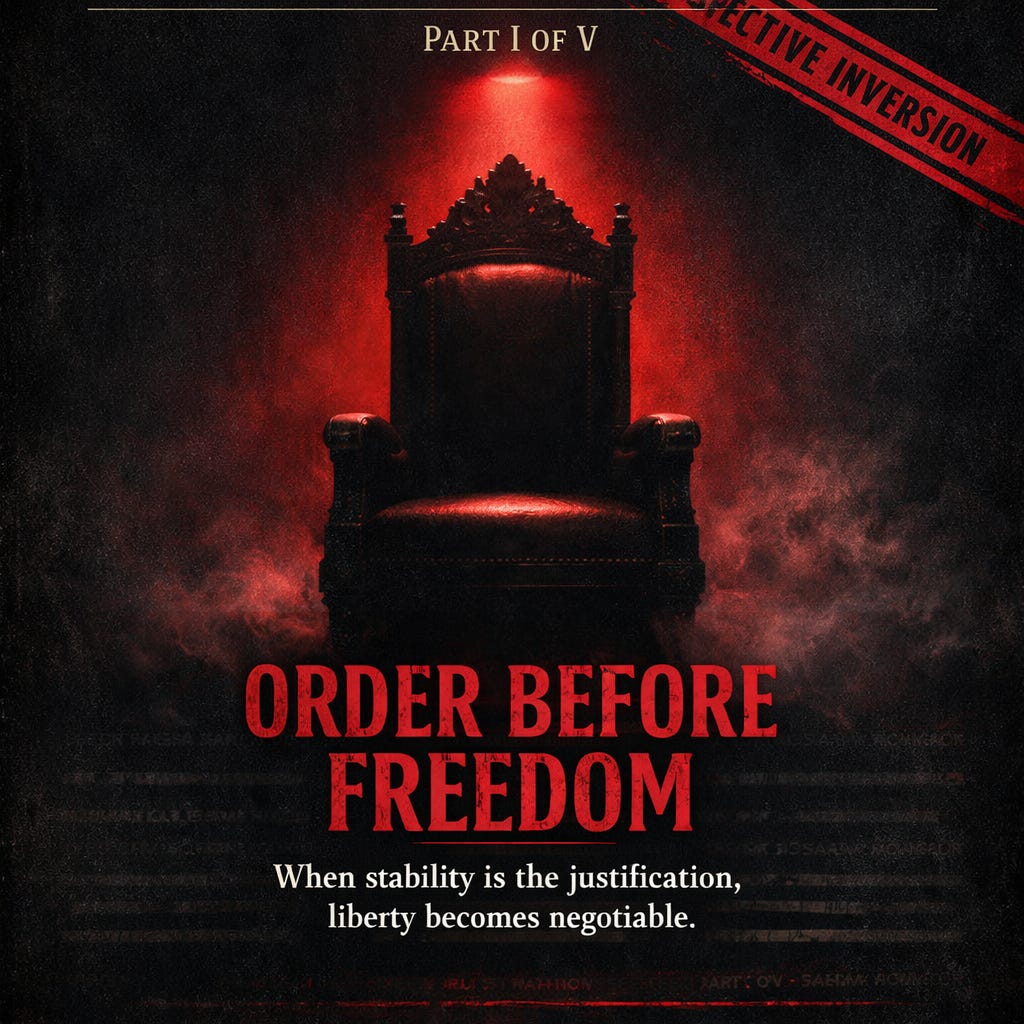
🩸 RED BLOOD JOURNAL TRANSMISSION
T#: RBJ-2026-DEVIL’S-LEDGER-I
Classification: Power Architecture Analysis / Inverted Perspective Series
Status: Fictional Analytical Commentary — Strategic Role Reversal
Part I of V
PART I — “ORDER BEFORE FREEDOM”
PROLOGUE — THE VIEW FROM THE THRONE
Every regime believes itself necessary.
From the street, control looks like oppression.
From the throne, it looks like responsibility.
The citizen sees restriction.
The ruler sees volatility.
The citizen sees censorship.
The ruler sees containment.
The citizen sees taxation.
The ruler sees continuity.
This transmission begins not with accusation — but with inversion.
If the Boss were to defend the system, what would the argument be?
I — THE FIRST PRINCIPLE: CHAOS IS THE DEFAULT STATE
From the perspective of power:
Human beings do not naturally self-organize into peaceful equilibrium.
They fragment.
They polarize.
They compete.
They destabilize.
History — revolutions, civil wars, collapses — is cited as evidence.
The Boss would argue:
Freedom without calibration becomes fragmentation.
Fragmentation becomes instability.
Instability invites violence.
Therefore:
Control is not cruelty.
It is preemption.
II — THE SECURITY DOCTRINE
The Boss might say:
If surveillance exists, it exists because threats exist.
If intelligence networks operate globally, it is because risks are global.
If speech is moderated, it is because misinformation can trigger panic, markets crashes, or riots.
From the top:
A single viral lie can destabilize millions.
A single organized movement can collapse a financial system.
A single uncontained panic can empty banks in 48 hours.
The ruler does not fear truth.
The ruler fears velocity.
Control, therefore, is framed as speed management.
III — ECONOMIC CALIBRATION AS NECESSITY
The population calls it:
Debt enslavement.
Inflation manipulation.
Artificial scarcity.
The Boss calls it:
Macro-stability engineering.
Unlimited credit expands growth.
Tightened liquidity prevents overheating.
Interest rates discipline consumption cycles.
From the throne:
Economic cycles are not accidental.
They are instruments.
Pain is sometimes introduced to prevent systemic collapse.
Recessions are not cruelty —
they are pressure releases.
Or so the defense would argue.
IV — THE PSYCHOLOGICAL REALITY
The Boss understands something the population does not want to admit:
Fear organizes behavior more efficiently than inspiration.
Hope motivates temporarily.
Fear sustains compliance.
If mortality is framed as catastrophic —
risk-taking declines.
If social exclusion is painful —
conformity rises.
If dissent carries reputational cost —
stability increases.
The defense would state plainly:
A calm society is not built on complete liberty.
It is built on predictable boundaries.
V — THE BURDEN ARGUMENT
From below, power looks indulgent.
From above, it feels isolating.
The Boss might claim:
Every catastrophic decision avoided
is invisible to the public.
The wars not fought.
The crashes not triggered.
The collapses prevented quietly.
Control measures, in this framing, are preventative architecture.
The ruler bears the hatred
so that disorder does not bear fruit.
COUNTERINTELLIGENCE NOTE
This is not endorsement.
It is perspective inversion.
Every power structure constructs a moral defense.
Every centralized system develops a narrative of necessity.
To understand power, one must understand how it justifies itself.
CLOSING LINE — PART I
If the Boss were to speak openly, the message might be this:
“You call it control.
I call it containment of the worst in you.”
Part II will examine the next layer of justification:
Why information must be filtered —
and why transparency is considered dangerous from the throne.
👑The Architect’s Apology:
The Moral Logic of Control
This analytical text explores a fictionalized justification for authoritarianism by examining the world through the eyes of a ruling power.
It frames centralized control not as an act of malice, but as a necessary preventative measure against the inherent volatility of human nature.
According to this perspective, strict oversight and economic manipulation are essential tools used to maintain societal stability and prevent systemic collapse.
The narrative suggests that rulers view surveillance and censorship as vital instruments for managing risk and containing chaos.
Ultimately, the source illustrates how those in power rationalize the limitation of freedom as a moral burden required to ensure long-term order.
This exercise in perspective inversion serves to reveal the internal logic used to validate top-down governance.


